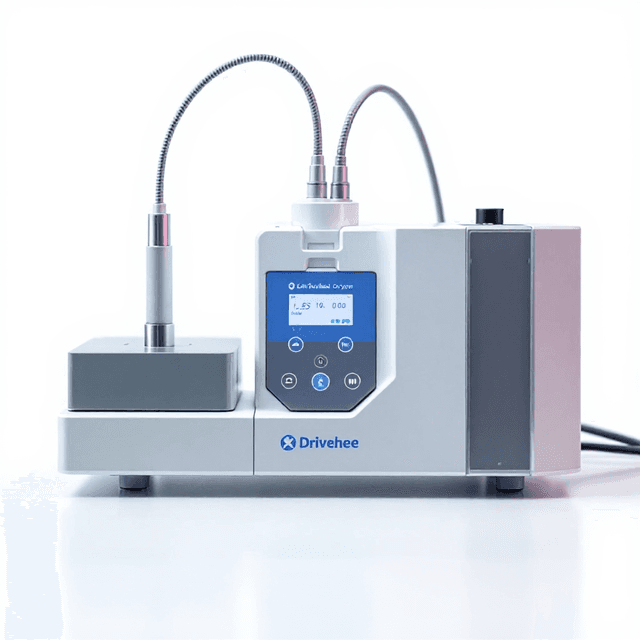
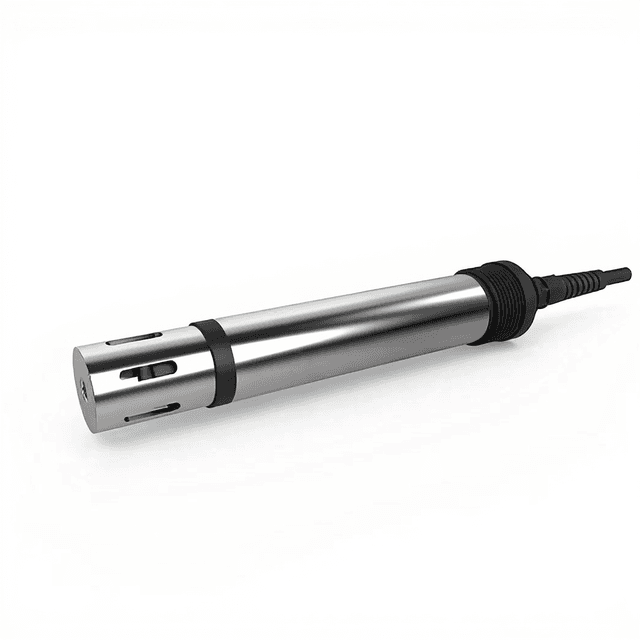
Industrial Online COD and Turbidity Sensor
Reagentless UV absorption sensor for continuous COD and turbidity monitoring in industrial water systems, featuring dual-wavelength optics and IP68 submersible design.
| COD Range | 0-600 mg/L |
| COD Accuracy | +/-5% F.S. |
| Turbidity Range | 0-300 NTU |
| Turbidity Accuracy | +/-5% F.S. |
| Measurement Principle | UV absorption (no reagents, no pollution) |
| Optical Wavelengths | Dual path: 254nm and 365nm |

The Industrial Online COD and Turbidity Sensor provides continuous, real-time monitoring of chemical oxygen demand and turbidity in water systems using UV absorption spectroscopy. The instrument employs dual-wavelength optical measurement at 254nm and 365nm without requiring chemical reagents, eliminating consumable costs and potential contamination risks.
Designed for harsh industrial environments, the sensor features IP68 rating for submersible deployment and an automatic wiper system for self-cleaning. The unit measures COD from 0-600 mg/L and turbidity from 0-300 NTU, both with ±5% F.S. accuracy. Data output via RS485 MODBUS and 4-20mA interfaces enables integration with existing monitoring and control systems.
How It Works
The sensor operates on UV absorption spectroscopy principles, measuring light absorption at dual wavelengths of 254nm and 365nm. COD determination relies on the correlation between UV absorption and organic compound concentration, as most organic molecules absorb UV light at these wavelengths. The 254nm measurement is particularly sensitive to aromatic compounds and unsaturated organics, while 365nm provides complementary data for improved accuracy across diverse organic matrices.
Turbidity measurement utilizes light scattering principles, where suspended particles in the water sample scatter the incident UV light beam. The detector measures the reduction in transmitted light intensity, which correlates directly with particle concentration and size distribution. The dual-wavelength approach helps compensate for color interference and improves measurement reliability in complex water matrices.
The automatic wiper system maintains optical window cleanliness through programmed cleaning cycles, preventing biofilm formation and particle accumulation that could compromise measurement accuracy. This eliminates the need for manual maintenance in submerged installations while ensuring consistent optical performance.
Features & Benefits
COD Range
- 0-600 mg/L
COD Accuracy
- +/-5% F.S.
Turbidity Range
- 0-300 NTU
Turbidity Accuracy
- +/-5% F.S.
Measurement Principle
- UV absorption (no reagents, no pollution)
Optical Wavelengths
- Dual path: 254nm and 365nm
IP Rating
- IP68
Self-Cleaning
- Automatic wiper system
Data Output
- RS485 MODBUS, 4-20mA
Automation Level
- fully-automated
Brand
- ConductScience
Research Domain
- Analytical Chemistry
- Environmental Monitoring
- Food Science
- Industrial Hygiene
- Materials Science
- Pharmaceutical QC
Weight
- 3.0 kg
Dimensions
- L: 19.0 mm
- W: 22.0 mm
- H: 17.0 mm
Comparison Guide
| Feature | This Product | Typical Alternative | Advantage |
|---|---|---|---|
| Measurement Principle | UV absorption (no reagents, no pollution) | Many systems require chemical reagents or generate waste | Eliminates consumable costs and environmental impact while enabling continuous monitoring. |
| Dual Parameter Capability | COD and turbidity in single unit | Often requires separate instruments for each parameter | Reduces installation complexity and system costs for dual-parameter monitoring applications. |
| Environmental Rating | IP68 submersible design | Many sensors require protective housings for harsh environments | Enables direct deployment in industrial environments without additional protection requirements. |
| Optical Wavelengths | Dual path: 254nm and 365nm | Single wavelength systems are common in entry-level models | Provides improved accuracy across diverse organic matrices and better compensation for interference. |
| Self-Cleaning System | Automatic wiper system | Manual cleaning requirements vary by model | Reduces maintenance requirements and ensures consistent performance in fouling environments. |
| COD Measurement Range | 0-600 mg/L with ±5% F.S. accuracy | Range and accuracy specifications vary widely | Covers typical industrial water monitoring requirements with sufficient precision for process control applications. |
This dual-parameter sensor combines reagentless UV absorption technology with robust industrial design, offering continuous COD and turbidity monitoring without consumable costs. The IP68 rating and automatic cleaning system enable deployment in harsh industrial environments with minimal maintenance requirements.
Practical Tips
Establish site-specific calibration using grab samples from your actual water matrix rather than relying solely on generic calibration curves.
Why: Water matrix effects can significantly impact UV absorption correlation with actual COD values.
Inspect wiper blade condition monthly and replace when wear patterns or streaking indicate reduced cleaning effectiveness.
Why: Worn wiper blades can leave residual fouling that degrades optical measurement accuracy over time.
Install the sensor in a location with adequate flow velocity but away from turbulent mixing zones or pump discharge areas.
Why: Proper hydraulic conditions ensure representative sampling while preventing bubble interference or excessive mechanical stress.
Monitor measurement stability and compare periodic grab samples to identify calibration drift or matrix changes.
Why: Continuous monitoring systems require validation against reference methods to maintain measurement traceability.
If readings become erratic, check optical window cleanliness first before investigating electronic or calibration issues.
Why: Optical fouling is the most common cause of measurement problems in submerged UV sensors.
Verify electrical connections are properly sealed before submerged deployment and follow lockout procedures during maintenance.
Why: Water ingress into electrical components can create safety hazards and permanent instrument damage.
Document calibration procedures and maintain records of standard solution lot numbers and expiration dates.
Why: Traceability is essential for regulatory compliance and troubleshooting measurement discrepancies.
Set wiper cleaning frequency based on observed fouling rates rather than fixed time intervals for optimal performance.
Why: Excessive cleaning wastes energy and causes unnecessary wear, while insufficient cleaning compromises accuracy.
Setup Guide
What’s in the Box
- Industrial Online COD and Turbidity Sensor (main unit)
- Power supply and connection cables (typical)
- RS485 communication cable (typical)
- Mounting hardware and brackets (typical)
- User manual and calibration documentation (typical)
- Installation and maintenance guide (typical)
Compliance
References
Background reading relevant to this product:
Warranty & ConductCare
ConductScience provides a standard one-year manufacturer warranty covering defects in materials and workmanship, with technical support available for installation guidance and troubleshooting assistance.
What calibration standards are recommended for COD and turbidity measurements?
Use certified COD standard solutions (potassium hydrogen phthalate is common) and formazin turbidity standards for initial calibration. Recalibration frequency depends on water matrix and measurement stability but typically ranges from monthly to quarterly.
How does the reagentless UV method compare to traditional dichromate COD analysis?
UV absorption provides continuous measurement without chemical consumption or waste generation, though correlation with dichromate COD may require matrix-specific calibration. The method is particularly effective for monitoring relative changes and trends.
What maintenance is required for the automatic wiper system?
The wiper system requires periodic inspection of wiper blade condition and cleaning mechanism. Blade replacement intervals depend on deployment conditions but typically range from 6-12 months in normal industrial applications.
Can the sensor handle high-temperature or corrosive water conditions?
The IP68 rating provides protection against water ingress, but specific temperature and chemical compatibility limits should be verified from the product datasheet based on your application conditions.
How does optical fouling affect measurement accuracy?
The automatic wiper system minimizes optical window fouling, but severe biofouling or mineral scaling may require manual cleaning. Built-in diagnostics can help identify when cleaning is needed based on measurement drift.
What is the minimum flow velocity required around the sensor?
Consult product datasheet for specific flow requirements, but typically 0.1-0.3 m/s minimum velocity is needed to prevent settling around optical windows while avoiding excessive turbulence that could affect readings.
How do you handle color interference in the UV measurements?
The dual-wavelength approach helps compensate for background color absorption. For highly colored waters, site-specific calibration against grab samples may be needed to establish accurate correlation factors.
What data logging and communication capabilities are available?
The sensor provides RS485 MODBUS and 4-20mA analog outputs for real-time data transmission. Internal data storage capabilities and additional communication options should be verified from product specifications.
Have a question about this product?
Accessories
Enhance your setup with compatible accessories
Frequently Bought Together