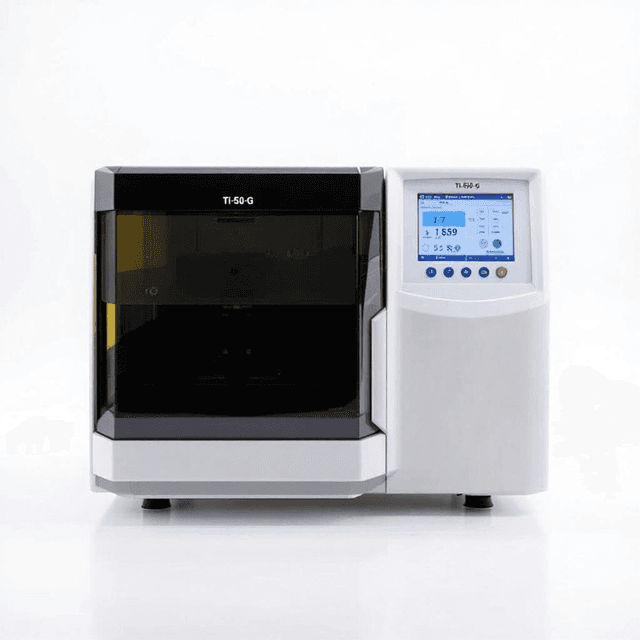
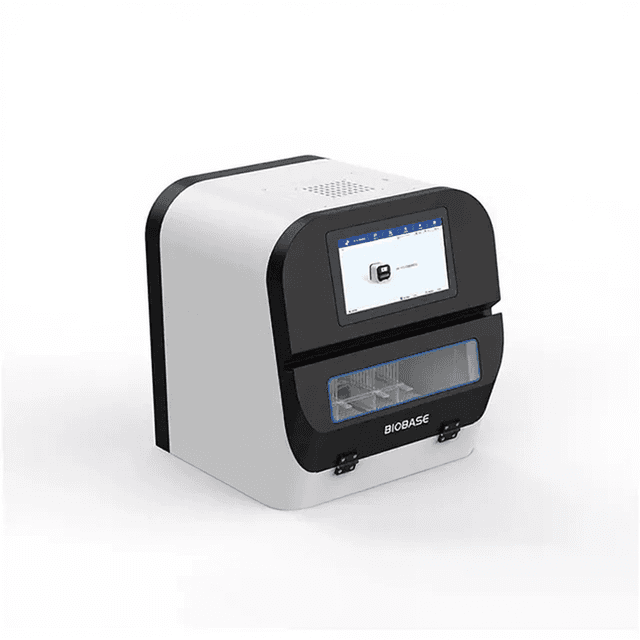
Karl Fischer Titrator
Precision Karl Fischer titrator for water content determination featuring dual volumetric and coulometric modes with ±(5%+3) μg accuracy and ≤3% repeatability.

Louise Corscadden, PhD
Director of Science · ConductScience
Ask Louise about Karl Fischer Titrator fit, setup, configuration, or quote prep.
Already working with us? Sign in to connect this with My Scientist.
Key Specifications
Full details →- Model fit
- Configured during quote
- SKU family
- BIO-0930
- Shipping box
- 40.0 x 34.0 x 40.0 cm
- Ordering
- Online checkout and quote request available
- Category
- Benchtop Instruments
- Build notes
- Confirm accessories, station layout, and support needs before purchase
The Karl Fischer Titrator is a precision analytical instrument designed for water content determination in a wide range of sample matrices. This benchtop system employs Karl Fischer titrimetry, the definitive method for trace water analysis, utilizing both volumetric and coulometric titration modes to accommodate samples with varying water content levels. The instrument features high-accuracy polarization current control (0.2 μA) and working current accuracy of 5%, enabling reliable quantitation of water from microgram to percentage levels.
The dual-mode capability allows researchers to select the optimal detection method based on sample characteristics and expected water content. Coulometric titration provides superior sensitivity for low water content samples, while volumetric titration offers efficiency for higher water content matrices. With measurement accuracy of ±(5%+3) μg and repeatability ≤3%, the system delivers the precision required for pharmaceutical, chemical, and materials analysis applications where water content critically affects product stability and performance.
How It Works
Karl Fischer titrimetry operates on the principle of a specific chemical reaction between water and Karl Fischer reagent containing iodine, sulfur dioxide, and a base in an alcohol medium. The stoichiometric reaction consumes one molecule of water per molecule of iodine, enabling precise quantitative determination. In volumetric mode, the instrument adds KF reagent until the endpoint is reached, with water content calculated from the volume of reagent consumed. Coulometric mode generates iodine electrochemically at the anode, with the quantity of water directly proportional to the charge passed according to Faraday's law.
The instrument monitors the reaction endpoint through polarization voltage measurement between platinum electrodes. When water is present, the voltage remains low as the electrochemically generated iodine is consumed. Upon water depletion, excess iodine causes a sharp voltage increase, signaling the endpoint. Precision current control ensures accurate iodine generation, while automated endpoint detection eliminates subjective visual determinations. The dual-mode design allows method selection based on sample water content: coulometric for 10 ppm to 5% water, volumetric for 0.1% to 100% water content ranges.
Features & Benefits
Shipping weight
- 10.0 lb
Shipping box
- L: 40.0 cm
- W: 34.0 cm
- H: 40.0 cm
| Feature | This Product | Typical Alternative | Advantage |
|---|---|---|---|
| Titration Modes | Dual volumetric and coulometric modes | Single-mode instruments offer either volumetric or coulometric only | Enables method optimization based on sample water content and analytical requirements |
| Polarization Current Accuracy | 0.2 μA accuracy | Entry-level models often provide 1-2 μA accuracy | Improved endpoint detection stability and reduced measurement uncertainty for trace analysis |
| Measurement Accuracy | ±(5%+3) μg | Basic units typically offer ±10% accuracy | Higher precision supports pharmaceutical and analytical applications requiring tight specifications |
| Repeatability | ≤3% RSD | Standard instruments often achieve 5-10% RSD | Reduced replicate requirements and improved method reliability for routine analysis |
| Working Current Accuracy | 5% accuracy | Lower-end models may have 10-15% current accuracy | More consistent iodine generation in coulometric mode for reproducible quantitative results |
| Footprint | 340×400×400mm compact design | Larger systems often require more bench space | Efficient use of laboratory space while maintaining full analytical capabilities |
This Karl Fischer Titrator offers dual-mode versatility with enhanced precision specifications in a compact benchtop format. The combination of high current accuracy and low measurement uncertainty supports demanding analytical applications while maintaining practical laboratory usability.
Practical Tips
Use fresh water standards stored in sealed ampoules and run calibration at the same temperature as your samples.
Why: Temperature variations affect reagent performance and water solubility, introducing systematic errors.
Replace Karl Fischer reagent when water equivalence drifts beyond ±5% or when solution becomes yellow-brown.
Why: Degraded reagent leads to slow endpoints and poor reproducibility due to side reaction formation.
Perform 2-3 blank titrations before each analytical session until consistent baseline values are achieved.
Why: System conditioning removes residual moisture and ensures stable performance for accurate low-level determinations.
If endpoints become slow or irreproducible, check electrode surfaces for contamination and clean with appropriate solvents.
Why: Electrode fouling reduces current efficiency and causes erratic voltage responses during titration.
Monitor drift by running a control standard every 10-15 samples during extended analytical sessions.
Why: Reagent aging and temperature fluctuations can introduce systematic bias that affects result accuracy.
Work with Karl Fischer reagents in a well-ventilated area and avoid skin contact with sulfur dioxide-containing solutions.
Why: KF reagents contain toxic components including methanol and sulfur dioxide that require proper handling precautions.
Use dry glassware and minimize sample exposure to atmospheric moisture during sample introduction.
Why: Environmental water pickup can significantly affect results when measuring low water content samples.
Store the instrument with desiccant in the titration cell when not in use for extended periods.
Why: Moisture accumulation in the system increases blank values and reduces sensitivity for subsequent analyses.
Setup Guide
What’s in the Box
- Karl Fischer Titrator main unit
- Power supply and cord
- Titration cell assembly (typical)
- Platinum electrode set (typical)
- Sample injection accessories (typical)
- USB cable for data transfer (typical)
- User manual and software (typical)
- Calibration certificate (typical)
Warranty
ConductScience provides a standard one-year manufacturer warranty covering defects in materials and workmanship. Technical support includes method development assistance and troubleshooting guidance for optimal analytical performance.
Compliance
What water content range can be measured with this instrument?
The dual-mode design accommodates a wide range: coulometric mode typically handles 10 ppm to 5% water content, while volumetric mode covers 0.1% to 100%. Consult product datasheet for specific range specifications for each mode.
How do I select between volumetric and coulometric modes?
Choose coulometric mode for samples with expected water content below 5% when maximum sensitivity is required. Use volumetric mode for samples with higher water content or when faster analysis is prioritized over ultimate sensitivity.
What types of samples can be analyzed?
The instrument handles diverse matrices including pharmaceuticals, chemicals, oils, polymers, and food products. Sample introduction methods include direct injection, extraction, and headspace analysis depending on matrix compatibility with Karl Fischer reagent.
How frequently does the system require calibration?
Perform daily verification with a water standard before analysis. Full recalibration is typically needed weekly or when results fall outside control limits. System conditioning with blank titrations is required at startup and after reagent changes.
What data output formats are available?
Consult product datasheet for specific data output capabilities. Most Karl Fischer systems provide results in ppm, percentage, or absolute water content with statistical calculations and graphical displays.
Can the instrument analyze samples containing interfering substances?
Samples containing aldehydes, ketones, or strong oxidizing agents may interfere with the Karl Fischer reaction. Pre-treatment methods or alternative reagent formulations may be required for challenging matrices.
What maintenance is required?
Regular maintenance includes electrode cleaning, reagent replacement, and system drying. Replace reagents when water equivalence drifts or when reagent appears discolored. Clean electrodes weekly or when response becomes sluggish.
How does this compare to other water determination methods?
Karl Fischer titration provides superior specificity compared to gravimetric loss-on-drying methods, as it selectively measures water rather than total volatiles. It offers better precision than near-infrared methods for low water content samples.
Have a question about this product?
Have a question? Just ask.
Send it over and we'll email you a personalized answer — no call, no scheduling.
Prefer to talk it through?
Frequently Bought Together