Large Cross-Junction Droplet Generator (400 um)
PDMS microfluidic chip with 400 μm cross-junction channels for generating 200-1000 μm droplets, optimized for cell encapsulation applications.

Louise Corscadden, PhD
Director of Science · ConductScience
Ask Louise about Large Cross-Junction Droplet Generator (400 um) fit, setup, configuration, or quote prep.
Already working with us? Sign in to connect this with My Scientist.
Key Specifications
Full details →- Model fit
- 3 selectable configurations
- SKU family
- WHM-0097
- Shipping box
- 181.8 x 136.3 x 90.9 cm
- Ordering
- Online checkout and quote request available
- Category
- Droplet Generator Chips
- Build notes
- Confirm accessories, station layout, and support needs before purchase
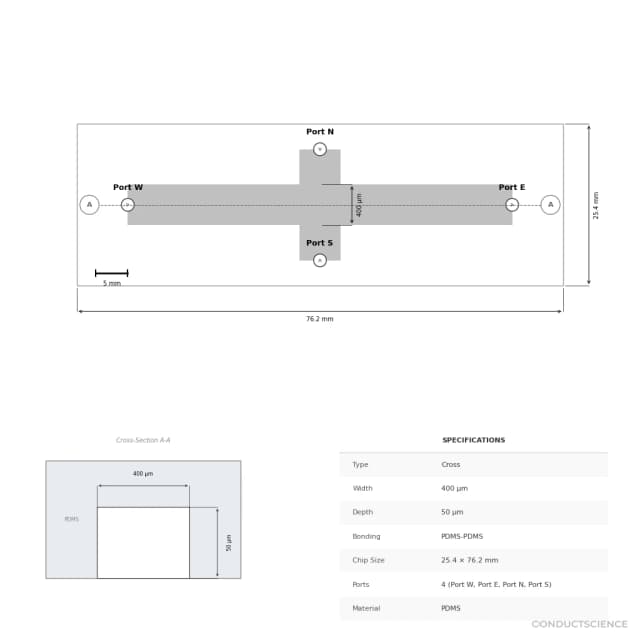
The Large Cross-Junction Droplet Generator (400 μm) is a PDMS-based microfluidic device designed for generating large-diameter droplets in the 200-1000 μm range. The device features 400 x 400 μm channels configured in a cross-junction geometry, enabling controlled droplet formation through precise fluid manipulation at the junction point.
This microfluidic chip is particularly suited for applications requiring large droplet volumes, including cell encapsulation experiments where single cells or cell clusters need to be compartmentalized within individual droplets. The cross-junction design provides stable droplet generation with predictable size control based on flow rate ratios and fluid properties.
How It Works
The cross-junction droplet generator operates on the principle of controlled fluid shearing at the intersection of perpendicular channels. Two immiscible fluids - typically an aqueous dispersed phase and an oil continuous phase - are introduced through separate inlets. At the cross-junction, the dispersed phase stream is pinched off by the continuous phase flowing from perpendicular channels, creating discrete droplets.
Droplet size is controlled by the ratio of flow rates between the continuous and dispersed phases, with higher continuous phase flow rates producing smaller droplets. The 400 μm channel dimensions allow for generation of large droplets (200-1000 μm diameter) suitable for encapsulating cells, organoids, or other large biological specimens. Surface tension forces and channel geometry determine the final droplet morphology and stability.
Features & Benefits
Shipping weight
- 3.3 lb
Shipping box
- L: 181.8 cm
- W: 136.3 cm
- H: 90.9 cm
| Feature | This Product | Typical Alternative | Advantage |
|---|---|---|---|
| Channel Width | 400 x 400 μm square channels | Entry-level devices often feature 50-200 μm channels | Larger channels accommodate cell suspensions and prevent clogging with biological samples |
| Droplet Size Range | 200-1000 μm diameter droplets | Standard devices typically generate 10-200 μm droplets | Large droplets enable single organoid encapsulation and multi-cell studies |
| Junction Design | Cross-junction configuration | Many alternatives use T-junction or flow-focusing designs | Cross-junction provides more symmetric flow patterns for consistent large droplet formation |
| Application Focus | Optimized for cell encapsulation | General-purpose droplet generators often prioritize small droplet uniformity | Purpose-built design ensures compatibility with cell culture workflows and biological samples |
This device offers significantly larger channel dimensions and droplet sizes compared to standard microfluidic droplet generators, specifically targeting cell encapsulation and organoid research applications. The cross-junction design and PDMS construction provide the biocompatibility and optical access needed for biological applications.
| Model | SKU | Listed price | Status | Shipping box |
|---|---|---|---|---|
| 25-Pack | WHM-0097-25PK | Quote | Available | 181.8 x 136.3 x 90.9 cm |
| 10-Pack | WHM-0097-10PK | $1,490.00 | Available | 181.8 x 136.3 x 90.9 cm |
| 5-Pack | WHM-0097-5PK | Quote | Available | 181.8 x 136.3 x 90.9 cm |
Practical Tips
Calibrate droplet size by systematically varying flow rate ratios while maintaining constant total flow rate.
Why: This approach isolates the effect of flow ratio on droplet size from overall system pressure changes.
Flush channels with appropriate cleaning solutions immediately after each use to prevent protein or cell adhesion.
Why: Biological materials can rapidly adhere to PDMS surfaces and create permanent blockages if not cleaned promptly.
Pre-equilibrate cell suspensions and oil phases to the same temperature before droplet generation.
Why: Temperature differences can create density gradients that affect droplet uniformity and cell viability.
If droplet formation becomes irregular, check for air bubbles in inlet tubing and verify consistent pump operation.
Why: Air bubbles and flow rate fluctuations are the most common causes of droplet size variability in microfluidic systems.
Monitor droplet generation under microscopic observation to verify size distribution and morphology in real-time.
Why: Visual monitoring allows immediate detection of formation irregularities that could affect experimental reproducibility.
Use appropriate biosafety containment when working with live cells and ensure oil phases are biocompatible for your application.
Why: Cell culture applications require sterile technique and non-toxic materials to maintain experimental validity and safety.
Setup Guide
What’s in the Box
- Large Cross-Junction Droplet Generator chip (400 μm)
- Product documentation (typical)
- Quality control certificate (typical)
Warranty
ConductScience provides a standard one-year manufacturer warranty covering defects in materials and workmanship, with technical support for setup and operation guidance.
Compliance
What flow rate ratios are recommended for different droplet sizes within the 200-1000 μm range?
Consult product datasheet for specific flow rate recommendations. Generally, higher continuous phase to dispersed phase ratios produce smaller droplets, but optimal ratios depend on fluid properties and viscosities.
Is the PDMS surface treatment reversible for switching between hydrophilic and hydrophobic applications?
Surface treatments can be modified, but some treatments may require chip replacement. Plasma treatment effects are temporary, while chemical modifications may be more permanent depending on the specific treatment protocol used.
What is the maximum operating pressure for the 400 μm channels?
Consult product datasheet for pressure specifications. PDMS chips typically have pressure limits related to channel deformation and bonding strength.
Can this device generate droplets with multiple encapsulated cell types simultaneously?
Yes, by pre-mixing different cell types in the dispersed phase or using multiple inlet configurations, though droplet composition will be statistical rather than precisely controlled per droplet.
How do I prevent channel clogging when working with cell suspensions?
Use appropriate cell concentrations, filter cell suspensions to remove aggregates, and maintain consistent flow rates. Consider using wider tubing connections and avoid air bubbles in the system.
What collection methods work best for downstream cell culture of encapsulated droplets?
Collection into biocompatible oil phases or direct collection onto culture plates works well. Consider droplet stability and breaking methods if cells need to be released from droplets for analysis.
Have a question about this product?
Have a question? Just ask.
Send it over and we'll email you a personalized answer — no call, no scheduling.
Prefer to talk it through?