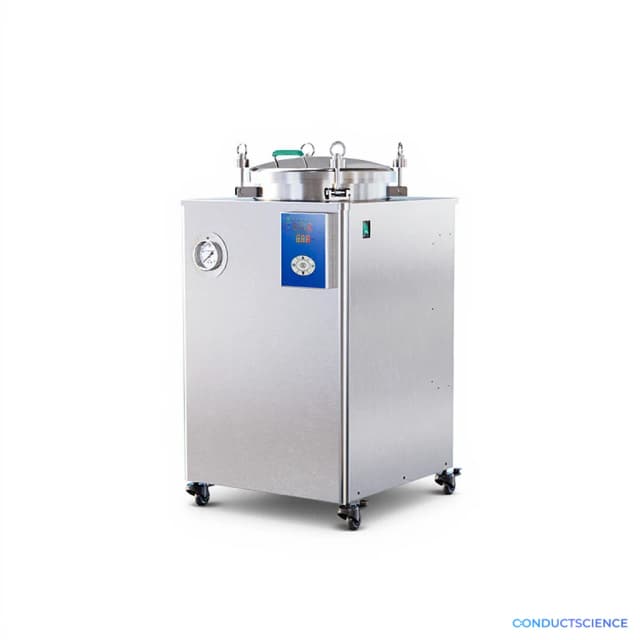
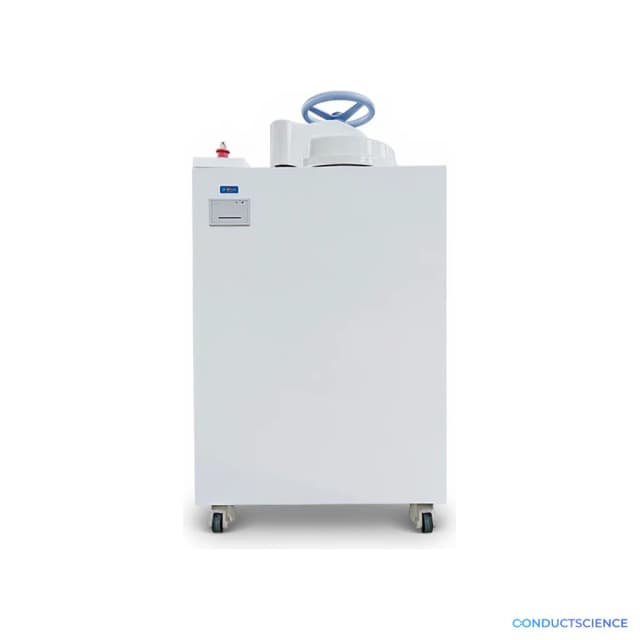
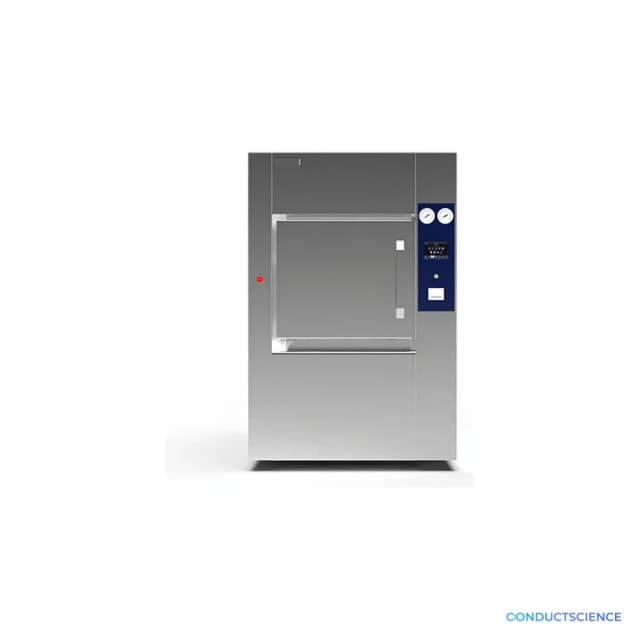
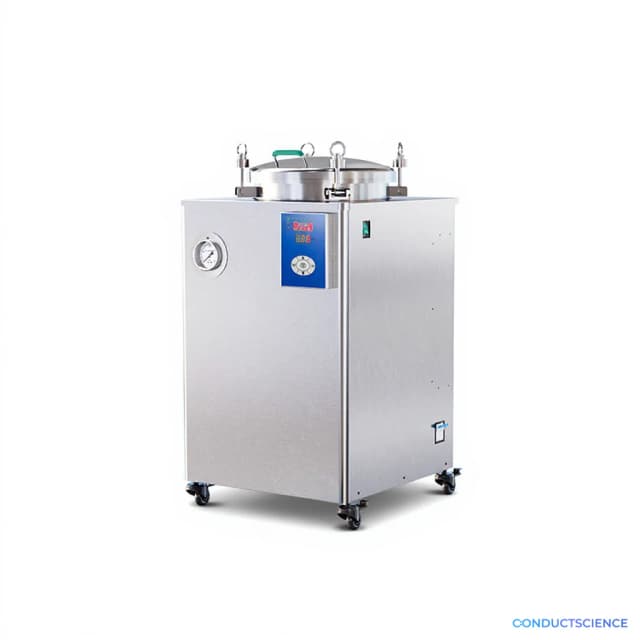
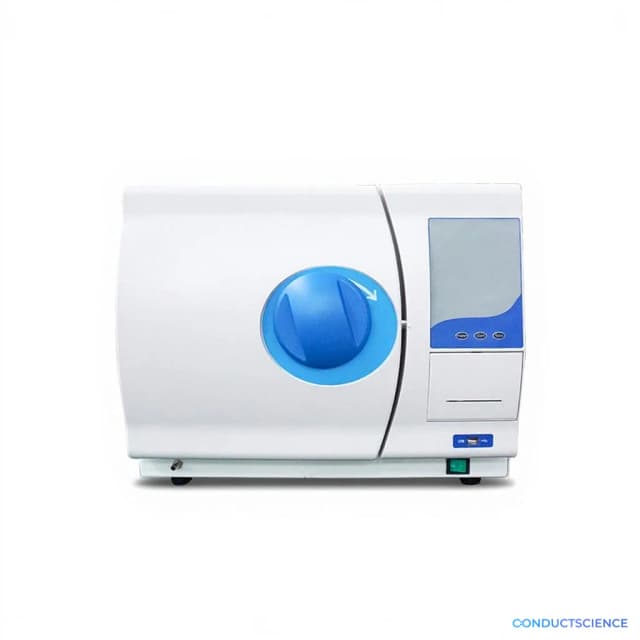
Large Steam Autoclave Medical Sterilizing Machine
High-capacity vertical steam autoclave with jacketed chamber design for laboratory and medical sterilization applications, available in 146L and 200L configurations. Requires three-phase power supply (380V, 50Hz).
| Brand | ConductScience |
| Automation Level | semi-automated |
| Chamber Type | Jacketed |
| Designed Pressure (Inner) | -0.1/0.3 MPa |
| Designed Pressure (Jacket) | 0.3 MPa |
| Max Designed Temp | 144°C |

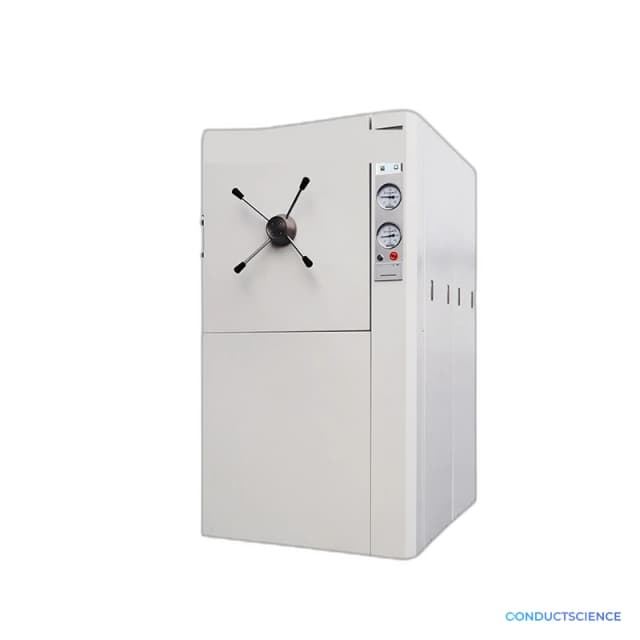
The Large Steam Autoclave (BIO-0153) is a high-capacity vertical sterilization system designed for laboratory and medical facility applications. This autoclave utilizes pressurized steam sterilization to achieve validated decontamination of laboratory instruments, glassware, media, and medical devices through controlled temperature and pressure cycles.
The system features a jacketed chamber design that provides uniform heat distribution and temperature control throughout the sterilization cycle. Available in 146L and 200L chamber configurations, this autoclave accommodates varying laboratory throughput requirements while maintaining consistent sterilization performance. The unit operates on three-phase 380V power systems with heating elements rated at 18KW for rapid heat-up and temperature maintenance.
Important: This autoclave requires three-phase electricity. Models up to 120L capacity are available for standard 110V installations — see our Class N and Class B benchtop autoclave range for single-phase options.
How It Works
Steam sterilization operates on the principle of moist heat destruction of microorganisms through protein coagulation and enzyme inactivation. The autoclave generates saturated steam under pressure, creating temperatures above 100°C that penetrate materials and achieve reliable microbial kill rates. The jacketed chamber design maintains uniform temperature distribution by circulating steam through the outer jacket while the inner chamber holds the load.
During the sterilization cycle, air is displaced from the chamber through gravity displacement or vacuum extraction, allowing steam to contact all surfaces directly. The combination of temperature, pressure, and time parameters creates conditions that denature proteins and nucleic acids in bacterial spores, vegetative bacteria, viruses, and fungi. Temperature monitoring systems track the sterilization process to ensure adequate heat penetration throughout the load.
Features & Benefits
Brand
- ConductScience
Research Domain
- Cell Biology
- Clinical Diagnostics
- Environmental Monitoring
- Food Science
- Microbiology
- Pharmaceutical QC
Automation Level
- semi-automated
Chamber Type
- Jacketed
Designed Pressure (Inner)
- -0.1/0.3 MPa
Designed Pressure (Jacket)
- 0.3 MPa
Max Designed Temp
- 144°C
Working Pressure
- 0.25 MPa
Max Working Temp
- 139°C
Built-in Steam Generator
- 0.28 MPa
Available Capacities
- 146L
- 200L
146L Chamber Size
- 420×420×830mm
146L External Size
- 1290×1680×1050mm
146L Net Weight
- 425 kg
146L Gross Weight
- 525 kg
200L Chamber Size
- 600×600×670mm
200L External Size
- 1290×1680×1100mm
200L Net Weight
- 510 kg
200L Gross Weight
- 610 kg
Power Consumption
- 18KW
Power Supply
- 380V, 50Hz (three-phase required)
Weight
- 68.56 kg
Dimensions
- L: 32.68 mm
- W: 16.54 mm
- H: 16.54 mm
Comparison Guide
| Feature | This Product | Typical Alternative | Advantage |
|---|---|---|---|
| Chamber Capacity | 146L and 241L chamber options available | Entry-level models often offer 50-100L capacity | Higher capacity enables batch processing of larger loads, reducing sterilization frequency and improving laboratory workflow efficiency. |
| Chamber Design | Jacketed chamber construction | Single-wall chambers common in basic models | Jacketed design provides superior temperature uniformity and reduces condensation formation for more reliable sterilization results. |
| Power Rating | 18KW heating elements | Lower-capacity units typically use 3-10KW heating | Higher power rating enables faster heat-up times and better temperature recovery between cycles for improved throughput. |
| Operating Pressure | 0.25-0.3 MPa pressure range | Standard autoclaves typically operate at 0.15-0.2 MPa | Higher operating pressure enables more efficient steam penetration and potentially shorter cycle times for validated sterilization. |
| Construction Weight | 425-610 kg depending on configuration | Benchtop models typically weigh 50-150 kg | Heavy-duty construction indicates robust components designed for continuous operation in high-volume laboratory environments. |
This large capacity autoclave offers significant throughput advantages with jacketed chamber technology and high-power heating systems. The dual chamber size options and robust construction make it suitable for laboratories requiring validated sterilization of large equipment batches or high daily processing volumes.
Practical Tips
Verify temperature accuracy using calibrated thermocouples placed throughout the chamber load to ensure uniform heat distribution meets validation requirements.
Why: Temperature uniformity is critical for reliable sterilization and regulatory compliance in validated processes.
Perform weekly chamber cleaning with appropriate detergents and monthly inspection of door seals and gaskets for wear or damage.
Why: Regular cleaning prevents residue buildup that can interfere with steam circulation and compromise sterilization effectiveness.
Load items to allow adequate steam circulation between packages and avoid overloading the chamber beyond recommended capacity.
Why: Proper loading ensures steam can reach all surfaces and prevents cold spots that could result in sterilization failures.
Monitor heat-up times and investigate any significant increases in time to reach operating temperature as this may indicate heating element or insulation issues.
Why: Changes in heat-up performance can indicate equipment problems that could affect sterilization cycle reliability.
Maintain detailed records of cycle parameters, load contents, and any process deviations for each sterilization run.
Why: Comprehensive documentation supports process validation requirements and enables trend analysis for preventive maintenance.
Always allow adequate cooling time before opening the chamber and use appropriate personal protective equipment when handling hot sterilized items.
Why: Steam sterilization creates high temperatures and pressures that pose burn hazards if proper safety procedures are not followed.
Use appropriate sterilization indicators and biological indicators to verify cycle effectiveness according to your laboratory's quality assurance protocols.
Why: Chemical and biological indicators provide independent verification that sterilization parameters were achieved throughout the load.
Schedule periodic calibration of pressure and temperature monitoring systems according to manufacturer recommendations and regulatory requirements.
Why: Accurate monitoring system calibration ensures reliable process control and maintains validation status for critical sterilization cycles.
Setup Guide
What’s in the Box
- Large steam autoclave main unit
- Operating manual and documentation
- Power cable and electrical connections (typical)
- Steam supply fittings (typical)
- Temperature monitoring probes (typical)
- Installation hardware kit (typical)
Compliance
Warranty & ConductCare
ConductScience provides a standard one-year manufacturer warranty covering parts and labor with comprehensive technical support for installation and operation guidance.
What sterilization cycles are supported and what are the typical time requirements?
The autoclave operates at temperatures of 139-144°C under pressures of 0.25-0.3 MPa. Specific cycle times depend on load configuration and should be validated for each application - consult product datasheet for detailed cycle parameters.
How do the two chamber sizes compare for laboratory workflow planning?
The 146L model (420×420×830mm internal) suits smaller laboratories or specialized applications, while the 241L model (600×600×670mm) accommodates higher throughput requirements with larger batch processing capability.
What electrical requirements are needed for installation?
The system requires 380V, 50Hz electrical supply with 18KW heating capacity and 2.5KW total power consumption. Professional electrical installation is recommended for proper grounding and safety compliance.
Can this autoclave handle both liquid and dry goods sterilization?
The steam sterilization method is suitable for heat-stable materials, instruments, and wrapped goods. Liquid sterilization capabilities depend on specific cycle programming - verify compatibility with your application requirements.
What maintenance procedures are required for reliable operation?
Regular maintenance includes chamber cleaning, steam generator descaling, door seal inspection, and temperature calibration verification. Frequency depends on usage intensity and water quality conditions.
How does the jacketed design improve sterilization performance?
The jacketed chamber maintains uniform temperature distribution by circulating steam through the outer jacket, reducing cold spots and improving heat penetration throughout the load for more reliable sterilization.
What documentation is provided for validation and quality assurance?
Standard documentation includes operating manuals and installation guidance. Process validation studies and qualification protocols may require additional documentation specific to your facility and regulatory requirements.
What are the electrical requirements for the 146L and 200L models?
Both the 146L and 200L models require three-phase electricity (380V, 50Hz) with 18KW power consumption. Standard single-phase 110V power cannot support autoclaves above 120L capacity. Confirm your facility has three-phase electrical service before ordering. For single-phase 110V installations, our benchtop autoclaves (up to 80L Class B or 120L Class N) are available.
What is the difference between the 146L and 200L configurations?
Both models share the same pressure ratings (0.25 MPa working, 139°C max working temperature) and jacketed chamber design. The 146L chamber measures 420×420×830mm and weighs 425 kg, while the 200L chamber measures 600×600×670mm and weighs 510 kg. Choose based on your throughput needs and available floor space.
Have a question about this product?
Accessories
Enhance your setup with compatible accessories
Upgrade Options