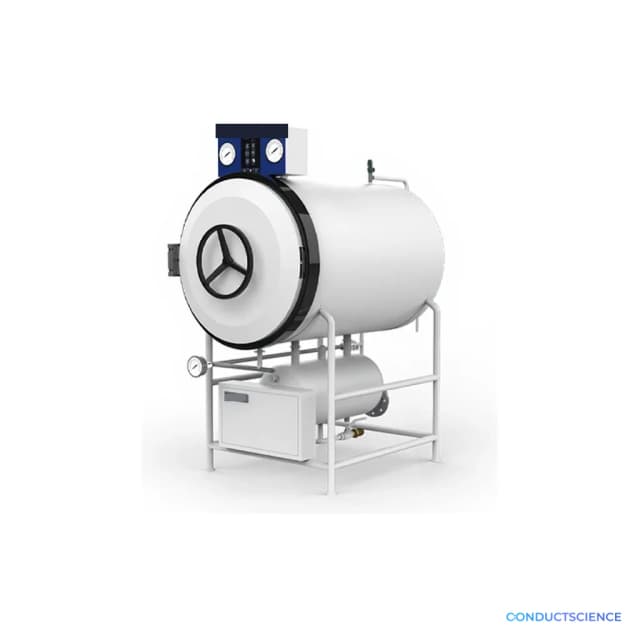
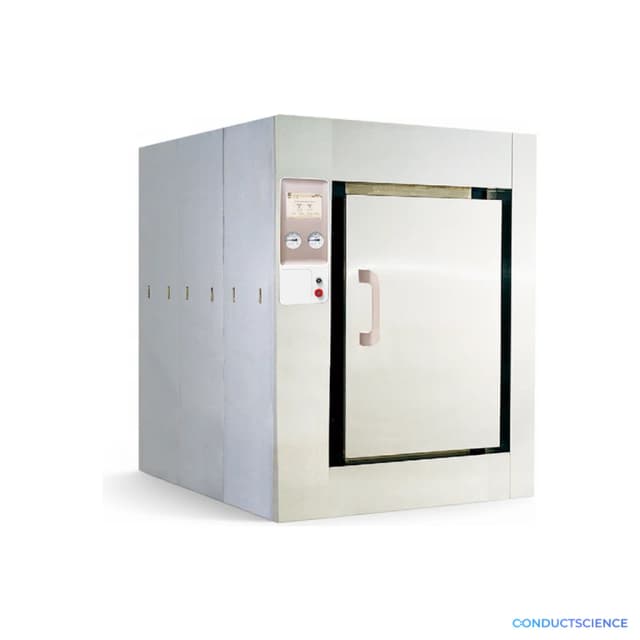
Horizontal Pulse Vacuum Autoclave
Large-capacity horizontal pulse vacuum autoclave available in 150L, 200L, 300L, and 360L configurations.
Features a 7-inch LCD touch screen, S30408 stainless steel chamber, and water circulating vacuum pump for validated laboratory sterilization.

Louise Corscadden, PhD
Director of Science · ConductScience
Ask Louise about Horizontal Pulse Vacuum Autoclave fit, setup, configuration, or quote prep.
Already working with us? Sign in to connect this with My Scientist.
Key Specifications
Full details →- Model fit
- 4 selectable configurations
- SKU family
- BIO-0151
- Shipping box
- 178.0 x 94.0 x 119.0 cm
- Ordering
- Online checkout and quote request available
- Category
- Autoclaves
- Build notes
- S30408 stainless steel
The Horizontal Pulse Vacuum Autoclave is a large-capacity steam sterilization system designed for laboratory and research facility applications requiring validated sterilization of instruments, media, and laboratory materials. The horizontal chamber design accommodates bulky items and delivers efficient steam penetration through integrated pulse vacuum technology.
The system features a water circulating vacuum pump for pre-vacuum and post-vacuum cycles, ensuring complete air removal and optimal steam penetration. The S30408 stainless steel chamber provides corrosion resistance and easy cleaning, while the 7-inch LCD touch screen provides precise control of sterilization temperature, pressure, and cycle timing.
Variant Specifications
| Spec | 150L | 200L | 300L | 360L |
|---|---|---|---|---|
| Chamber Size | ϕ500 x 780 mm | ϕ500 x 1020 mm | ϕ650 x 980 mm | ϕ650 x 1130 mm |
| External Size | 940 x 1190 x 1780 mm | 940 x 1400 x 1780 mm | 1170 x 1570 x 1980 mm | 1170 x 1570 x 1980 mm |
| Net Weight | 400 kg | 450 kg | 590 kg | 605 kg |
| Package Size | 1110 x 1385 x 2080 mm | 1110 x 1585 x 2080 mm | 1330 x 1755 x 2270 mm | 1330 x 1755 x 2270 mm |
| Gross Weight | 520 kg | 600 kg | 755 kg | 770 kg |
How It Works
The horizontal pulse vacuum autoclave operates through a multi-stage steam sterilization process that combines moist heat and pressure to achieve microbial kill. The system begins with pulse vacuum cycles where the water circulating vacuum pump removes air from the chamber and load, creating conditions of -0.1 MPa vacuum. This air removal is critical for effective steam penetration into porous materials and hollow instruments.
During the sterilization phase, saturated steam is introduced to achieve the set temperature (105-134°C) at working pressure of 0.23 MPa. The horizontal chamber design with φ500×780mm dimensions allows for efficient steam circulation around irregularly shaped loads. Temperature is maintained within 0.1°C precision throughout the programmable sterilization time (0-99 minutes).
Following sterilization, the system performs post-vacuum drying cycles (0-99 minutes) to remove residual moisture from the load. The S30408 stainless steel chamber construction ensures chemical resistance to steam and cleaning agents while providing smooth surfaces for easy decontamination.
Features & Benefits
Automation Level
- semi-automated
Door
- Manual
Designed Pressure
- -0.1 / 0.3 MPa
Working Pressure
- 0.23 MPa
Working Temp.
- 105–134°C
Temp. Precision
- 0.1°C
Sterilization Time
- 0–99 min
Drying Time
- 0–99 min
Vacuum System
- Water circulating vacuum pump
Chamber Material
- S30408 stainless steel
Brand
- ConductScience
Research Domain
- Cell Biology
- Clinical Diagnostics
- Environmental Monitoring
- Food Science
- Microbiology
- Pharmaceutical QC
Display Type
- 7-inch LCD touch screen
Rack
- 1 mesh frame with 1 cover
Power Consumption
- 20 kVA
Standard Accessories
- Stainless steel frame with cover, mobile sensor, printer
Shipping weight
- 400.0 lb
Shipping box
- L: 178.0 cm
- W: 94.0 cm
- H: 119.0 cm
| Feature | This Product | Typical Alternative | Advantage |
|---|---|---|---|
| Chamber Capacity | 150-300L capacity options | Benchtop models typically offer 20-100L capacity | Allows batch processing of large volumes, reducing cycle frequency and labor costs in high-throughput laboratories. |
| Vacuum Technology | Water circulating vacuum pump with pulse vacuum capability | Entry-level models may use gravity displacement or simple vacuum systems | Ensures complete air removal from complex loads and porous materials for reliable sterilization outcomes. |
| Temperature Precision | 0.1°C temperature precision | Standard models often provide ±1-2°C accuracy | Supports precise validation protocols and documentation requirements for regulated environments. |
| User Interface | 7-inch LCD touch screen display | Basic models may use simple digital displays or analog controls | Provides intuitive cycle programming and real-time parameter monitoring for enhanced operational control. |
| Cycle Flexibility | Independent sterilization (0-99 min) and drying (0-99 min) time programming | Fixed cycle options are common in simpler systems | Allows optimization of cycle parameters for different load types and facility workflow requirements. |
| Chamber Design | Horizontal configuration with manual door operation | Vertical chamber designs dominate the small autoclave market | Facilitates loading of bulky equipment and provides better steam circulation for irregular-shaped items. |
This autoclave combines large-capacity processing with precise control systems and pulse vacuum technology. The horizontal chamber design and advanced interface provide operational advantages for laboratories with diverse sterilization requirements and high throughput needs.
| Model | SKU | Listed price | Status | Shipping box |
|---|---|---|---|---|
| 360L | BIO-0151-360L | $24,990.00 | Available | 178.0 x 94.0 x 119.0 cm |
| 300L | BIO-0151-300L | $19,990.00 | Available | 178.0 x 94.0 x 119.0 cm |
| 200L | BIO-0151-200L | $18,990.00 | Available | 178.0 x 94.0 x 119.0 cm |
| 150L | BIO-0151-150L | $16,990.00 | Available | 178.0 x 94.0 x 119.0 cm |
Practical Tips
Verify temperature accuracy using calibrated thermocouples placed in multiple chamber locations during empty and loaded test cycles.
Why: Temperature uniformity is critical for validation and ensuring all portions of loads receive adequate sterilization conditions.
Monitor water circulating vacuum pump reservoir levels daily and replace water regularly to prevent mineral buildup.
Why: Clean water ensures consistent vacuum performance and prevents pump damage from scale formation.
Load items to allow steam circulation around all surfaces and avoid overloading the chamber capacity.
Why: Proper loading ensures steam penetration to all load surfaces and prevents cold spots that could compromise sterilization.
If vacuum performance decreases, check door seal integrity and vacuum pump water quality before servicing pump components.
Why: Many vacuum issues result from simple maintenance problems rather than pump mechanical failure.
Document cycle parameters and monitor temperature uniformity studies according to your facility's validation schedule.
Why: Regular validation data supports compliance requirements and identifies performance drift before it affects sterilization efficacy.
Allow chamber pressure to equilibrate before opening the manual door, and use appropriate PPE when handling hot loads.
Why: Residual pressure and high temperatures pose safety risks during load removal even after cycle completion.
Establish standard operating procedures for different load types with appropriate sterilization and drying times.
Why: Standardized protocols ensure consistent results and support staff training and quality assurance requirements.
Clean chamber interior regularly with appropriate cleaning agents compatible with S30408 stainless steel construction.
Why: Regular cleaning prevents contamination buildup and maintains chamber surface integrity for reliable operation.
Setup Guide
What’s in the Box
- Horizontal pulse vacuum autoclave main unit
- 7-inch LCD touch screen control panel
- Water circulating vacuum pump system
- Power cables and electrical connections (typical)
- User manual and operation procedures
- Installation and maintenance documentation (typical)
- Chamber cleaning supplies (typical)
Warranty
ConductScience provides standard one-year manufacturer warranty covering parts and labor for manufacturing defects. Technical support includes installation guidance and operational troubleshooting assistance.
Compliance
What load types can be processed in this horizontal chamber design?
The φ500×780mm horizontal chamber accommodates bulky laboratory equipment, wrapped instrument sets, liquid media in large containers, and irregular-shaped items that may not fit efficiently in vertical autoclaves.
How does the pulse vacuum system improve sterilization effectiveness?
The water circulating vacuum pump removes air from the chamber and load materials through repeated vacuum/steam pulses, ensuring steam penetration into hollow instruments and porous materials for reliable microbial kill.
What cycle validation data can be documented for quality assurance?
The system provides real-time monitoring of temperature, pressure, and time parameters through the LCD interface. Consult product datasheet for specific data logging and documentation capabilities.
What maintenance is required for the water circulating vacuum pump?
Regular maintenance includes monitoring water reservoir levels, checking pump performance during vacuum cycles, and periodic inspection of seals and connections according to the maintenance schedule provided.
Can this autoclave handle both dry goods and liquid loads?
Yes, the programmable sterilization and drying cycles (0-99 minutes each) can be adjusted for different load types, though liquid loads require specific cycle parameters to prevent boiling over.
How does this compare to vertical chamber autoclaves for laboratory use?
The horizontal design provides easier loading of bulky items and better steam circulation around irregular loads, while vertical designs may offer more efficient space utilization for standard laboratory glassware.
What electrical and facility requirements are needed for installation?
The 400 kg unit requires appropriate floor loading capacity and electrical connections suitable for the heating and vacuum pump systems. Consult installation manual for specific utility requirements.
What temperature range flexibility is available for different sterilization protocols?
The system operates from 105-134°C with 0.1°C precision, allowing selection of appropriate temperatures for heat-sensitive materials or high-assurance sterilization requirements.
Have a question about this product?
Have a question? Just ask.
Send it over and we'll email you a personalized answer — no call, no scheduling.
Prefer to talk it through?
Accessories
Enhance your setup with compatible accessories
Frequently Bought Together