Manganese Test Kit
Colorimetric test kit for manganese determination in water using potassium periodate oxidation method, providing field-suitable analysis for environmental and industrial monitoring applications.

Louise Corscadden, PhD
Director of Science · ConductScience
Ask Louise about Manganese Test Kit fit, setup, configuration, or quote prep.
Already working with us? Sign in to connect this with My Scientist.
Key Specifications
Full details →- Model fit
- 2 selectable configurations
- SKU family
- CS-LH-WTK016
- Shipping box
- 30.0 x 20.0 x 10.0 cm
- Ordering
- Online checkout and quote request available
- Category
- Water Test Kits
- Build notes
- Confirm accessories, station layout, and support needs before purchase
The Manganese Test Kit provides colorimetric determination of manganese content in water samples using the potassium periodate oxidation method. This analytical kit employs the oxidation of Mn²⁺ to the distinctly colored permanganate ion (MnO₄⁻) by potassium periodate, producing a purple complex suitable for spectrophotometric quantification. The method is widely used for environmental water quality assessment, industrial process monitoring, and laboratory analysis where manganese concentration determination is required.
The kit utilizes established analytical chemistry principles for manganese determination through colorimetric analysis. The potassium periodate oxidation reaction converts manganese(II) to manganese(VII), creating a measurable color change proportional to manganese concentration. This approach provides a practical alternative to instrumental methods like ICP-OES for routine manganese monitoring in various water matrices, offering field-deployable analysis capabilities for environmental and industrial applications.
How It Works
The manganese test kit operates on the principle of potassium periodate oxidation, where manganese(II) ions in solution are oxidized to permanganate ions (MnO₄⁻) in the presence of periodate (IO₄⁻). The reaction follows the stoichiometry: 2Mn²⁺ + 5IO₄⁻ + 3H₂O → 2MnO₄⁻ + 5IO₃⁻ + 6H⁺. The resulting permanganate ion exhibits a characteristic purple color with strong absorption in the visible spectrum, typically measured at 525-530 nm wavelength.
The colorimetric analysis relies on Beer's law, where the absorbance of the colored solution is directly proportional to the concentration of manganese present. The intensity of the purple color increases with higher manganese concentrations, enabling quantitative determination through visual comparison with color standards or spectrophotometric measurement. The method requires careful pH control and the addition of phosphoric acid to prevent interference from ferric ions, which form colorless complexes under acidic conditions.
Sample preparation involves acidification to ensure manganese dissolution and oxidation state stability. The periodate reagent is added under controlled conditions to initiate the oxidation reaction, typically requiring several minutes for color development. The final colored solution can be analyzed either through visual comparison with calibrated color charts or instrumental measurement using spectrophotometry for precise quantification.
Features & Benefits
Brand
- ConductScience
Research Domain
- Analytical Chemistry
- Environmental Monitoring
- Food Science
- Industrial Hygiene
- Materials Science
Shipping weight
- 0.26 lb
Shipping box
- L: 30.0 cm
- W: 20.0 cm
- H: 10.0 cm
| Feature | This Product | Typical Alternative | Advantage |
|---|---|---|---|
| Detection Method | Potassium periodate oxidation with colorimetric detection | Many kits use PAN (1-(2-pyridylazo)-2-naphthol) or formaldoxime colorimetric methods | Periodate oxidation provides selective manganese determination with minimal sample pretreatment requirements. |
| Analytical Approach | Visual color comparison and spectrophotometric compatibility | Some kits are limited to visual comparison only | Dual compatibility allows both field screening and laboratory precision measurement using the same reagent system. |
| Interference Management | Phosphoric acid treatment for ferric ion interference control | Basic kits may lack specific interference control measures | Targeted interference control improves accuracy in complex water matrices containing multiple metals. |
| Operating Temperature | Room temperature operation | Some methods require elevated temperatures for optimal reaction kinetics | Eliminates heating requirements, reducing equipment needs and enabling true field portability. |
| Reaction Chemistry | Direct oxidation to permanently colored permanganate ion | Complex formation methods may have stability limitations | Permanganate ion provides stable color development with extended measurement window for analysis flexibility. |
| Kit Format | Complete reagent system with standardized components | Entry-level kits may require additional reagent preparation | Ready-to-use format reduces preparation time and minimizes potential procedural errors in field applications. |
This manganese test kit offers potassium periodate oxidation chemistry with room temperature operation and dual visual/instrumental measurement capability. The integrated interference control system and complete reagent format provide reliable field-deployable analysis for routine manganese monitoring applications.
| Model | SKU | Listed price | Status | Shipping box |
|---|---|---|---|---|
| 50 | CS-LH-WTK016 | $1,799.99 | Available | 30.0 x 20.0 x 10.0 cm |
| 25 | CS-LH-WTK016 | $999.99 | Available | 30.0 x 20.0 x 10.0 cm |
Practical Tips
Prepare fresh calibration standards for each analysis session using the provided reference materials and following the same procedure as samples.
Why: Ensures accurate concentration determination and accounts for reagent aging or environmental variations affecting color development.
Store reagents in a cool, dark environment and check expiration dates regularly to maintain analytical performance.
Why: Potassium periodate and other reagents can degrade over time, affecting oxidation efficiency and color development consistency.
Maintain consistent timing for color development and measurement to ensure reproducible results across analyses.
Why: Reaction kinetics can affect color intensity, and standardized timing eliminates this variable from the analytical procedure.
If weak or no color development occurs, verify sample pH and consider diluting highly concentrated samples that may exceed the linear range.
Why: pH affects periodate reactivity, and very high manganese concentrations can saturate the colorimetric response, leading to inaccurate results.
Analyze duplicate samples and include blank determinations to assess precision and identify potential contamination sources.
Why: Quality control measures help detect analytical problems and provide confidence intervals for reported manganese concentrations.
Use appropriate personal protective equipment and ensure adequate ventilation when handling periodate and acid reagents.
Why: Chemical reagents can cause skin or respiratory irritation, and proper safety measures prevent exposure during analysis procedures.
Filter turbid samples before analysis to remove particulate matter that could interfere with colorimetric measurements.
Why: Suspended particles can scatter light and interfere with color development, leading to inaccurate manganese determinations.
Use distilled or deionized water for all reagent preparations and dilutions to prevent background interference.
Why: Trace metals in tap water can interfere with the analysis or contribute to background color, affecting measurement accuracy.
Setup Guide
What’s in the Box
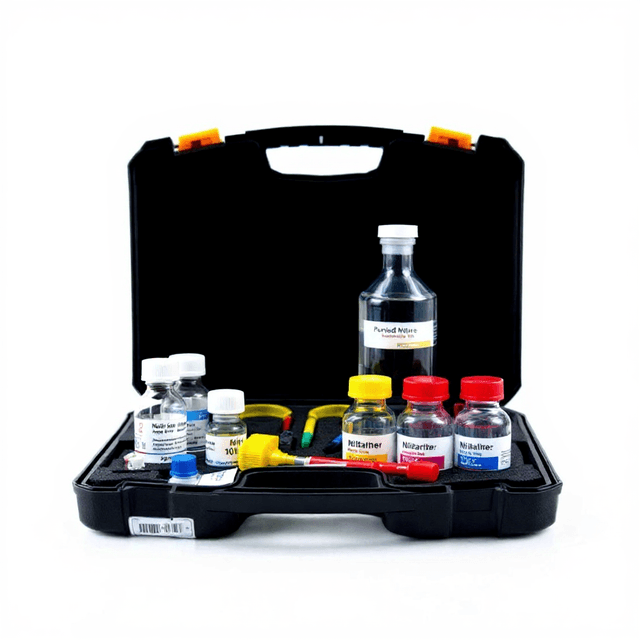
- Potassium periodate reagent solution
- Phosphoric acid solution
- Test tubes or sample vessels
- Measuring pipettes or syringes
- Color comparison chart
- Instruction manual with procedure
- Manganese standard solution
Warranty
ConductScience provides a one-year manufacturer warranty covering reagent stability and kit component integrity. Technical support is available for analytical procedures and troubleshooting assistance.
Compliance
References
Background reading relevant to this product:
What is the detection principle used in this manganese test kit?
The kit uses potassium periodate oxidation to convert Mn²⁺ to MnO₄⁻, producing a purple-colored complex that can be quantified colorimetrically through visual comparison or spectrophotometric measurement.
How does the kit handle potential interferences in water samples?
The kit includes phosphoric acid to prevent ferric ion interference by forming colorless iron-phosphate complexes. However, cerium(III) and chromium(III) may cause interference due to their oxidation by periodate and should be considered during analysis.
What sample preparation is required before analysis?
Samples should be acidified for preservation if needed and brought to room temperature. Proper pH control is essential for the periodate oxidation reaction, and samples may require filtration if particulate matter is present.
Can this kit be used for both field and laboratory analysis?
Yes, the kit is designed for portable use and operates at room temperature without complex instrumentation. Results can be obtained through visual color comparison for field screening or spectrophotometric measurement for laboratory precision.
How long does the color development reaction take?
Color development typically requires several minutes for completion. Consult the kit instructions for specific timing requirements, as reaction kinetics may vary with temperature and sample matrix composition.
What wavelength should be used for spectrophotometric measurement?
The permanganate ion exhibits characteristic absorption at 525-530 nm wavelength. This wavelength range provides optimal sensitivity for spectrophotometric quantification of the purple complex.
How does this colorimetric method compare to instrumental techniques like ICP-OES?
While ICP-OES provides higher precision and multi-element capability, this colorimetric method offers field portability, lower cost, and immediate results without complex instrumentation, making it suitable for routine monitoring and screening applications.
Have a question about this product?
Have a question? Just ask.
Send it over and we'll email you a personalized answer — no call, no scheduling.
Prefer to talk it through?
Accessories
Enhance your setup with compatible accessories
Frequently Bought Together