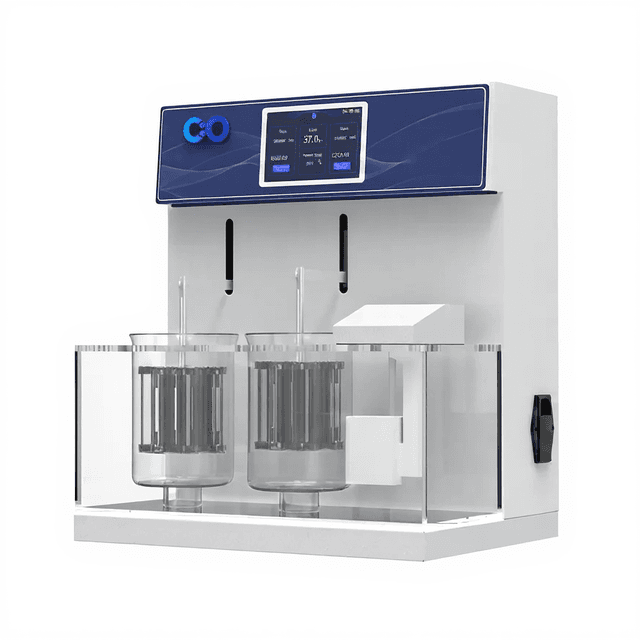
Melting Point Tester
Automated melting point tester with oil bath heating system, providing ±0.5°C precision for compound identification and purity assessment with integrated thermal printer documentation.

Louise Corscadden, PhD
Director of Science · ConductScience
Ask Louise about Melting Point Tester fit, setup, configuration, or quote prep.
Already working with us? Sign in to connect this with My Scientist.
Key Specifications
Full details →- Model fit
- Configured during quote
- SKU family
- BIO-MPTD-1
- Shipping box
- 12.6 x 12.01 x 7.87 cm
- Ordering
- Online checkout and quote request available
- Category
- Lab Equipment
- Build notes
- Confirm accessories, station layout, and support needs before purchase
The BIO-MPTD-1 Melting Point Tester provides precise thermal analysis for compound identification and purity assessment across pharmaceutical, chemical, and research applications. This automated instrument utilizes methyl silicone oil bath heating with magnetic stirring to ensure uniform temperature distribution during measurements, achieving precision of ±0.5°C for melting points below 200°C and ±1.0°C above 200°C.
The system features automatic measurement, diagnosis, and alarm functions with four selectable heating rates (0.5-3.0°C/min) for optimal analysis of different sample types. An integrated thermo-sensitive mini printer provides immediate documentation of results, while the high-precision temperature sensor automatically corrects for non-linear errors across the RT to 290°C measurement range.
How It Works
The BIO-MPTD-1 operates on the principle of controlled thermal analysis, where the sample is gradually heated in a uniform temperature environment while observing the solid-to-liquid phase transition. The instrument uses a methyl silicone oil bath as the heat transfer medium, which provides excellent thermal stability and uniform temperature distribution across the measurement range of room temperature to 290°C.
Sample preparation involves placing the crystalline material in a sealed capillary tube, which is then positioned in the oil bath. The automatic magnetic stirring system ensures consistent temperature throughout the bath volume, eliminating thermal gradients that could affect measurement accuracy. The high-precision temperature sensor continuously monitors the oil bath temperature and feeds this data to the frequency-converting control system, which maintains precise heating rates with less than 5% deviation from the selected rate.
During measurement, the system automatically detects the melting point by monitoring the phase transition characteristics of the sample. The integrated printer provides immediate documentation of results, including temperature profiles and melting point values, creating a permanent record for quality control and regulatory compliance purposes.
Features & Benefits
Printer Type
- thermo sensitive mini printer
Stirring System
- automatic magnetic stirring system
Temperature Sensor
- high-precision temperature sensor
Error Correction
- automatic non-linear error correction
Automation Features
- automatic measurement, automatic diagnosis and automatic alarm
Control Type
- full-automatic frequency converting control
Oil Bath
- uniform temperature oil bath
Automation Level
- semi-automated
Research Domain
- Analytical Chemistry
- Environmental Monitoring
- Food Science
- Industrial Hygiene
- Materials Science
- Pharmaceutical QC
Shipping weight
- 11.02 lb
Shipping box
- L: 12.6 cm
- W: 12.01 cm
- H: 7.87 cm
| Feature | This Product | Typical Alternative | Advantage |
|---|---|---|---|
| Temperature Range | RT to 290°C measurement capability | Entry-level models often limited to 250°C or require different heating blocks for extended range | Single instrument covers full range of pharmaceutical and chemical compounds without accessory changes. |
| Heating Rate Control | Four precise heating rates (0.5-3.0°C/min) with <5% deviation | Basic models may offer fixed heating rate or less precise control | Allows method optimization for different sample types and precision requirements. |
| Temperature Precision | ±0.5°C below 200°C, ±1.0°C above 200°C with 0.1°C resolution | Entry-level instruments typically achieve ±1-2°C precision | Higher precision enables detection of minor impurities and polymorphic differences. |
| Documentation System | Integrated thermo-sensitive mini printer with automatic result recording | Many models require manual recording or external computer connection | Immediate hard-copy documentation eliminates transcription errors and supports GLP compliance. |
| Oil Bath System | Automatic magnetic stirring with 250ml tall-form beaker | Manual stirring or smaller bath volumes common in basic models | Uniform temperature distribution across measurement zone improves accuracy and allows multiple simultaneous samples. |
| Automation Features | Automatic measurement, diagnosis, and alarm with error correction | Basic models require manual observation and recording | Reduces operator variability and enables unattended operation for routine measurements. |
The BIO-MPTD-1 provides laboratory-grade precision and automation features in a compact benchtop format. The combination of automated temperature control, integrated documentation, and precision measurement capabilities makes it well-suited for routine analytical and quality control applications requiring reliable melting point data.
Practical Tips
Use multiple certified reference standards (benzoic acid 122.4°C, caffeine 235-237°C, vanillin 81-83°C) to verify calibration across the working temperature range.
Why: Multi-point calibration ensures accuracy throughout the measurement range and identifies potential sensor drift.
Replace methyl silicone oil when it becomes discolored or shows particulate contamination, typically every 50-100 measurements depending on sample types.
Why: Clean oil ensures optimal heat transfer and prevents cross-contamination between samples.
Allow 10-15 minutes for oil bath temperature equilibration before starting measurements, particularly when changing temperature ranges.
Why: Temperature equilibration eliminates thermal gradients that could affect measurement accuracy and reproducibility.
If melting points appear broad or unclear, reduce heating rate and verify sample is completely dry and finely ground.
Why: Moisture and large particle size cause thermal lag and poorly defined melting transitions.
Run duplicate measurements with fresh sample preparations, especially for critical identity or purity assessments.
Why: Duplicate measurements identify sample preparation issues and provide statistical confidence in results.
Ensure adequate ventilation when heating samples that may release vapors, and use appropriate personal protective equipment.
Why: Some compounds may decompose or release toxic vapors during heating, requiring proper laboratory safety measures.
Document calibration verification results in a logbook with date, operator, reference standards used, and any deviations observed.
Why: Calibration documentation provides traceability and supports method validation requirements in regulated environments.
Position capillary tubes consistently in the sample holder to ensure uniform heating and reliable temperature measurement.
Why: Consistent sample positioning eliminates measurement variability due to thermal gradients within the oil bath.
Setup Guide
What’s in the Box
- BIO-MPTD-1 Melting Point Tester main unit
- 250ml tall-form beaker for oil bath
- Methyl silicone oil (initial supply)
- Thermo-sensitive printer paper rolls
- Melting point capillary tubes (typical)
- Power cord with regional adapter
- User manual and operation guide
- Calibration certificate (typical)
Warranty
ConductScience provides a comprehensive one-year manufacturer warranty covering parts and labor, with technical support for calibration procedures and method development assistance.
Compliance
References
Background reading relevant to this product:
What sample preparation is required for accurate melting point determination?
Samples should be finely ground and dried, packed 2-3mm deep in sealed capillary tubes with uniform density. Particle size affects heat transfer and melting point sharpness, so consistent grinding is essential for reproducible results.
How does heating rate selection affect measurement accuracy?
Slower heating rates (0.5-1.0°C/min) provide higher accuracy and sharper melting points but require longer analysis time. Faster rates (3.0°C/min) are suitable for preliminary screening but may show broader melting ranges due to thermal lag.
What maintenance is required for the oil bath system?
Methyl silicone oil should be replaced when it becomes discolored or contaminated. Regular cleaning of the beaker and stirring mechanism prevents cross-contamination between samples. Oil level should be checked before each measurement session.
How frequently should temperature calibration be performed?
Temperature calibration should be verified monthly using certified reference standards spanning the measurement range, or more frequently if accuracy requirements are critical. Calibration is essential after any service or component replacement.
Can the instrument measure decomposition temperatures?
The instrument can detect thermal events up to 290°C, but decomposition may complicate melting point determination. Visual observation combined with temperature monitoring helps distinguish between melting and decomposition processes.
What factors affect measurement reproducibility?
Key factors include sample particle size uniformity, packing density in capillaries, oil bath temperature stability, ambient temperature control, and consistent heating rates. Proper sample preparation is critical for reproducible results.
How does this compare to DSC for melting point analysis?
Traditional melting point apparatus like the BIO-MPTD-1 provides visual observation of phase transition with good precision for routine QC. DSC offers quantitative enthalpy data and higher sensitivity but requires larger samples and higher cost.
What documentation is provided by the thermal printer?
The integrated printer records temperature profiles, heating rates, detected melting points, measurement parameters, and timestamp data, providing complete traceability for quality control and regulatory documentation requirements.
Have a question about this product?
Have a question? Just ask.
Send it over and we'll email you a personalized answer — no call, no scheduling.
Prefer to talk it through?