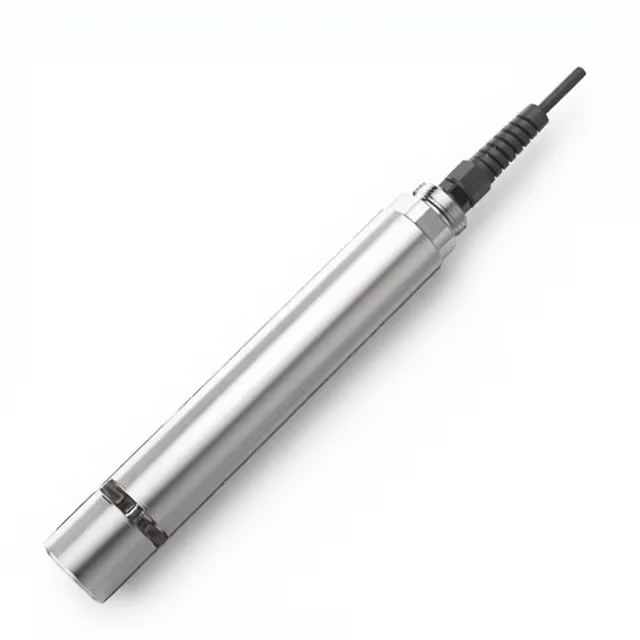
Online Industrial Turbidity Sensor
Industrial turbidity sensor using 90-degree scattered light nephelometry with near-infrared LED source, measuring 0-200 NTU with ±0.2 NTU accuracy for continuous water quality monitoring.

Louise Corscadden, PhD
Director of Science · ConductScience
Ask Louise about Online Industrial Turbidity Sensor fit, setup, configuration, or quote prep.
Already working with us? Sign in to connect this with My Scientist.
Key Specifications
Full details →- Model fit
- Configured during quote
- SKU family
- CS-LH-DZ09-200
- Shipping box
- 15.0 x 5.0 x 5.0 cm
- Ordering
- Online checkout and quote request available
- Category
- Industrial Sensors
- Build notes
- Confirm accessories, station layout, and support needs before purchase
The Online Industrial Turbidity Sensor (Model LH-DZ09-200) employs 90-degree scattered light nephelometry with a near-infrared LED source to measure suspended matter concentrations in aqueous samples. The sensor operates on the principle that suspended particles scatter incident light proportionally to their concentration, enabling quantitative turbidity determination from 0-200 NTU with ±0.2 NTU or ±5% accuracy.
The system utilizes a near-infrared light source to minimize chromatic interference, with the detector positioned at 90 degrees to the incident beam to capture scattered radiation. This optical configuration supports workflows following ISO 7027 turbidity measurement principles. The sensor features IP68 protection rating for underwater deployment up to 6 meters depth, with MODBUS/RS485 digital interface and 4-20mA analog output for industrial integration.
How It Works
The sensor operates using nephelometric light scattering principles, where a near-infrared LED emits a collimated beam through the sample at a defined angle. When the light beam encounters suspended particles during transmission, Rayleigh and Mie scattering phenomena occur based on particle size relative to the wavelength. The detector, positioned at exactly 90 degrees to the incident light path, measures the intensity of scattered radiation.
The concentration of suspended matter exhibits a direct proportional relationship with scattered light intensity, following the fundamental nephelometric equation. The near-infrared wavelength selection minimizes interference from dissolved colored compounds that absorb visible light but are transparent to near-IR radiation. This optical configuration provides enhanced sensitivity to particle concentration changes while reducing matrix effects from sample coloration.
Signal processing electronics convert the scattered light measurements into standardized turbidity units through calibrated algorithms. The system performs continuous real-time measurements with selectable resolution settings (0.01, 0.1, or 1.0 NTU) to match application requirements for precision versus measurement speed.
Features & Benefits
Model
- LH-DZ09-200
Measuring range
- 0-200
Deepest depth
- Underwater 6M
Digital interface
- MODBUS/RS485
Analog interface
- 4-20mA
powered by
- 12VDC±20%
Calibration
- One point or two point
Protection class
- Ip68
Installation method
- Flow tank installation or Submerged installation
Cable length
- 5M
Automation Level
- semi-automated
Brand
- ConductScience
Accuracy
- ±0.2NTU or ±5%
Temperature Range
- -10 -50â
Size
- Φ54*150mm
Research Domain
- Environmental Monitoring
- Food Science
- Industrial Hygiene
- Microbiology
- Pharmaceutical QC
Shipping weight
- 3.0 lb
Shipping box
- L: 15.0 cm
- W: 5.0 cm
- H: 5.0 cm
| Feature | This Product | Typical Alternative | Advantage |
|---|---|---|---|
| Measurement Range | 0-200 NTU with ±0.2 NTU accuracy | Entry-level models often offer narrower ranges or lower accuracy specifications | Wide measurement range accommodates both drinking water quality and industrial wastewater monitoring applications with consistent precision. |
| Resolution Settings | Three selectable resolutions: 0.01, 0.1, and 1.0 NTU | Fixed resolution sensors provide limited optimization capability | Allows researchers to optimize measurement precision versus response time based on specific experimental requirements. |
| Environmental Protection | IP68 rated for 6-meter underwater deployment | Standard sensors typically offer IP65 or lower protection ratings | Enables direct installation in challenging environments including submerged applications without additional protective housings. |
| Communication Interfaces | Dual MODBUS/RS485 and 4-20mA analog outputs | Single interface options limit system integration flexibility | Provides compatibility with both modern digital control systems and legacy analog process equipment. |
| Light Source Technology | Near-infrared LED for chromatic interference elimination | White light sources may experience interference from colored samples | Ensures accurate measurements in industrial process streams with variable coloration or dissolved organic compounds. |
| Calibration Options | One-point or two-point calibration capability | Fixed calibration systems provide limited adjustment capability | Accommodates various quality control protocols from simple verification to full linearity validation using certified standards. |
The LH-DZ09-200 combines wide measurement range capabilities with flexible resolution settings and robust environmental protection. The near-infrared optical system and dual interface options provide advantages for researchers requiring accurate measurements in challenging industrial environments with comprehensive system integration capability.
Practical Tips
Perform calibration using fresh formazin standards prepared within 24 hours, as standard solutions degrade over time affecting accuracy.
Why: Aged formazin standards exhibit particle aggregation that alters scattering properties and compromises calibration validity.
Clean optical windows with 10% hydrochloric acid solution monthly in high-mineral water applications to remove scale buildup.
Why: Mineral deposits on optical surfaces reduce light transmission and create false readings that increase apparent turbidity values.
Install the sensor in a location with laminar flow conditions, avoiding areas downstream from pumps or valves that create turbulence.
Why: Air bubbles introduced by turbulence scatter light similarly to particles, causing erroneously high turbidity readings.
If readings drift upward over time, inspect for biofilm formation on optical windows in biological treatment applications.
Why: Microbial growth on sensor surfaces creates additional light scattering that registers as increased turbidity independent of sample conditions.
Set averaging time to 30-60 seconds in applications with variable particle concentrations to reduce measurement noise.
Why: Longer averaging periods smooth fluctuations from particle distribution heterogeneity while maintaining representative measurements.
Verify IP68 seal integrity before underwater installation by conducting pressure testing at rated depth.
Why: Water intrusion into sensor housing will cause immediate failure of electronic components and potential safety hazards.
Use two-point calibration spanning the expected measurement range rather than single-point calibration for critical applications.
Why: Two-point calibration corrects for both offset errors and scale factor deviations, improving accuracy across the full measurement range.
Record baseline readings in clean water conditions during initial installation for future performance comparison.
Why: Baseline measurements provide reference points to identify sensor drift or fouling conditions during routine maintenance intervals.
Setup Guide
What’s in the Box
- LH-DZ09-200 turbidity sensor with optical assembly
- 5-meter connecting cable with terminal connections
- Mounting hardware for flow tank installation
- User manual and calibration instructions
- Protective caps for optical windows (typical)
- Quick start setup guide (typical)
Warranty
ConductScience provides a standard one-year manufacturer warranty covering defects in materials and workmanship, with technical support for calibration procedures and troubleshooting assistance.
Compliance
What calibration standards are required for accurate turbidity measurement?
Use certified formazin standards prepared according to ISO 7027 or EPA protocols. Primary standards at 0.02, 20, 200, and 1000 NTU are recommended, with the sensor supporting one-point or two-point calibration procedures depending on required accuracy.
How does the near-infrared light source improve measurement accuracy compared to white light systems?
Near-infrared wavelength minimizes absorption interference from dissolved organic compounds and colored substances that would affect visible light measurements, providing more accurate turbidity readings in samples with natural or industrial coloration.
What maintenance procedures are required for optimal sensor performance?
Clean optical windows monthly using lint-free cloth and distilled water, inspect for biofilm growth in biological applications, and perform calibration verification quarterly using certified reference standards within the operational measurement range.
Can the sensor be used for both continuous monitoring and discrete sampling applications?
Yes, the sensor supports continuous real-time monitoring through digital interfaces and can be used for discrete measurements by configuring appropriate averaging times and resolution settings based on sample stability requirements.
What is the typical response time for turbidity measurements?
Response time ranges from 10-30 seconds depending on resolution settings and averaging parameters, with higher resolution measurements requiring longer stabilization time for optimal precision.
How does the 90-degree detection angle affect measurement sensitivity?
The 90-degree configuration provides maximum sensitivity to small particles while maintaining linearity across the measurement range, as scattered light intensity peaks at this angle for most particle size distributions encountered in water quality applications.
What sample flow requirements are necessary for accurate measurements?
Maintain minimum flow velocity of 0.1 m/s past the optical windows to prevent particle settling and ensure representative sampling, while avoiding excessive turbulence that could introduce air bubbles affecting readings.
How does this sensor compare to laboratory benchtop turbidimeters in terms of measurement accuracy?
The sensor provides comparable accuracy (±0.2 NTU) to laboratory instruments for online monitoring applications, with the advantage of continuous real-time measurements versus discrete sampling required for benchtop analysis.
Have a question about this product?
Have a question? Just ask.
Send it over and we'll email you a personalized answer — no call, no scheduling.
Prefer to talk it through?
Accessories
Enhance your setup with compatible accessories
Frequently Bought Together