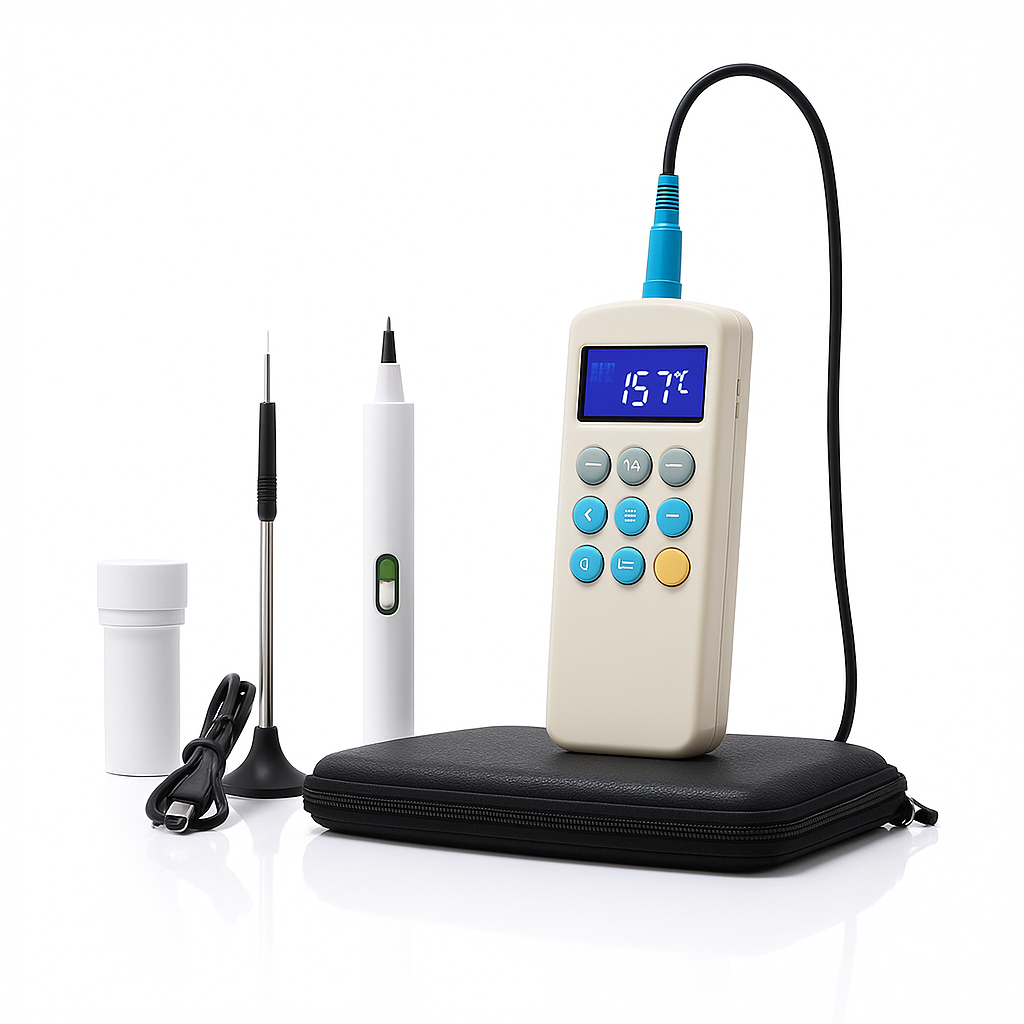
Pen-Type ORP Meter
Portable ORP meter with platinum electrode providing ±1mV accuracy across -1000 to +1000mV range for electrochemical analysis and water quality assessment.

Louise Corscadden, PhD
Director of Science · ConductScience
Ask Louise about Pen-Type ORP Meter fit, setup, configuration, or quote prep.
Already working with us? Sign in to connect this with My Scientist.
Key Specifications
Full details →- Model fit
- Configured during quote
- SKU family
- CS-LH-M300
- Shipping box
- 20.0 x 10.0 x 5.0 cm
- Ordering
- Online checkout and quote request available
- Category
- Portable Analyzers
- Build notes
- Confirm accessories, station layout, and support needs before purchase
The LH-M300 ORP test pen is a portable electrochemical instrument designed for precise oxidation-reduction potential measurements in aqueous solutions. The instrument employs a replaceable platinum round flat electrode that responds rapidly to electron transfer reactions in solution, providing millivolt readings that quantify the oxidizing or reducing tendency of the test medium. The platinum electrode configuration offers superior chemical stability and response characteristics compared to other electrode materials, enabling accurate measurements across the full -1000 to +1000 mV range.
This handheld instrument features a 20×30mm LCD backlight display with automatic data lock functionality and IP65 protection rating for field use in demanding laboratory and environmental conditions. The compact pen-style design (185×40×48mm) facilitates single-handed operation while maintaining measurement precision of ±1mV. Temperature compensation is integrated through simultaneous temperature measurement (0-100°C range) with automatic calibration capabilities at any point within the measurement scale, ensuring accurate ORP readings across varying thermal conditions typical in water quality and process monitoring applications.
How It Works
Oxidation-reduction potential measurement relies on electrochemical principles where electron transfer reactions create measurable voltage differences between a sensing electrode and reference system. The LH-M300 utilizes a platinum sensing electrode that develops a potential proportional to the logarithmic ratio of oxidized to reduced species concentrations in solution, following the Nernst equation. When immersed in the test solution, the platinum surface equilibrates with dissolved redox-active compounds, generating a stable potential that reflects the solution's overall electron availability.
The measurement system compares this sensing electrode potential against a stable reference electrode potential to determine the net ORP value in millivolts. Positive readings indicate oxidizing conditions where electron-accepting species predominate, while negative readings suggest reducing environments rich in electron-donating compounds. The integrated temperature sensor enables automatic compensation for thermal effects on electrode kinetics and solution conductivity, maintaining measurement accuracy across the 0-60°C operating range.
Data acquisition occurs through high-impedance voltage measurement circuitry that minimizes current flow through the electrode system, preserving solution chemistry during measurement. The automatic data lock feature captures stable readings once electrode equilibration is achieved, typically within seconds for most aqueous solutions containing sufficient ionic strength for proper electrode function.
Features & Benefits
Model
- LH-M300
Item
- Specification
ORP measuring range
- -1000~+1000mV
ORP resolution
- 1mV
ORP accuracy
- ±1mV
Temperature measuring range
- 0-100.0â/32-212â
Working temperature
- 0-60.0â/32-140â
Temperature resolution
- 0.1â
Calibration
- ±0.2âï¼Calibration at any point within the full scale rangeï¼
ORP electrode
- Replaceable platinum round flat electrode
IP grade
- IP65
Automatic backlight
- 1 minute
Automatic shut-down
- 20 minutes
Automation Level
- manual
Brand
- ConductScience
Display Type
- 20*30mmLCD backlight display
Power/Voltage
- 1.5V AAAbattery
Size
- 185*40*48mm(H*W*D)
Research Domain
- Analytical Chemistry
- Environmental Monitoring
- Food Science
- Industrial Hygiene
- Microbiology
- Pharmaceutical QC
Shipping weight
- 0.26 lb
Shipping box
- L: 20.0 cm
- W: 10.0 cm
- H: 5.0 cm
| Feature | This Product | Typical Alternative | Advantage |
|---|---|---|---|
| Measurement Range | -1000 to +1000mV | Entry-level models often provide narrower ranges such as -500 to +500mV | Extended range accommodates strongly reducing or oxidizing samples without dilution or conditioning steps |
| Accuracy Specification | ±1mV across full range | Basic instruments typically offer ±5-10mV accuracy | Higher precision enables detection of subtle redox changes important in quality control applications |
| Electrode Design | Replaceable platinum round flat electrode | Many portable meters use fixed electrodes requiring complete instrument replacement | Reduces long-term operational costs and enables electrode optimization for specific sample types |
| Temperature Compensation | Integrated temperature sensor (0-100°C range) | Basic models often lack temperature measurement capability | Simultaneous temperature measurement enables proper data interpretation and quality documentation |
| Environmental Protection | IP65 rating with water and dust protection | Lower-cost alternatives may lack environmental sealing | Enables reliable field use in harsh conditions without instrument damage or measurement drift |
| Calibration Flexibility | Single-point calibration at any value within full range | Fixed calibration points limit optimization for specific applications | Allows accuracy optimization for the user's specific measurement range rather than manufacturer-preset points |
The LH-M300 combines laboratory-grade accuracy with field portability through its replaceable platinum electrode system and comprehensive environmental protection. The extended measurement range and flexible calibration capabilities provide versatility for diverse electrochemical analysis applications while maintaining cost-effective operation through replaceable components.
Practical Tips
Perform calibration verification using fresh standard solutions at the temperature closest to your sample conditions.
Why: Temperature differences between calibration and measurement can introduce systematic errors in ORP readings.
Clean the platinum electrode with dilute acid solution followed by thorough distilled water rinse after measurements in high-ionic strength samples.
Why: Salt deposits can insulate the electrode surface and slow response time for subsequent measurements.
Allow 2-3 minutes equilibration time in each new sample before recording readings, especially when transitioning between different solution types.
Why: Electrode surface must reach chemical equilibrium with the new solution for accurate potential development.
If readings appear erratic or slow to stabilize, check electrode surface for contamination and verify adequate sample ionic strength.
Why: Poor electrode contact or low conductivity solutions can cause unstable potential measurements.
Record both ORP and temperature values for each measurement to enable proper data interpretation and trend analysis.
Why: Temperature significantly affects redox equilibria and electrode response, making it essential for quality documentation.
Do not exceed the 0-60°C operating temperature range or 100°C sample temperature limits during measurements.
Why: Excessive temperature can damage internal electronics and compromise measurement accuracy or instrument safety.
Store the electrode in appropriate storage solution when not in use to maintain hydration and response characteristics.
Why: Dry storage can cause electrode surface changes that lead to slow response and calibration drift.
If the instrument fails to power on, verify battery polarity and charge level before assuming instrument malfunction.
Why: Battery issues are the most common cause of apparent instrument failure in portable electronic devices.
Setup Guide
What’s in the Box
- LH-M300 ORP meter with platinum electrode
- 1.5V AAA battery
- User manual and calibration instructions
- Protective carrying case (typical)
- Electrode storage solution (typical)
Warranty
ConductScience provides a one-year manufacturer warranty covering defects in materials and workmanship, with technical support for calibration procedures and electrode maintenance.
Compliance
What is the expected lifetime of the platinum electrode under normal use conditions?
Platinum electrodes typically provide 1-2 years of service with proper maintenance, though lifetime depends on sample chemistry and measurement frequency. The replaceable design allows continued instrument use with fresh electrodes when response degrades.
How does temperature affect ORP measurements and what compensation is provided?
Temperature affects both electrode kinetics and solution conductivity, typically causing ~0.2mV/°C drift. The integrated temperature sensor enables manual compensation calculations, though users should consult the manual for specific temperature coefficients relevant to their solutions.
What calibration standards are recommended for ORP verification?
Commercial ORP standards such as quinhydrone solutions (+263mV) or Zobell's solution (+430mV) provide reliable calibration references. The instrument's single-point calibration can be performed at any value within the measurement range.
Can this meter be used for continuous monitoring applications?
The LH-M300 is designed for spot measurements rather than continuous monitoring. Battery life and electrode maintenance requirements make it most suitable for periodic sampling and laboratory analysis rather than permanent installation.
What sample volume and container requirements apply for accurate measurements?
Minimum sample volume should allow complete submersion of both platinum and reference electrodes, typically 50-100mL. Use non-metallic containers to avoid interference, and ensure adequate sample mixing for representative measurements.
How does this instrument compare to laboratory-grade ORP meters?
The LH-M300 offers portable convenience with accuracy comparable to benchtop instruments for most applications. Laboratory meters may provide additional features like data logging, multiple electrode inputs, or enhanced temperature compensation algorithms.
What maintenance procedures are required for optimal performance?
Regular electrode cleaning with appropriate solutions, proper storage in electrode solution when not in use, and periodic calibration verification. Consult product datasheet for specific cleaning protocols based on sample matrix composition.
Are there any chemical interferences that affect measurement accuracy?
Strong acids, bases, or complexing agents may interfere with electrode response. Heavy metals can poison platinum surfaces, while oil or organic films may slow response time. Consult product datasheet for comprehensive interference information.
Have a question about this product?
Have a question? Just ask.
Send it over and we'll email you a personalized answer — no call, no scheduling.
Prefer to talk it through?
Accessories
Enhance your setup with compatible accessories
Frequently Bought Together