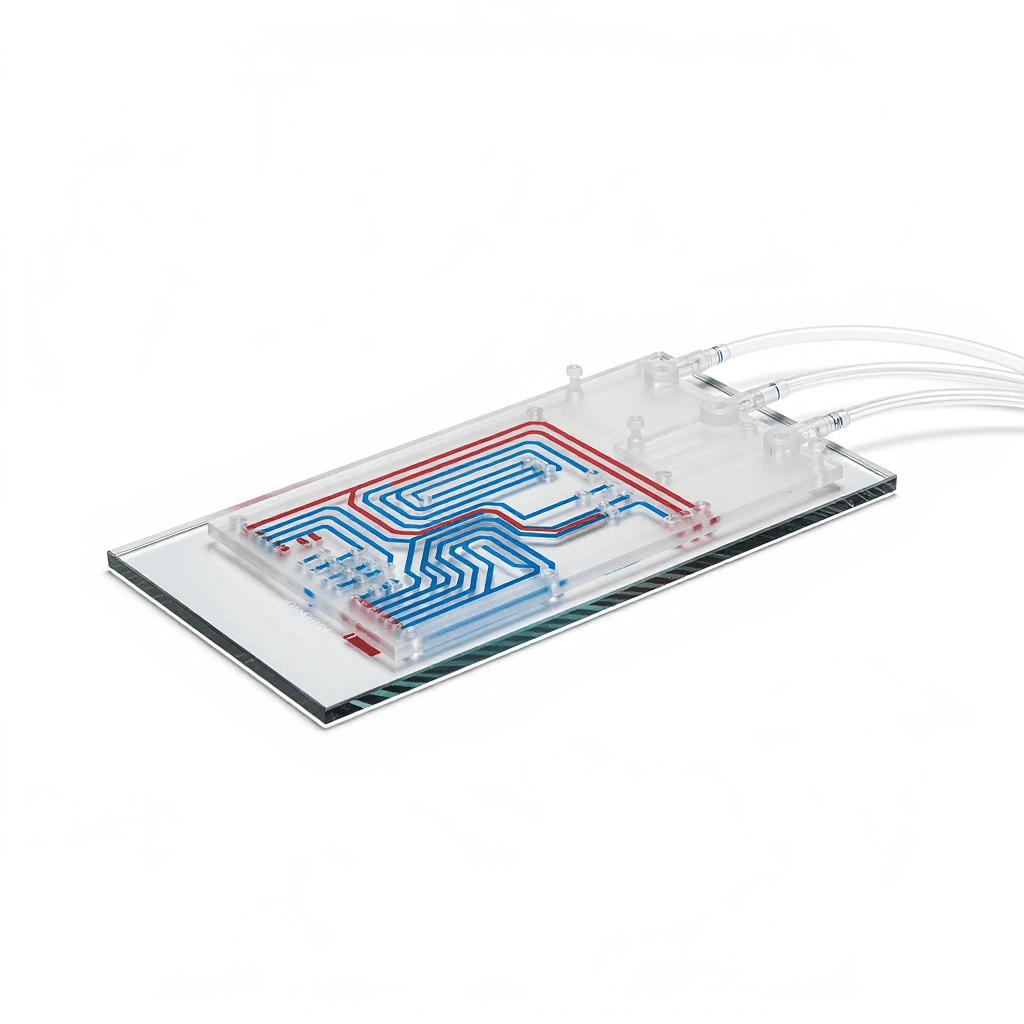
PDMS Pre-Polymer Kit
Two-component PDMS elastomer kit with base polymer and curing agent for fabricating optically clear, biocompatible microfluidic devices and cell culture substrates.
| Contents | Base + curing agent |
| Mix Ratio | 10:1 (standard) |
| Properties | Optically clear, biocompatible |
| Automation Level | manual |
| Brand | ConductScience |
The PDMS Pre-Polymer Kit provides polydimethylsiloxane (PDMS) base polymer and curing agent for fabricating optically clear, biocompatible microfluidic devices and cell culture substrates. This two-component silicone elastomer system cures at room temperature or elevated temperatures to form flexible, gas-permeable structures with excellent optical properties for microscopy applications.
The kit includes pre-measured base polymer and curing agent optimized for a standard 10:1 mixing ratio, eliminating measurement errors and ensuring consistent mechanical properties across batches. The biocompatible formulation supports direct cell culture applications and provides the chemical inertness required for biological assays and drug screening protocols.
How It Works
PDMS polymerization occurs through a platinum-catalyzed hydrosilylation reaction between vinyl-terminated polydimethylsiloxane chains in the base polymer and methylhydrosiloxane cross-linking agents in the curing agent. The reaction proceeds without producing volatile byproducts, making it suitable for enclosed applications and biological environments.
The 10:1 mixing ratio provides optimal cross-link density for most microfluidic applications, yielding a Shore A hardness of approximately 50 and tensile strength suitable for device demolding and handling. Curing kinetics are temperature-dependent, with complete polymerization occurring in 24 hours at room temperature or 2-4 hours at 65°C.
The resulting elastomer exhibits high optical transparency (>95% transmission at 400-700 nm), gas permeability for oxygen and carbon dioxide exchange, and surface properties that can be modified through plasma treatment or chemical functionalization for specific cell adhesion requirements.
Features & Benefits
Contents
- Base + curing agent
Mix Ratio
- 10:1 (standard)
Properties
- Optically clear, biocompatible
Automation Level
- manual
Brand
- ConductScience
Research Domain
- Analytical Chemistry
- Cancer Research
- Cell Biology
- Developmental Biology
- Microbiology
- Pharmaceutical QC
Weight
- 1.0 lbs
Dimensions
- L: 150.0 in
- W: 100.0 in
- H: 80.0 in
Comparison Guide
| Feature | This Product | Typical Alternative | Advantage |
|---|---|---|---|
| Mixing Ratio | 10:1 (standard) | Some systems use 1:1 ratios requiring more precise measurement | Reduces measurement errors and simplifies scaling for different batch sizes |
| Optical Properties | Optically clear formulation | Industrial grades may have higher opacity or yellowish tint | Enables high-quality microscopy and fluorescence imaging without optical interference |
| Biocompatibility | Biocompatible composition | Standard silicones may require cytotoxicity validation | Supports direct cell culture applications without additional biocompatibility testing |
| Component Format | Base + curing agent | Some systems require additional catalysts or additives | Simplified mixing process reduces contamination risk and preparation time |
| Curing Flexibility | Room temperature or thermal curing | Some formulations require only elevated temperature processing | Allows processing without specialized equipment while maintaining accelerated curing options |
This PDMS kit provides the standard 10:1 mixing ratio and biocompatible formulation specifically optimized for research applications. The optically clear, room-temperature curing system offers the reliability and consistency required for reproducible device fabrication in academic and industrial research environments.
Practical Tips
Weigh components by mass rather than volume for accurate 10:1 ratio, as slight density variations can affect mixing proportions.
Why: Mass measurements provide better accuracy than volumetric measurements for viscous polymers.
Mix components in a figure-8 pattern rather than circular stirring to ensure complete homogenization without excessive air entrapment.
Why: Figure-8 mixing provides better shear distribution while minimizing bubble formation.
Clean mixing containers immediately after use with isopropanol before PDMS can begin curing on surfaces.
Why: Cured PDMS is difficult to remove and can contaminate subsequent batches.
If curing appears incomplete after expected time, verify curing agent was not omitted and temperature is maintained consistently.
Why: Incomplete curing usually indicates insufficient curing agent or temperature fluctuations during polymerization.
Allow freshly cured devices to outgas for 24-48 hours before cell culture applications to eliminate residual volatile compounds.
Why: Outgassing prevents potential cytotoxicity from uncured oligomers or reaction byproducts.
Work in well-ventilated areas and avoid skin contact with uncured components, especially the curing agent.
Why: Uncured PDMS components can cause skin sensitization and respiratory irritation in some individuals.
Test cure completeness by checking for tackiness at device edges where curing is typically slowest.
Why: Incomplete curing at thicker sections can compromise device performance and biocompatibility.
Setup Guide
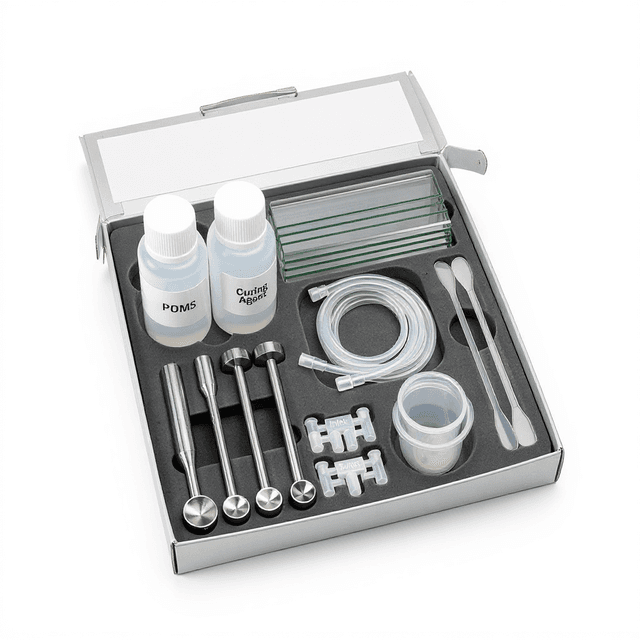
What’s in the Box
- PDMS base polymer component
- Curing agent component
- Mixing instructions and ratio guidelines
- Material safety data sheets
- Storage and handling recommendations (typical)
Warranty
ConductScience provides a one-year warranty covering material defects and contamination issues from date of shipment. Technical support includes mixing protocols, curing optimization, and troubleshooting assistance for device fabrication applications.
Compliance
What is the pot life of the mixed PDMS before curing begins?
Mixed PDMS typically has a working time of 30-45 minutes at room temperature before viscosity increases significantly, allowing sufficient time for degassing and casting procedures.
Can the curing temperature be adjusted to modify elastomer properties?
Higher curing temperatures (up to 150°C) can be used to accelerate polymerization and potentially increase cross-link density, but standard applications use 65°C for optimal balance of cure speed and material properties.
How should uncured PDMS components be stored for maximum shelf life?
Store both components in sealed containers at room temperature away from light and moisture. Properly stored components maintain activity for 12-18 months from manufacture date.
What degassing method is most effective for bubble removal?
Vacuum degassing at 25-50 mmHg for 10-15 minutes effectively removes entrained air while preventing solvent evaporation or premature curing initiation.
Can plasma treatment be performed on cured PDMS for surface modification?
Oxygen plasma treatment creates hydrophilic surface groups and improves bonding to glass or other PDMS layers, with treatment effects lasting several hours in ambient conditions.
What is the minimum feature resolution achievable with this PDMS formulation?
Feature resolution depends on mold quality rather than PDMS properties, with sub-micron features possible using high-resolution lithographic masters and proper degassing techniques.
How does this kit compare to alternative silicone elastomer systems?
The 10:1 ratio provides easier handling compared to 1:1 systems while offering better optical clarity and lower autofluorescence than many alternative formulations designed for industrial applications.
Have a question about this product?
Accessories
Enhance your setup with compatible accessories
Frequently Bought Together
Upgrade Options