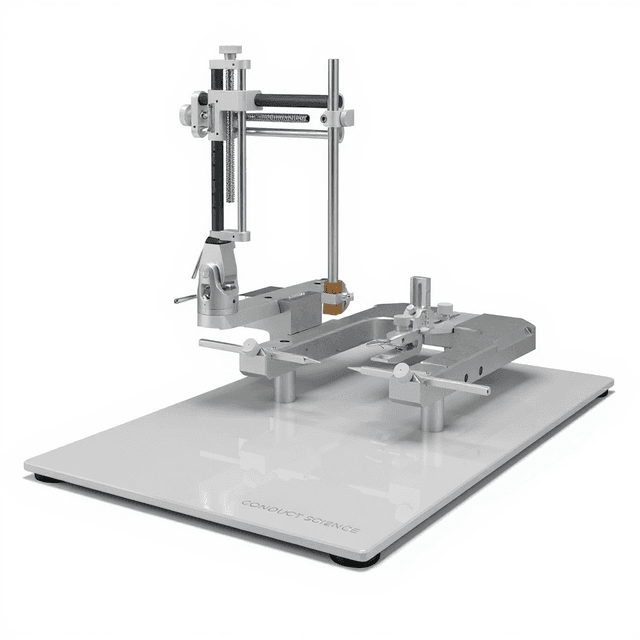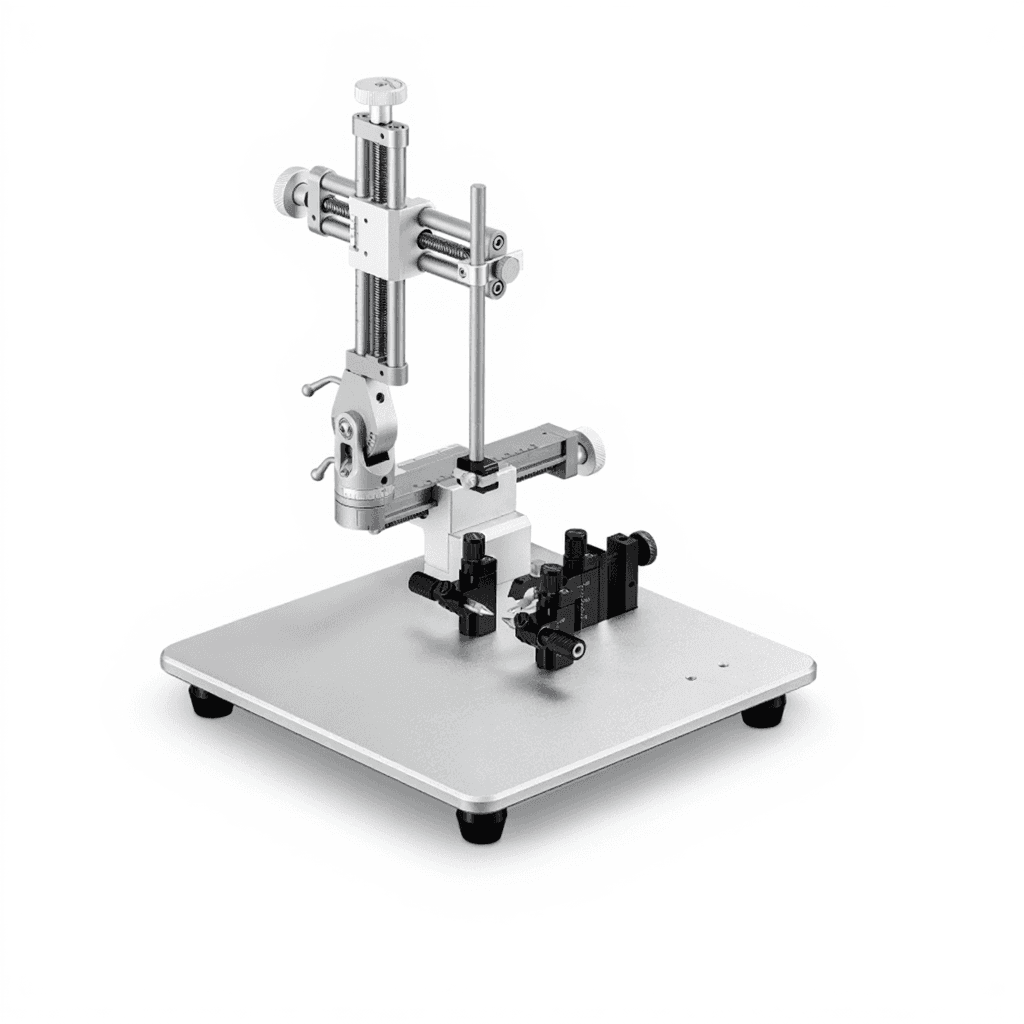
Precise Stereotaxic Positioner
Three-dimensional stereotaxic positioning system for precise brain region targeting in laboratory animals, available in standard (100 µm) and digital (10 µm) accuracy versions with single or double manipulator arms.
| manipulator_dimensions | three-dimensional |
| reference_system | skull landmarks (e.g., Bregma) |
| compatible_techniques | optogenetics, two-photon, endogenous brain imaging, fiber optic recording, electrophysiology |
| operations_supported | injections, stimulations, impairment, guided positioning |
| Automation Level | manual |
| Species | Mouse, Rat |
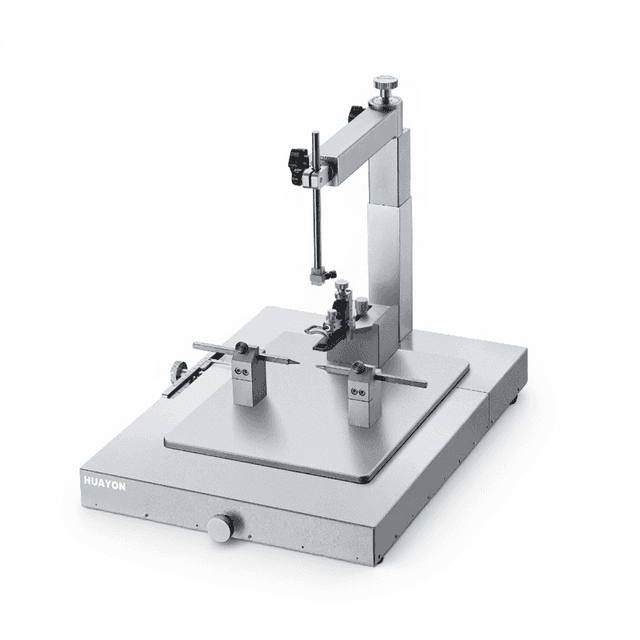
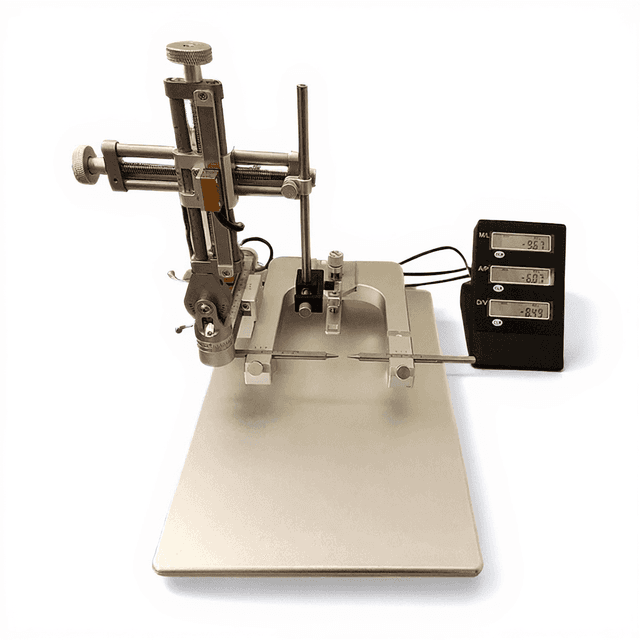
The Precise Stereotaxic Positioner is a three-dimensional manipulator system designed for accurate targeting of brain regions in laboratory animals. The instrument utilizes skull landmarks such as bregma as reference points to enable precise positioning of electrodes, injection needles, cannulas, and optical fibers within specific neural structures. Available in both standard (100 µm accuracy) and digital (10 µm accuracy) versions, the system supports single or double arm configurations to accommodate various experimental protocols.
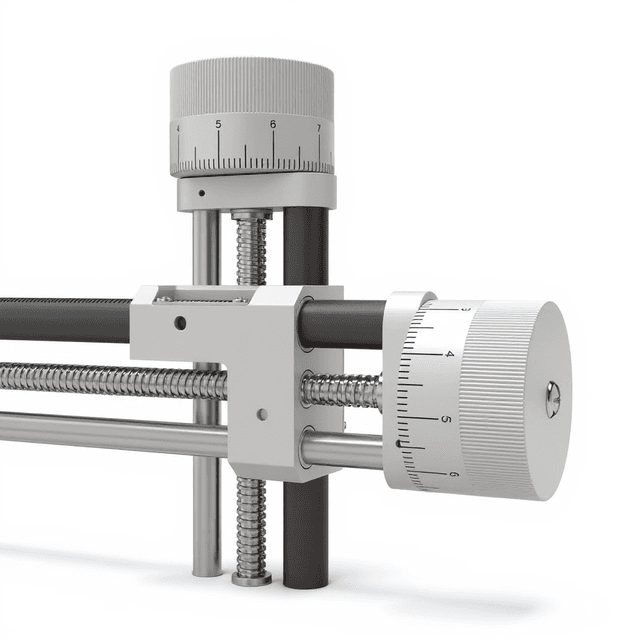
The positioner integrates with multiple neuroscience techniques including optogenetics, two-photon microscopy, electrophysiology, and fiber optic recording systems. Powered by a single 1.5V battery to eliminate electronic interference, the instrument features interchangeable head fixation components for different animal models and maintains traditional screw rotation operation for precise manipulation. The system enables researchers to perform injections, stimulations, lesioning procedures, and guided positioning with reproducible accuracy for neuroanatomy and functional neuroscience studies.
How It Works
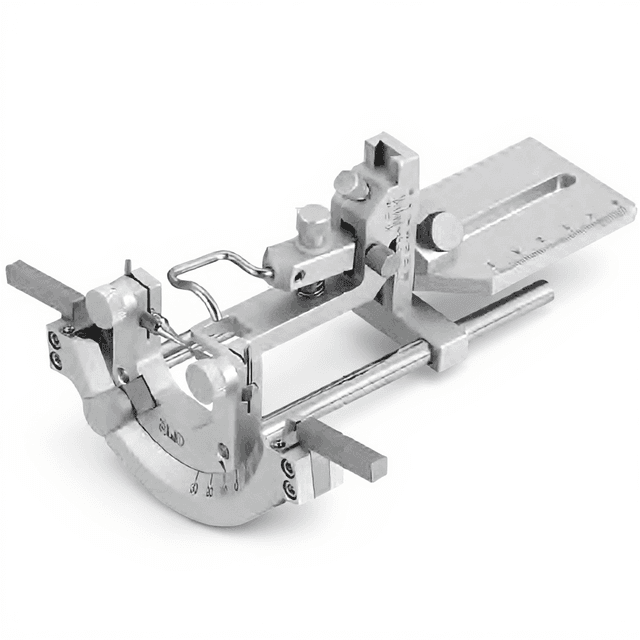
The stereotaxic positioner operates on the principle of three-dimensional coordinate mapping using anatomical landmarks on the skull surface. The system establishes a reference coordinate system with bregma (the intersection of the coronal and sagittal sutures) serving as the primary landmark. Once the animal's head is secured in the stereotaxic frame using ear bars and a nose clamp, the manipulator arm can be positioned to specific coordinates relative to bregma using standard brain atlas coordinates.
The digital version employs high-resolution encoders to provide 10 µm positioning accuracy, while the standard version achieves 100 µm accuracy through precision mechanical components. The manipulator arm moves through 80 mm of travel in three axes (anterior-posterior, medial-lateral, and dorsal-ventral), allowing access to virtually any brain region. A one-click return function enables rapid repositioning from target coordinates back to the bregma reference point for verification or multiple targeting procedures.
The battery-powered design eliminates electrical interference that could compromise electrophysiological recordings, while interchangeable mounting systems accommodate various tools including microelectrodes, injection needles, optical fibers, and stimulation electrodes. The traditional screw-based movement system provides stable, vibration-free positioning essential for maintaining target accuracy during extended procedures.
Features & Benefits
Arm
- Single
- Double
Version
- Manual
- Digital
manipulator_dimensions
- three-dimensional
reference_system
- skull landmarks (e.g., Bregma)
compatible_techniques
- optogenetics, two-photon, endogenous brain imaging, fiber optic recording, electrophysiology
operations_supported
- injections, stimulations, impairment, guided positioning
Automation Level
- manual
Research Domain
- Addiction Research
- Anxiety and Depression
- Behavioral Pharmacology
- Learning and Memory
- Motor Function
- Neurodegeneration
- Neuroscience
Species
- Mouse
- Rat
Weight
- 17.64 lbs
Dimensions
- L: 30.0 in
- W: 25.0 in
- H: 25.0 in
Comparison Guide
| Feature | This Product | Typical Alternative | Advantage |
|---|---|---|---|
| Positioning Accuracy | 10 µm (digital) / 100 µm (standard) | Entry-level models often provide 50-200 µm accuracy | Higher precision enables targeting of smaller brain nuclei and supports sub-laminar cortical injections. |
| Power System | 1.5V battery operation | Most systems use AC power with potential electrical interference | Eliminates electrical noise critical for clean electrophysiological recordings. |
| Arm Configuration Options | Single or double arm configurations | Many systems offer only single arm operation | Double arm option enables simultaneous bilateral procedures or combined recording/stimulation protocols. |
| Movement Range | 80 mm in three axes | Standard range varies from 50-100 mm depending on model | Comprehensive brain access from cortex to brainstem without animal repositioning. |
| Coordinate Return Function | One-click return to bregma reference | Manual repositioning required in basic systems | Rapid verification and multi-site targeting improve surgical efficiency and accuracy. |
| Animal Compatibility | Interchangeable fixation components for multiple species | Some systems require separate purchases for different animal models | Versatile platform accommodates different research models without additional equipment costs. |
The Precise Stereotaxic Positioner combines high-accuracy positioning with interference-free operation and flexible configuration options. The digital version's 10 µm precision and battery-powered design address key limitations of conventional systems, while interchangeable components and dual arm capability support diverse experimental protocols.
Practical Tips
Verify coordinate accuracy daily using a precision reference grid before beginning surgical procedures.
Why: Environmental factors and mechanical settling can introduce small positioning errors that accumulate over multiple targeting procedures.
Clean mechanical components with alcohol and lubricate lead screws monthly to maintain smooth operation.
Why: Tissue debris and oxidation can cause binding that reduces positioning accuracy and increases manipulation force.
Allow the system to equilibrate to room temperature for 30 minutes before use if stored in different conditions.
Why: Thermal expansion of metal components can shift mechanical zero positions and affect targeting precision.
If digital displays show erratic readings, replace the battery and reset the coordinate system to factory defaults.
Why: Low battery voltage can cause unstable encoder signals leading to incorrect position reporting.
Record actual injection or electrode coordinates achieved rather than intended targets for post-hoc verification.
Why: Documenting achieved positions enables correlation of experimental outcomes with precise anatomical locations.
Always engage head fixation components gradually and verify secure positioning before beginning coordinate movements.
Why: Proper animal restraint prevents movement artifacts and protects both the animal and precision instruments from damage.
Use the bregma return function to verify coordinate accuracy before and after each targeting procedure.
Why: Mechanical drift during surgery can be detected and corrected before it affects experimental outcomes.
Store the instrument with manipulator arms in mid-range positions to prevent spring fatigue and mechanical stress.
Why: Extreme positions can cause component wear and reduce long-term positioning accuracy.
Setup Guide
What’s in the Box
- Main stereotaxic base unit
- Manipulator arm assembly (single or double as specified)
- Head fixation components (ear bars, nose clamp, adapters)
- Tool mounting hardware
- Calibration tools (typical)
- User manual and coordinate reference guide
- Battery compartment and power components
Warranty
ConductScience provides a comprehensive one-year manufacturer warranty covering defects in materials and workmanship, with technical support for setup, calibration, and troubleshooting assistance.
Compliance
What is the practical difference in targeting accuracy between standard and digital versions?
Standard versions provide 100 µm accuracy suitable for most brain region targeting, while digital versions achieve 10 µm accuracy critical for precise single-cell targeting, small nucleus injections, or applications requiring sub-laminar precision in cortical structures.
Can the system accommodate both mice and rats without additional purchases?
Yes, interchangeable head fixation components including species-specific ear bars and adapters are included to support different animal models from mice to rats.
How does the battery power system prevent electrical interference?
The single 1.5V battery eliminates ground loops and electrical noise that AC-powered systems can introduce, ensuring clean baseline recordings essential for electrophysiology and preventing artifacts during neural signal acquisition.
What is the coordinate range accessible with the 80 mm travel distance?
The 80 mm range in each axis provides access from anterior frontal cortex to posterior cerebellum and from superficial cortical layers to ventral brainstem structures in both mice and rats using standard atlas coordinates.
Can optical fibers and electrodes be used simultaneously with the double arm configuration?
Yes, the double arm system enables simultaneous placement of different tools such as recording electrodes and optical fibers for combined electrophysiology and optogenetics experiments.
What maintenance is required for sustained accuracy?
Regular calibration verification using provided tools, cleaning of mechanical components, battery replacement, and periodic accuracy checks against known reference points maintain optimal positioning precision.
How does the one-click bregma return function work?
Digital models store the bregma reference coordinates electronically, allowing instant return to the zero position for verification or repositioning without manual coordinate entry.
Have a question about this product?
Accessories
Enhance your setup with compatible accessories
Frequently Bought Together
Upgrade Options