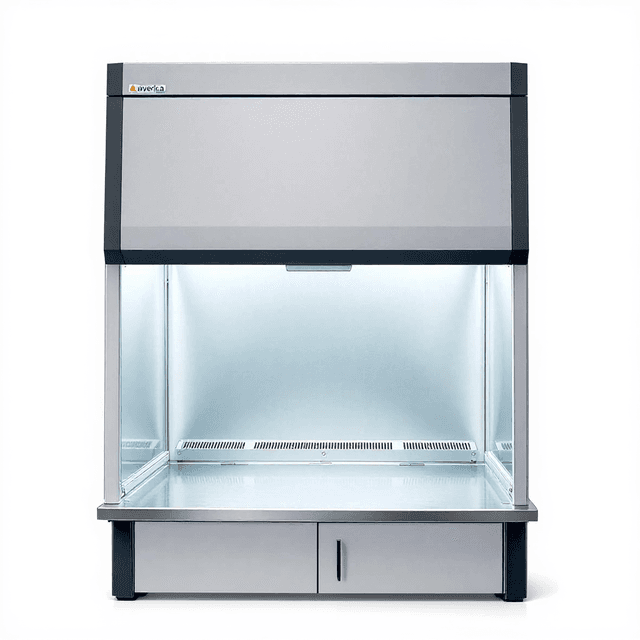
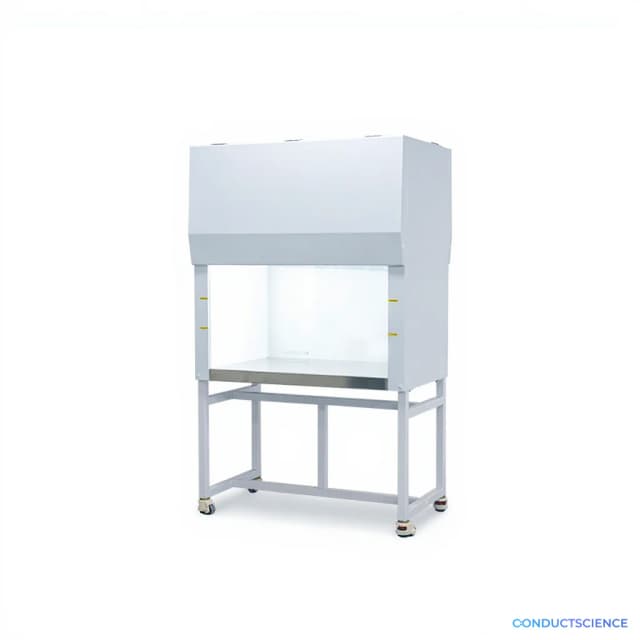
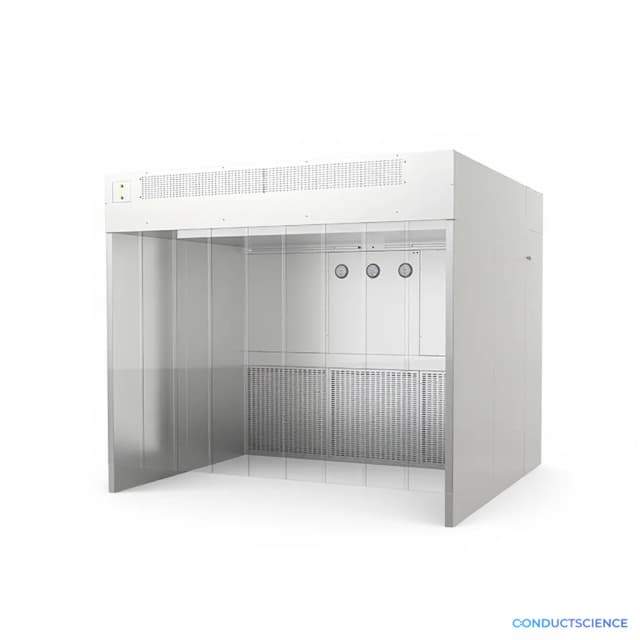
Small Vertical Laminar Flow Cabinet
Compact vertical laminar flow cabinet delivering HEPA-filtered air for sterile procedures and contamination-sensitive work in laboratory environments.
A laminar flow clean bench protects only the sample. It blows filtered air toward the user, so it is not for infectious or toxic work.

Louise Corscadden, PhD
Director of Science · ConductScience
Ask Louise about Small Vertical Laminar Flow Cabinet fit, setup, configuration, or quote prep.
Already working with us? Sign in to connect this with My Scientist.
Key Specifications
Full details →- Model fit
- Configured during quote
- SKU family
- BIO-0901
- Shipping box
- 116.0 x 68.0 x 41.0 cm
- Ordering
- Online checkout and quote request available
- Category
- Clean Benches & Fume Hoods
- Build notes
- Confirm accessories, station layout, and support needs before purchase
The Small Vertical Laminar Flow Cabinet provides a controlled environment for sterile procedures requiring particulate-free conditions. This compact unit generates unidirectional airflow to maintain aseptic conditions within the work zone, protecting samples and procedures from environmental contamination. The vertical laminar flow design draws ambient air through HEPA filtration, delivering clean air downward across the work surface at consistent velocities.
With dimensions of 116 cm length × 68 cm width × 41 cm height and a 75 kg operating weight, this cabinet fits standard laboratory benchtops while providing adequate workspace for routine sterile manipulations. The contained design supports procedures requiring protection from airborne particles and microorganisms without the infrastructure requirements of larger walk-in cleanroom facilities.
How It Works
Vertical laminar flow cabinets operate on the principle of unidirectional airflow filtration to create a controlled environment. Ambient air enters the system through pre-filters that remove larger particles, then passes through high-efficiency particulate air (HEPA) filters typically rated at 99.97% efficiency for particles 0.3 micrometers and larger. The filtered air flows vertically downward through the work zone at uniform velocities, typically 0.3-0.5 m/s, creating a continuous barrier against environmental contamination.
The vertical airflow pattern establishes a protective envelope around work materials, with clean air flowing from the filter plenum through the work surface and into the exhaust system. This design prevents turbulent mixing of clean and contaminated air while maintaining consistent air quality throughout the work zone. The cabinet maintains slight positive pressure relative to the surrounding laboratory environment, preventing ingress of unfiltered air during normal operation.
Features & Benefits
Automation Level
- manual
Research Domain
- Cell Biology
- Clinical Diagnostics
- Environmental Monitoring
- Food Science
- Microbiology
- Pharmaceutical QC
Shipping weight
- 75.0 lb
Shipping box
- L: 116.0 cm
- W: 68.0 cm
- H: 41.0 cm
| Feature | This Product | Typical Alternative | Advantage |
|---|---|---|---|
| Cabinet Dimensions | 116×68×41 cm compact design | Larger units often exceed 150 cm length | Fits standard benchtops while maintaining adequate workspace for routine procedures. |
| Weight and Portability | 75 kg operating weight | Floor-standing models typically exceed 100-200 kg | Allows benchtop installation without floor reinforcement requirements. |
| Installation Requirements | Self-contained operation | Many units require dedicated ventilation connections | Operates independently without permanent laboratory modifications or external exhaust systems. |
| Airflow Design | Vertical laminar flow pattern | Horizontal flow designs available | Provides downward airflow that maintains contamination protection while allowing ergonomic access to work zone. |
This cabinet combines compact dimensions with vertical laminar airflow design, providing contamination control suitable for benchtop installation. The self-contained operation eliminates requirements for dedicated ventilation infrastructure while maintaining controlled air quality for sterile procedures.
Practical Tips
Verify airflow velocity at multiple points across the work zone using calibrated anemometer during initial setup and periodic maintenance.
Why: Uniform airflow distribution ensures consistent contamination protection throughout the work area.
Monitor pressure differential across HEPA filters monthly and maintain log of readings to track filter loading.
Why: Systematic monitoring prevents filter overloading that can compromise airflow performance and contamination control.
Allow 10-15 minutes warm-up time after startup and minimize rapid movements within the work zone during procedures.
Why: Stable airflow conditions and minimal turbulence maintain the protective air barrier around work materials.
Position equipment and materials to avoid blocking airflow patterns and maintain clear pathways for air movement.
Why: Proper placement preserves laminar flow characteristics and prevents contamination from air circulation disruption.
Use smoke sticks or other visualization methods to identify airflow disruptions if contamination events occur.
Why: Visual airflow assessment helps identify turbulence sources that can compromise sterile conditions.
Verify cabinet is intended for product protection only and not for containment of hazardous materials.
Why: Vertical laminar flow design provides downward airflow without exhaust filtration for operator protection.
Document airflow measurements and filter pressure readings to establish baseline performance and track changes over time.
Why: Systematic documentation enables trending analysis and predictive maintenance scheduling.
Setup Guide
What’s in the Box
- Small Vertical Laminar Flow Cabinet main unit
- HEPA filter assembly (typical)
- Power cord and electrical connections (typical)
- Operation and maintenance manual (typical)
- Airflow certification documentation (typical)
Warranty
ConductScience provides standard one-year manufacturer warranty covering materials and workmanship defects, with technical support for installation guidance and operational troubleshooting.
Compliance
What airflow velocity should be maintained for optimal contamination control?
Typical vertical laminar flow cabinets operate at 0.3-0.5 m/s face velocity. Consult product datasheet for specific airflow specifications and use calibrated anemometer for verification.
How frequently should HEPA filters be replaced?
Filter replacement depends on usage conditions and particle loading. Monitor pressure differential across filters and replace when specified limits are exceeded, typically annually under normal use.
Can this cabinet be used for hazardous materials?
This unit provides product protection through downward airflow but does not contain exhaust filtration for operator protection. Use only for non-hazardous materials or consult safety guidelines.
What surface decontamination procedures are recommended?
Clean work surfaces with appropriate disinfectants between procedures. Use 70% isopropanol or other validated agents compatible with cabinet materials and allow complete evaporation before use.
How long is the recommended warm-up time before use?
Allow minimum 10-15 minutes for airflow stabilization after startup. Verify proper airflow pattern and velocity before beginning sterile procedures.
What electrical requirements are needed for installation?
Consult product datasheet for specific power requirements including voltage, frequency, and amperage. Ensure adequate circuit capacity and proper grounding for safe operation.
Have a question about this product?
Have a question? Just ask.
Send it over and we'll email you a personalized answer — no call, no scheduling.
Prefer to talk it through?