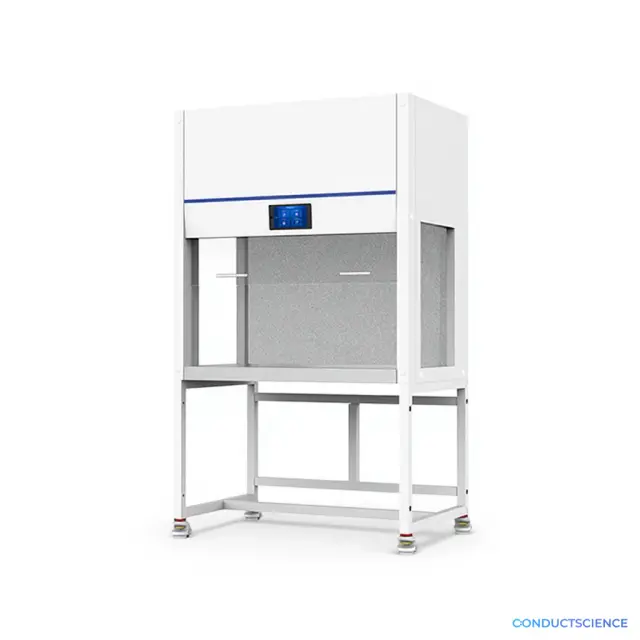
Vertical Laminar Flow Cabinet
Vertical laminar flow cabinet with 99.995% HEPA filtration and 7-inch touchscreen control, providing sterile working environment for cell culture and sterile technique applications.

Louise Corscadden, PhD
Director of Science · ConductScience
Ask Louise about Vertical Laminar Flow Cabinet fit, setup, configuration, or quote prep.
Already working with us? Sign in to connect this with My Scientist.
Key Specifications
Full details →- Model fit
- Configured during quote
- SKU family
- _old_BIO-0900
- Shipping box
- 185.0 x 106.0 x 62.0 cm
- Ordering
- Online checkout and quote request available
- Category
- Clean Benches & Fume Hoods
- Build notes
- Confirm accessories, station layout, and support needs before purchase
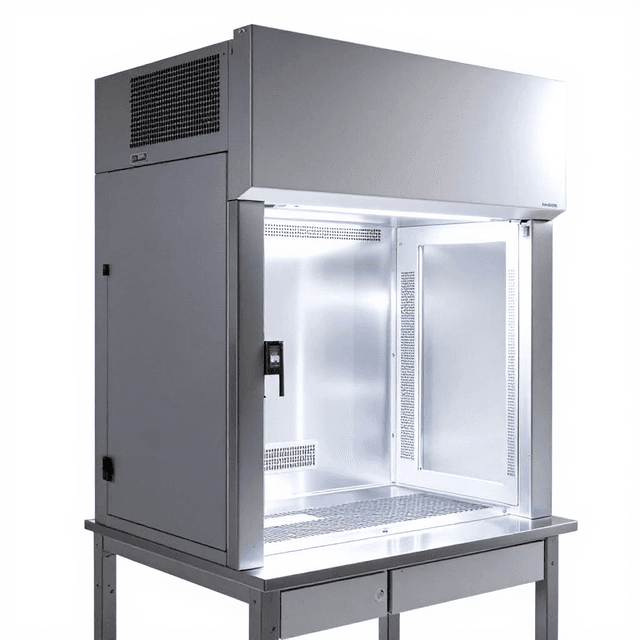
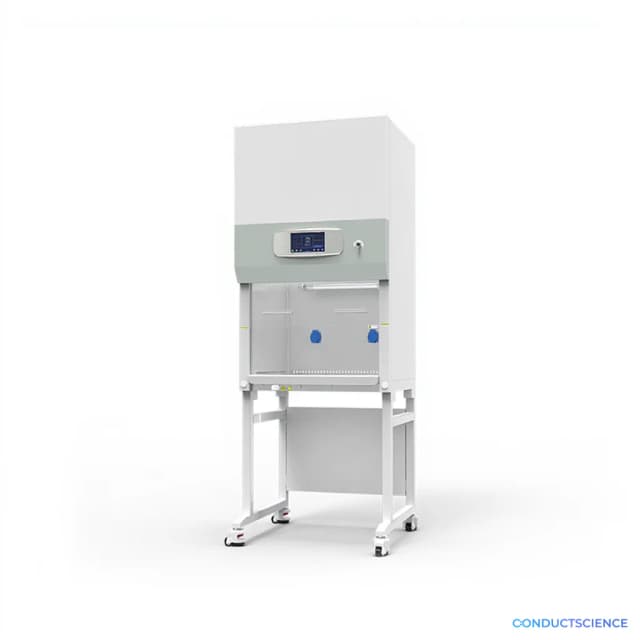
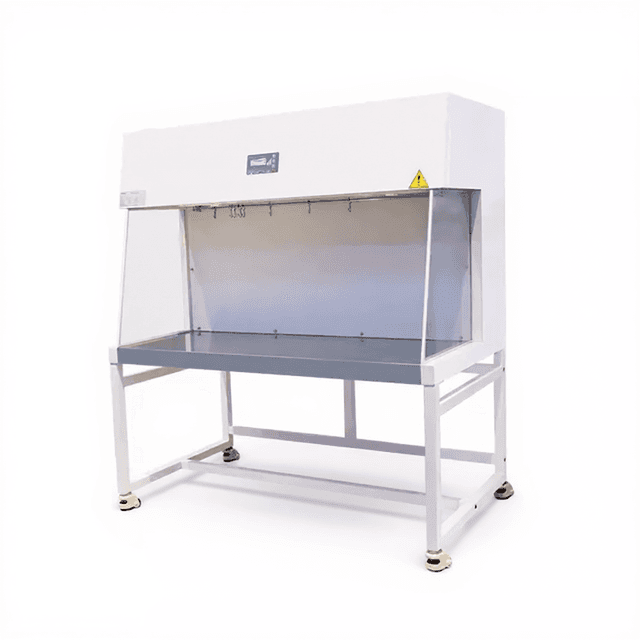
The Vertical Laminar Flow Cabinet (BIO-0900) provides Class II biological safety cabinet functionality for sterile work applications requiring particle-free environments. The unit features vertical downward airflow with a 99.995% efficiency HEPA filter at 0.3μm, maintaining airflow velocities of 0.30-0.45 m/s within a 935×530×650mm working chamber. The cabinet incorporates a 7-inch color touchscreen interface for system control and monitoring, with integrated LED illumination providing ≥300 lux at the work surface.
Designed for laboratory applications requiring sterile technique, the cabinet maintains low vibration levels (≤5μm rms) and operates at ≤65 dB(A) noise levels. The manual front window provides adjustable safety height from 200-350mm with maximum opening of 400mm. Colony count performance specifications indicate ≤0.5 CFU/30min under standard operating conditions, supporting critical sterile work protocols in research and quality control environments.
How It Works
The vertical laminar flow cabinet operates on the principle of unidirectional airflow filtration to create a sterile working environment. Room air is drawn into the unit through a polyester fiber pre-filter, which removes larger particles and extends HEPA filter life. The pre-filtered air then passes through a 99.995% efficient HEPA filter at 0.3μm particle size, removing bacteria, fungi, and submicron particles.
Filtered air flows vertically downward through the work chamber at controlled velocities between 0.30-0.45 m/s, creating a laminar flow pattern that sweeps contaminants away from the work surface and out through the front opening. The continuous downward airflow prevents outside contaminants from entering the sterile work zone while protecting samples and cultures from particulate contamination. The manual front window allows operator access while maintaining proper airflow patterns when positioned within the specified safety height range of 200-350mm.
Features & Benefits
Automation Level
- semi-automated
External Size(W*D*H)
- 1060*620*1850mm
Internal Size(W*D*H)
- 935*530*650mm
Work Surface Height
- 750mm
Safety Height
- 200~350mm
Max Opening
- 400mm
Airflow Velocity
- 0.30~0.45m/s
Pre-filter
- Polyester fiber
HEPA Filter
- One, 99.995% efficiency at 0.3μm
Front Window
- Manual
Noise
- ≤65dB(A)
Illumination
- ≥300lx
Vibration
- ≤5μm(rms)
Safety
- Colonies Number≤0.5CFU/30min
Brand
- ConductScience
Research Domain
- Cell Biology
- Clinical Diagnostics
- Developmental Biology
- Immunology
- Microbiology
- Pharmaceutical QC
Display Type
- 7-inch color touch screen
Shipping weight
- 177.0 lb
Shipping box
- L: 185.0 cm
- W: 106.0 cm
- H: 62.0 cm
| Feature | This Product | Typical Alternative | Advantage |
|---|---|---|---|
| HEPA Filter Efficiency | 99.995% at 0.3μm | Entry-level models often provide 99.97% efficiency | Higher efficiency provides superior particle removal for critical sterile applications requiring maximum contamination control. |
| User Interface | 7-inch color touchscreen | Basic models use simple switches or small LCD displays | Intuitive touchscreen interface provides better system monitoring and control without external devices. |
| Airflow Control | Variable 0.30-0.45 m/s velocity | Fixed airflow velocity in many models | Adjustable airflow allows optimization for different applications while maintaining laminar flow characteristics. |
| Vibration Control | ≤5μm rms vibration specification | Many models do not specify vibration control | Low vibration operation prevents disturbance to sensitive cell culture and microscopy work performed within the cabinet. |
| Work Surface Illumination | ≥300 lux LED lighting | Fluorescent lighting or lower intensity LEDs | High-intensity LED illumination provides excellent visibility for detailed sterile work without heat generation. |
This cabinet combines high-efficiency HEPA filtration with touchscreen control and low-vibration operation. The adjustable airflow and comprehensive performance specifications support demanding sterile work applications requiring precise environmental control.
Practical Tips
Verify airflow velocity at multiple points across the work surface monthly using a calibrated anemometer.
Why: Ensures uniform laminar flow pattern and early detection of HEPA filter loading or system performance degradation.
Replace polyester pre-filter when pressure differential increases or every 3-6 months depending on environment.
Why: Pre-filter maintenance extends HEPA filter life and maintains optimal airflow performance.
Allow cabinet to run for 15 minutes before beginning sterile work to stabilize airflow patterns.
Why: Startup time ensures uniform airflow distribution and removes any particles disturbed during cabinet opening.
Maintain front window safety height between 200-350mm during operation for optimal containment.
Why: Proper window height maintains airflow patterns while providing adequate operator protection and workspace access.
Perform microbiological validation quarterly using settle plates positioned throughout the work area.
Why: Regular validation confirms sterile performance and identifies potential contamination sources before they affect experiments.
If airflow velocity decreases, check pre-filter loading before assuming HEPA filter replacement is needed.
Why: Pre-filter restriction is the most common cause of airflow reduction and is easily corrected with filter replacement.
Position frequently used items in the center of the work surface to minimize arm movements disrupting airflow.
Why: Centered workflow reduces air turbulence and maintains optimal particle removal from the sterile workspace.
Setup Guide
What’s in the Box
- Vertical laminar flow cabinet main unit
- User manual and installation guide
- Power cord
- HEPA filter performance certificate (typical)
- Airflow calibration certificate (typical)
Warranty
ConductScience provides standard one-year manufacturer warranty covering parts and labor, with technical support for installation guidance and operational questions.
Compliance
What is the actual HEPA filter efficiency specification?
The cabinet uses a single HEPA filter with 99.995% efficiency at 0.3μm particle size, meeting high-efficiency filtration requirements for sterile applications.
How do I verify proper airflow performance?
Airflow velocity should be measured at multiple points across the work surface using a calibrated anemometer, maintaining 0.30-0.45 m/s throughout the workspace.
What maintenance is required for optimal performance?
Regular pre-filter replacement, periodic HEPA filter testing, work surface decontamination, and annual airflow certification are recommended maintenance procedures.
Can this cabinet accommodate standard laboratory equipment?
The 935×530×650mm internal workspace accommodates most standard cell culture equipment, small centrifuges, and multiple culture vessels simultaneously.
How is microbiological performance validated?
Colony count performance is specified at ≤0.5 CFU/30min using standard settle plate or active air sampling methods according to established protocols.
What are the power and installation requirements?
Consult product datasheet for specific electrical requirements. Unit requires level installation surface and adequate clearance for air intake and maintenance access.
How does this compare to horizontal laminar flow cabinets?
Vertical flow provides better operator protection by directing airflow away from the user, while horizontal flow cabinets direct air toward the operator but may offer better sample protection in some applications.
Have a question about this product?
Have a question? Just ask.
Send it over and we'll email you a personalized answer — no call, no scheduling.
Prefer to talk it through?
Accessories
Enhance your setup with compatible accessories
Frequently Bought Together