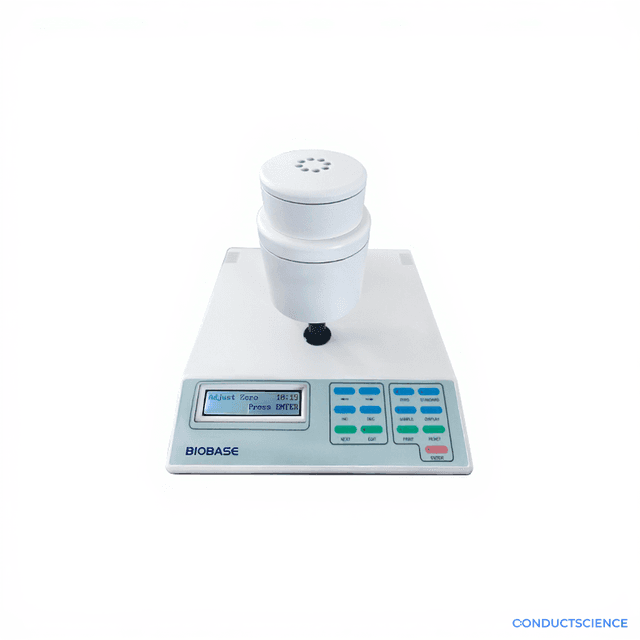
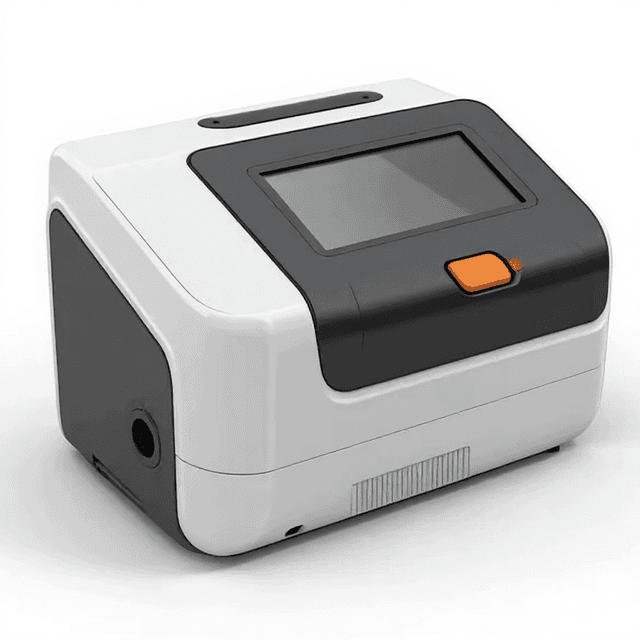
Spectrophotometric Colorimeter
Precision spectrophotometric colorimeter with d/8 geometry, 400-700nm wavelength range, and comprehensive color space analysis for standardized color measurement in research applications.

Louise Corscadden, PhD
Director of Science · ConductScience
Ask Louise about Spectrophotometric Colorimeter fit, setup, configuration, or quote prep.
Already working with us? Sign in to connect this with My Scientist.
Key Specifications
Full details →- Model fit
- Configured during quote
- SKU family
- BIO-0468
- Shipping box
- 23.0 x 9.0 x 7.7 cm
- Ordering
- Online checkout and quote request available
- Category
- Analytical Instruments
- Build notes
- Confirm accessories, station layout, and support needs before purchase
The Spectrophotometric Colorimeter (BIO-0468) provides precise color measurement and analysis for research applications requiring accurate colorimetric data. This benchtop instrument utilizes a d/8 illumination geometry with combined LED sources and a silicon photodiode array to measure color parameters across the visible spectrum (400-700nm). The system delivers rapid 1.5-second measurements with high inter-instrument agreement within ΔE*ab 0.2.
Equipped with a φ58mm integrating sphere and φ8mm measuring aperture, the colorimeter supports multiple color spaces including CIE LAB, XYZ, Yxy, and LCh, along with comprehensive color difference formulas (ΔE*ab, ΔE*94, ΔE*00, and others). The instrument accommodates various illuminant conditions (D65, A, C, F-series) and observer angles (2°/10°) for standardized color evaluation protocols.
How It Works
The colorimeter operates on the principle of tristimulus colorimetry, measuring how samples reflect light across the visible spectrum. Combined LED sources provide stable, broad-spectrum illumination that enters a φ58mm integrating sphere, creating diffuse d/8 geometry illumination as specified by CIE standards. The sample is illuminated at all angles while measurement occurs at 8 degrees from normal, eliminating directional effects and surface texture influences.
Reflected light from the φ8mm measurement aperture is dispersed and detected by a silicon photodiode array across 31 wavelengths from 400-700nm at 10nm intervals. The system calculates tristimulus values (X, Y, Z) based on CIE standard observer functions and converts these to various color spaces including LAB, LCh, and Yxy coordinates. Multiple illuminant conditions can be applied mathematically to simulate different viewing environments without changing the physical light source.
Features & Benefits
Automation Level
- semi-automated
Illumination/Observation System
- d/8(diffused illumination, 8-degree viewing angle) Conforms to CIE No.15, GB/T 3978
Integrating Sphere Size
- φ58mm
Light Source
- Combined LED sources
Sensor
- Silicon photodiode array
Wavelength Range
- 400~700nm
Wavelength Pitch
- 10nm
Reflectance Range
- 0~200%
Measuring Aperture
- φ8mm
Color Space
- CIE LAB, XYZ, Yxy, LCh, CIE, LUV
Color Difference Formula
- ΔE*ab, ΔE*uv, ΔE*94, ΔE*cmc(2:1), ΔE*cmc(1:1), ΔE*00
Observer
- 2°/10°
Illuminant
- D65, D50, A, C, D55, D75, F1, F2(CWF), F3, F4, F5, F6, F7(DLF), F8, F9, F10(TPL5), F11(TL84), F12(TL
Measurement Time
- 1.5s
Inter Instrument Agreement
- Within ΔE*ab 0.2(Average for 12 BCRA Series II color tiles)
Brand
- ConductScience
Research Domain
- Analytical Chemistry
- Clinical Diagnostics
- Environmental Monitoring
- Food Science
- Materials Science
- Pharmaceutical QC
Shipping weight
- 3.0 lb
Shipping box
- L: 23.0 cm
- W: 9.0 cm
- H: 7.7 cm
| Feature | This Product | Typical Alternative | Advantage |
|---|---|---|---|
| Illumination Geometry | d/8 geometry with φ58mm integrating sphere conforming to CIE No.15 | Basic models may offer 45/0 geometry or smaller spheres | Eliminates surface texture effects and provides better measurement reproducibility for research applications |
| Wavelength Coverage | 400-700nm range with 10nm resolution across 31 data points | Entry-level instruments often use filtered measurements or limited wavelength points | Complete visible spectrum analysis enables detailed spectral characterization and metamerism detection |
| Color Difference Formulas | Six formulas including ΔE*ab, ΔE*94, ΔE*00, and CMC variants | Basic colorimeters typically offer 1-2 color difference calculations | Comprehensive analysis options allow selection of industry-appropriate metrics for different research applications |
| Illuminant Options | 12 illuminant conditions including D65, A, C, D55, D75, and F-series fluorescent sources | Standard models often limited to 2-4 illuminant conditions | Extensive illuminant selection enables thorough metamerism evaluation and lighting-specific color matching studies |
| Measurement Precision | Inter-instrument agreement within ΔE*ab 0.2 for BCRA standards | Basic instruments may have agreement specifications of 0.5-1.0 ΔE units | Higher precision supports multi-instrument studies and provides better data quality for research publications |
This colorimeter combines research-grade precision with comprehensive analytical capabilities, offering complete visible spectrum analysis, multiple standardized illuminant conditions, and advanced color difference calculations. The d/8 measurement geometry and high inter-instrument agreement make it suitable for demanding research applications requiring reproducible color data across different measurement conditions.
Practical Tips
Store white calibration standards in a clean, dry environment and handle only by the edges to maintain surface cleanliness between calibrations.
Why: Contaminated calibration standards introduce systematic errors that affect all subsequent measurements.
Clean the measurement aperture and integrating sphere with a soft, dry brush or compressed air to remove dust accumulation.
Why: Dust on optical surfaces can cause measurement drift and reduce precision over time.
Allow the instrument to warm up for the recommended time before calibration and take multiple readings of each sample for statistical analysis.
Why: LED source stability improves with warm-up time, and multiple measurements provide better precision estimates.
Monitor calibration verification measurements over time to identify trends that may indicate component aging or environmental changes.
Why: Systematic tracking of calibration standards helps identify when service or recalibration may be needed.
If measurements appear unstable, check that samples are flat against the measurement port and that ambient lighting is not entering the measurement area.
Why: Light leaks or poor sample contact can cause measurement variations that appear as sample color changes.
Document illuminant and observer settings used for each measurement series to ensure consistency in longitudinal studies.
Why: Color values are dependent on measurement conditions, and consistent settings are essential for meaningful comparisons.
Avoid looking directly into the measurement aperture when the instrument is operating, as LED sources can be bright.
Why: Direct viewing of measurement illumination can cause temporary vision effects or discomfort.
Setup Guide
What’s in the Box
- Spectrophotometric Colorimeter main unit
- Power adapter (typical)
- White calibration standard (typical)
- Black calibration trap (typical)
- USB cable for data transfer (typical)
- User manual and software CD (typical)
- Calibration certificate (typical)
Warranty
ConductScience provides a comprehensive 1-year manufacturer warranty covering parts and labor, with technical support for calibration procedures and measurement protocols.
Compliance
What calibration standards are required for accurate color measurements?
The instrument requires white and black calibration standards. White calibration uses certified reflectance standards (typically BCRA or NIST-traceable tiles), while black calibration uses a light trap or closed aperture. Calibration should be performed before each measurement session and verified periodically with certified color tiles.
How does the d/8 geometry compare to other measurement configurations?
The d/8 geometry provides diffuse illumination at all angles with 8-degree viewing, eliminating surface texture effects that can affect measurements in directional geometries. This makes it ideal for textured or non-uniform samples compared to 45/0 geometry, though it may not reveal surface effects that are visible to the human eye.
Which color difference formula should be used for different applications?
ΔE*ab is most widely used for general applications, ΔE*94 provides better correlation with visual assessment for textiles, ΔE*00 offers the most advanced perceptual uniformity, and CMC formulas are preferred for specific industries. The choice depends on your field's accepted standards and the level of visual correlation required.
How do I select the appropriate illuminant for my measurements?
D65 simulates average daylight and is most common for general applications. A represents incandescent lighting, while F-series illuminants simulate various fluorescent sources. Choose the illuminant that best matches your samples' end-use viewing conditions, or measure under multiple illuminants to assess metamerism.
What sample preparation is required for consistent measurements?
Samples should have a flat surface larger than the 8mm aperture, be clean and dry, and positioned consistently against the measurement port. For powders or liquids, use appropriate sample holders to maintain consistent sample thickness and surface condition. Avoid samples with fluorescent properties under standard measurement conditions.
How often should the instrument be recalibrated?
Perform calibration before each measurement session and verify with certified standards. For critical applications, check calibration every few hours during extended measurement campaigns. The LED sources provide good stability, but environmental changes in temperature and humidity may require more frequent calibration verification.
What data output formats are available for integration with laboratory systems?
Consult the product datasheet for specific data export formats and software compatibility. Most colorimeters provide data in standard formats compatible with color management software and statistical analysis packages.
How does measurement repeatability compare to other colorimeter technologies?
The instrument achieves inter-instrument agreement within ΔE*ab 0.2 based on BCRA standards. Short-term repeatability is typically better than 0.1 ΔE*ab units. Silicon photodiode arrays generally provide better long-term stability than photomultiplier tube systems but consult specifications for detailed precision data.
Have a question about this product?
Have a question? Just ask.
Send it over and we'll email you a personalized answer — no call, no scheduling.
Prefer to talk it through?