Square-Loop Droplet Generator Chip
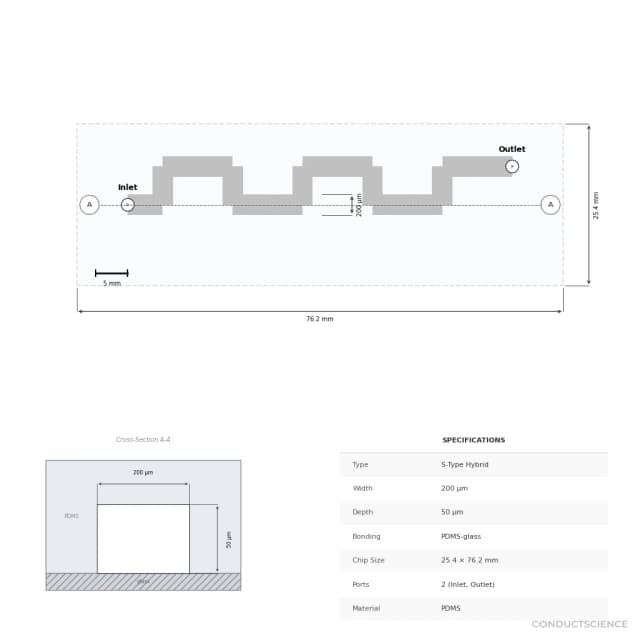
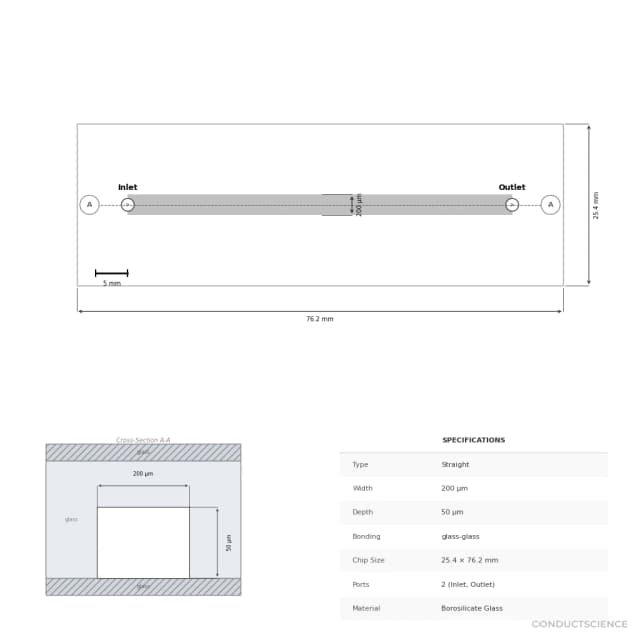
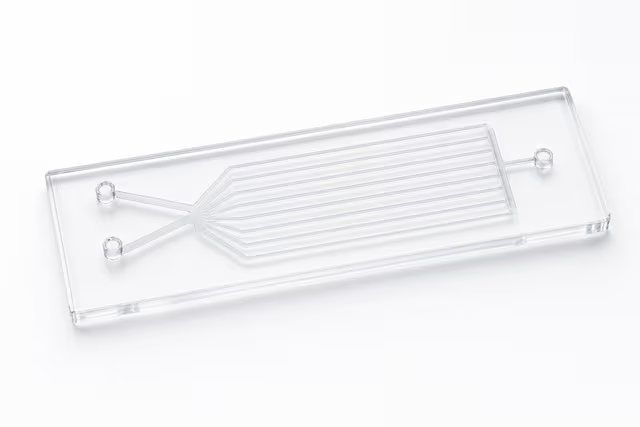
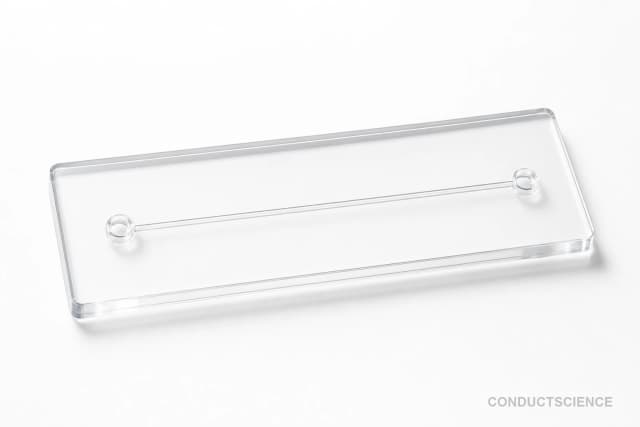
PDMS microfluidic chip with 100 x 100 μm square channels in square-loop geometry for controlled droplet generation and enhanced flow recirculation.
Reusable chip — designed for multiple experimental runs. Compatible with standard microfluidic tubing: steel pins (0.7 mm ID / 1.0 mm OD) and silicone tubing (0.8 mm ID / 1.9 mm OD). Available in bulk packs (5‑, 10‑, and 25‑unit) for lab-scale and consumable workflows.

Louise Corscadden, PhD
Director of Science · ConductScience
Ask Louise about Square-Loop Droplet Generator Chip fit, setup, configuration, or quote prep.
Already working with us? Sign in to connect this with My Scientist.
Key Specifications
Full details →- Model fit
- 3 selectable configurations
- SKU family
- WHM-0096
- Shipping box
- 181.8 x 136.3 x 90.9 cm
- Ordering
- Online checkout and quote request available
- Category
- Droplet Generator Chips
- Build notes
- Confirm accessories, station layout, and support needs before purchase
The Square-Loop Droplet Generator Chip is a PDMS-based microfluidic device designed for controlled droplet formation in microfluidic applications. The chip features 100 x 100 μm square channels arranged in a square-loop recirculation geometry, providing enhanced flow control and mixing characteristics compared to conventional straight-channel designs.
The square-loop configuration creates recirculation zones that improve droplet formation consistency and enable better control over droplet size distribution. This geometry is particularly valuable for applications requiring monodisperse droplets or encapsulation of sensitive materials, as the recirculating flow patterns reduce shear stress while maintaining precise droplet breakoff.
How It Works
The square-loop droplet generator operates on flow-focusing principles combined with geometric flow manipulation. Two immiscible fluids - a continuous phase and dispersed phase - are introduced at separate inlets. The dispersed phase flows through the central channel while the continuous phase surrounds it at the junction.
The square-loop geometry creates recirculation zones that modify the local flow field around the droplet formation point. These recirculation patterns enhance mixing of the continuous phase and provide more uniform shear conditions, resulting in improved droplet size consistency. The 100 x 100 μm square cross-section maintains constant hydraulic diameter while the sharp corners create secondary flows that further stabilize the droplet breakoff process.
Droplet size is controlled by adjusting the flow rate ratio between continuous and dispersed phases, with the recirculation zones providing additional control over the breakoff frequency and droplet formation dynamics.
Features & Benefits
Shipping weight
- 3.3 lb
Shipping box
- L: 181.8 cm
- W: 136.3 cm
- H: 90.9 cm
| Feature | This Product | Typical Alternative | Advantage |
|---|---|---|---|
| Channel Geometry | Square-loop recirculation design with 100 x 100 μm channels | Simple T-junction or Y-junction configurations without recirculation zones | Provides enhanced mixing and more uniform droplet formation through controlled flow recirculation |
| Channel Cross-Section | Square 100 x 100 μm channels | Circular or rectangular channels with varying aspect ratios | Square geometry offers uniform hydraulic diameter and predictable pressure drop characteristics |
| Material Construction | PDMS polymer | Glass or other polymer materials | Combines optical transparency, biocompatibility, and cost-effectiveness for routine applications |
| Flow Control Features | Integrated recirculation zones for enhanced mixing | Basic flow-focusing without specialized mixing features | Improves droplet size uniformity and reduces formation instabilities |
This chip combines the advantages of PDMS construction with an innovative square-loop geometry that enhances droplet formation control. The 100 x 100 μm channels provide optimal sizing for most microencapsulation applications while the recirculation design improves consistency over conventional geometries.
| Model | SKU | Listed price | Status | Shipping box |
|---|---|---|---|---|
| 25-Pack | WHM-0096-25PK | Quote | Available | 181.8 x 136.3 x 90.9 cm |
| 10-Pack | WHM-0096-10PK | $1,490.00 | Available | 181.8 x 136.3 x 90.9 cm |
| 5-Pack | WHM-0096-5PK | Quote | Available | 181.8 x 136.3 x 90.9 cm |
Practical Tips
Pre-wet channels with continuous phase before introducing dispersed phase to ensure stable wetting conditions.
Why: Proper wetting prevents irregular droplet formation and channel blockages during startup.
Calibrate droplet size measurements using known microsphere standards under identical flow conditions.
Why: Ensures accurate size measurements and validates system performance for quantitative studies.
Store chips in clean, dry conditions and avoid prolonged exposure to organic solvents that may swell PDMS.
Why: Prevents channel deformation and maintains consistent hydraulic properties over multiple uses.
If droplets become irregular, check for air bubbles in fluid lines and verify pressure balance between inlets.
Why: Air bubbles and pressure imbalances are common causes of droplet formation instability.
Allow system to reach steady-state for at least 10 droplet formation cycles before collecting data.
Why: Initial transient effects can skew droplet size measurements and formation frequency data.
Use appropriate chemical-resistant tubing when working with organic solvents or harsh chemicals.
Why: Prevents contamination and ensures safe handling of potentially hazardous fluids.
Setup Guide
What’s in the Box
- Square-loop droplet generator chip (typical)
- User manual with flow rate recommendations (typical)
- Quality control certificate (typical)
Warranty
ConductScience provides a standard 1-year manufacturer warranty covering defects in materials and workmanship. Technical support is available for setup optimization and troubleshooting.
Compliance
What flow rate ranges work best with the 100 x 100 μm channels?
Optimal flow rates typically range from 0.1-10 μL/min for the dispersed phase and 1-50 μL/min for the continuous phase, depending on fluid viscosities and desired droplet size. Start with low rates and optimize based on droplet formation stability.
How does the square-loop geometry affect droplet formation compared to T-junctions?
The recirculation zones in the square-loop design provide more uniform shear conditions and enhanced mixing, typically resulting in improved droplet size consistency and reduced polydispersity compared to simple T-junction geometries.
What cleaning protocols are recommended between different sample types?
Flush with appropriate solvent (isopropanol for most applications), followed by deionized water and air drying. For protein or cell samples, use 10% bleach solution followed by extensive water rinsing.
Can this chip handle high-viscosity dispersed phases?
Yes, but higher viscosity fluids may require increased pressure or modified flow rate ratios. The square geometry provides better pressure distribution than circular channels for viscous fluids.
What microscopy setup is needed for droplet monitoring?
A standard inverted microscope with 10-40x objectives is sufficient. High-speed cameras are recommended for detailed droplet formation dynamics studies.
How long can PDMS chips be stored before use?
PDMS chips should be used within 6 months of manufacture when stored in clean, dry conditions. Extended storage may affect surface properties and wetting characteristics.
Have a question about this product?
Have a question? Just ask.
Send it over and we'll email you a personalized answer — no call, no scheduling.
Prefer to talk it through?