Capillary Electrophoresis Microfluidic Chip
Precision microfluidic chip for capillary electrophoresis separation of proteins and DNA with configurable channel depths and cross-channel geometry for optimized biomolecule analysis.
Reusable chip — designed for multiple experimental runs. Compatible with standard microfluidic tubing: steel pins (0.7 mm ID / 1.0 mm OD) and silicone tubing (0.8 mm ID / 1.9 mm OD). Available in bulk packs (5‑, 10‑, and 25‑unit) for lab-scale and consumable workflows.

Louise Corscadden, PhD
Director of Science · ConductScience
Ask Louise about Capillary Electrophoresis Microfluidic Chip fit, setup, configuration, or quote prep.
Already working with us? Sign in to connect this with My Scientist.
Key Specifications
Full details →- Model fit
- 3 selectable configurations
- SKU family
- WHM-0024
- Shipping box
- 25.0 x 15.0 x 3.0 cm
- Ordering
- Online checkout and quote request available
- Category
- Lab Equipment
- Build notes
- Confirm accessories, station layout, and support needs before purchase
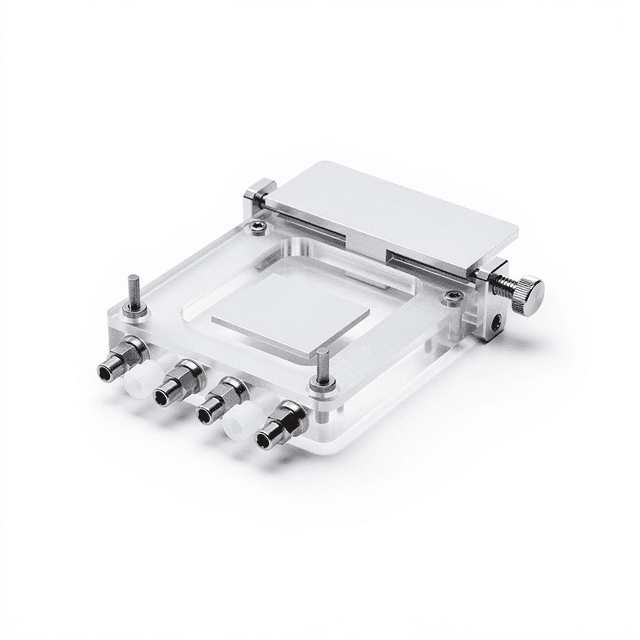
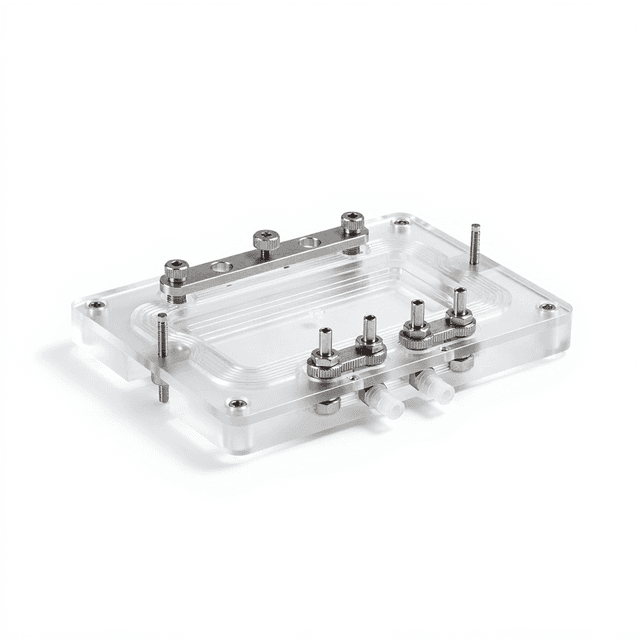
The Capillary Electrophoresis Microfluidic Chip is a precision-fabricated analytical platform designed for high-resolution separation of proteins, nucleic acids, and other biomolecules in microvolume samples. This cross-channel microfluidic device integrates sample injection, separation, and detection zones within a compact 25mm × 15mm format, enabling capillary electrophoresis analyses with minimal sample consumption and reduced separation times compared to conventional capillary systems.
The chip features configurable channel depths of 100, 200, or 500 micrometers, allowing researchers to optimize separation conditions for specific analyte classes and molecular weight ranges. The cross-channel geometry provides reliable sample introduction and precise electrokinetic control, supporting both protein characterization workflows and DNA fragment analysis applications where high separation efficiency and reproducible migration times are essential.
How It Works
Capillary electrophoresis separation occurs through differential migration of charged molecules under an applied electric field within the microfluidic channels. The cross-channel design incorporates a sample reservoir, buffer reservoirs, and a separation channel with integrated electrodes for voltage application. Samples are introduced electrokinetically by applying a brief voltage pulse that drives analytes from the sample reservoir into the separation channel.
During separation, molecules migrate according to their charge-to-size ratio, with smaller, highly charged species moving faster than larger or less charged analytes. The configurable channel depth allows optimization of electric field strength and heat dissipation, enabling researchers to adjust resolution and separation time based on analyte properties. Detection typically occurs near the channel outlet using optical, electrochemical, or mass spectrometric methods.
The microfluidic format provides several advantages including reduced Joule heating due to efficient heat dissipation, minimal sample dispersion from short diffusion distances, and the ability to integrate multiple analytical functions on a single platform for automated sample processing workflows.
Features & Benefits
Shipping weight
- 0.03 lb
Shipping box
- L: 25.0 cm
- W: 15.0 cm
- H: 3.0 cm
| Feature | This Product | Typical Alternative | Advantage |
|---|---|---|---|
| Channel Depth Options | Three selectable depths: 100, 200, and 500 μm | Fixed channel dimensions with limited optimization capability | Allows researchers to optimize separation conditions for specific analyte size ranges and resolution requirements. |
| Chip Dimensions | Compact 25mm × 15mm format | Larger chip formats requiring more reagents and bench space | Reduces buffer consumption and enables integration with standard microscopy platforms for detection. |
| Application Range | Dual capability for protein and DNA separation | Application-specific chips optimized for single analyte types | Provides analytical flexibility for laboratories working with diverse biomolecular samples. |
| Channel Geometry | Cross-channel design with integrated injection zone | Linear channel designs requiring external injection systems | Enables precise sample introduction and reproducible separation conditions through electrokinetic focusing. |
| Weight and Portability | Ultra-lightweight at 0.03 kg | Heavier chip assemblies or mounting systems | Facilitates easy handling and reduces mechanical stress on positioning systems during operation. |
This microfluidic chip distinguishes itself through configurable channel depths that allow optimization for different analyte classes, a compact format that minimizes reagent usage, and cross-channel geometry that provides precise sample introduction. The dual application capability for both protein and DNA analysis offers analytical versatility in a single platform.
| Model | SKU | Listed price | Status | Shipping box |
|---|---|---|---|---|
| 25-Pack | WHM-0024-25PK | Quote | Available | 25.0 x 15.0 x 3.0 cm |
| 10-Pack | WHM-0024-10PK | $1,490.00 | Available | 25.0 x 15.0 x 3.0 cm |
| 5-Pack | WHM-0024-5PK | Quote | Available | 25.0 x 15.0 x 3.0 cm |
Practical Tips
Condition new chips by filling with separation buffer and applying 50% of operating voltage for 10-15 minutes before first use.
Why: Channel conditioning stabilizes surface charges and removes manufacturing residues for reproducible separations.
Flush channels with distilled water followed by storage buffer between extended periods of non-use.
Why: Prevents salt crystallization and protein adsorption that can block channels and degrade performance.
Use protein or DNA ladder standards to verify migration time reproducibility and establish retention time windows for unknowns.
Why: Migration time calibration ensures accurate molecular weight determination and validates separation performance.
If current drops during separation, check for air bubbles in electrode reservoirs and verify electrical connections.
Why: Air bubbles interrupt electrical continuity and can cause separation artifacts or complete system failure.
Monitor baseline stability and peak symmetry to assess channel condition and separation quality.
Why: Peak distortion indicates channel degradation, buffer depletion, or suboptimal voltage conditions requiring correction.
Always disconnect power before handling the chip or changing buffer solutions to prevent electrical shock.
Why: High voltage electrophoresis systems pose electrical hazards during operation and require proper safety protocols.
Select channel depth based on analyte size and required resolution, using deeper channels for larger molecules or higher sample loading.
Why: Channel depth optimization balances separation resolution against analysis time and sample loading capacity.
Setup Guide
What’s in the Box
- Capillary electrophoresis microfluidic chip
- Protective storage case
- Installation guide
- Technical specifications sheet
- Quality certificate (typical)
Warranty
ConductScience provides a standard 1-year manufacturer warranty covering fabrication defects and materials quality, with technical support for integration and optimization guidance.
Compliance
References
Background reading relevant to this product:
What buffer systems are compatible with the microfluidic channels?
Standard capillary electrophoresis buffers including Tris-glycine, bis-tris, and phosphate systems are compatible. Consult product datasheet for pH range and ionic strength recommendations for optimal separation performance.
How do I select the appropriate channel depth for my application?
Use 100 μm channels for small molecules and peptides requiring high resolution, 200 μm for general protein analysis, and 500 μm for larger protein complexes or when higher sample loading is needed.
What detection methods can be integrated with this chip?
The chip supports UV-Vis absorbance, fluorescence, electrochemical, and mass spectrometric detection methods. Detection zone positioning allows integration with standard microscope-based systems.
What is the typical sample volume requirement?
Sample volumes typically range from 1-10 μL depending on the injection protocol and channel depth selected. Consult application notes for volume optimization guidance.
How many analyses can be performed with one chip?
Chip lifetime depends on sample type and cleaning protocols. Typical usage ranges from 50-200 analyses with proper buffer management and channel conditioning between runs.
What voltage ranges are recommended for separation?
Optimal separation voltages typically range from 500-2000 V depending on channel depth and buffer conditions. Higher voltages may be used for faster separations but require careful thermal management.
How does this compare to traditional capillary electrophoresis systems?
The microfluidic format offers faster separations, lower sample consumption, and better thermal management compared to fused silica capillaries, with the trade-off of shorter effective separation lengths.
Have a question about this product?
Have a question? Just ask.
Send it over and we'll email you a personalized answer — no call, no scheduling.
Prefer to talk it through?
Accessories
Enhance your setup with compatible accessories
Frequently Bought Together