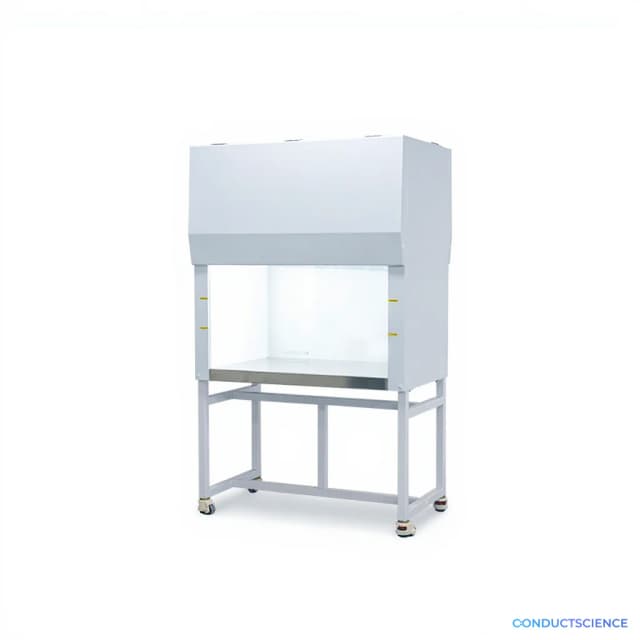
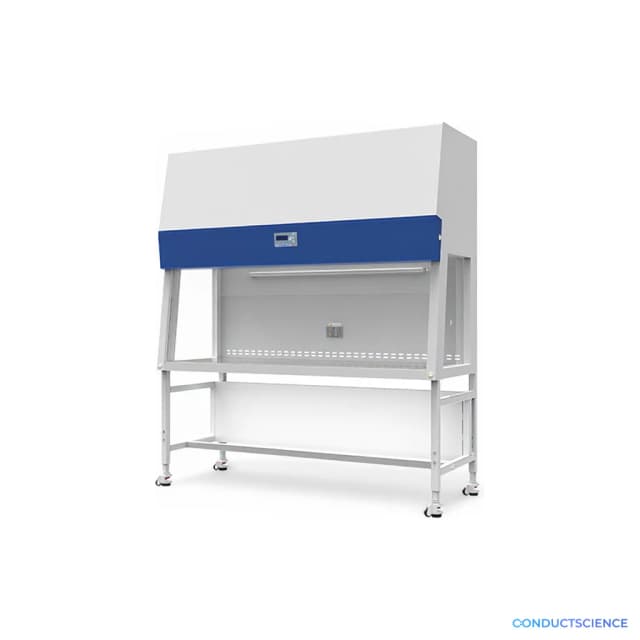
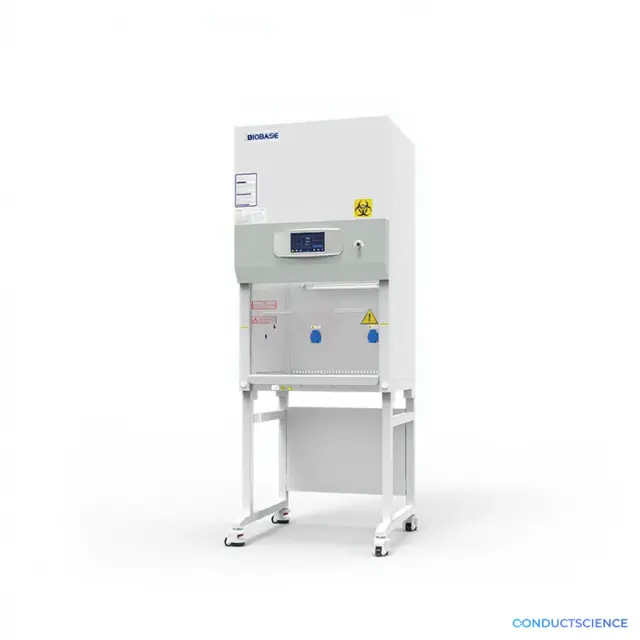
Vertical Laminar Flow Cabinet
Vertical laminar flow cabinet providing ISO Class 5 clean air environment for laboratory applications requiring contamination control and sterile working conditions.
| Automation Level | manual |

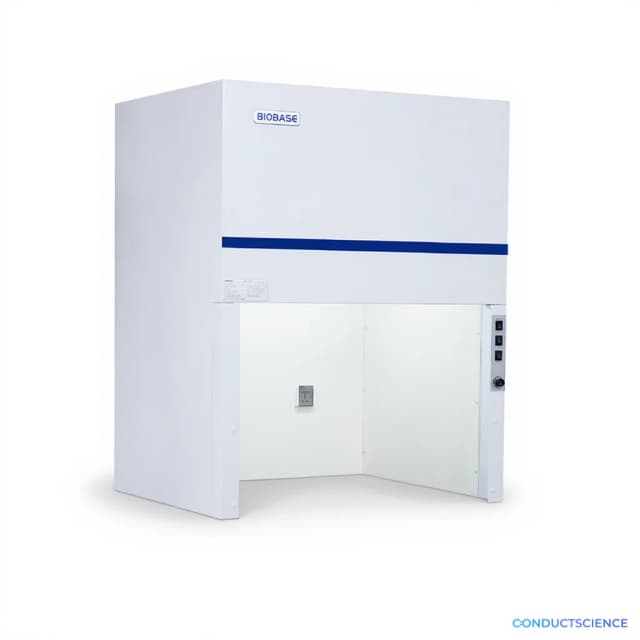
The Vertical Laminar Flow Cabinet provides a controlled clean air environment for laboratory applications requiring protection from airborne contamination. This unit employs vertical downflow air filtration to create an ISO Class 5 (Class 100) work environment, making it suitable for sample preparation, tissue culture work, and other procedures requiring particulate-free conditions.
The cabinet features a compact design with dimensions of 204 cm length × 130 cm width × 75 cm height, providing adequate workspace while maintaining efficient airflow patterns. The vertical laminar flow configuration directs HEPA-filtered air downward across the work surface, creating a uniform clean zone that minimizes turbulence and cross-contamination risks.
How It Works
The vertical laminar flow cabinet operates on the principle of unidirectional airflow to create a sterile work environment. Ambient air is drawn into the system through pre-filters and then passed through high-efficiency particulate air (HEPA) filters that remove 99.97% of particles 0.3 micrometers and larger. The filtered air is then directed vertically downward across the work surface in a uniform laminar flow pattern.
The vertical airflow configuration provides product protection by creating a positive pressure environment that prevents contaminated air from entering the work zone. The continuous downward flow of clean air sweeps away particles generated within the cabinet and maintains the sterile field. Air velocities are typically maintained at 0.45 ± 0.05 m/s to ensure effective particulate removal while minimizing turbulence.
The cabinet design includes an open front for operator access while maintaining containment through careful airflow management. The work surface and interior walls are constructed from materials that can be easily cleaned and disinfected to maintain sterility between uses.
Features & Benefits
Automation Level
- manual
Research Domain
- Analytical Chemistry
- Cell Biology
- Environmental Monitoring
- Food Science
- Microbiology
- Pharmaceutical QC
Weight
- 228.0 kg
Dimensions
- L: 204.0 mm
- W: 130.0 mm
- H: 75.0 mm
Comparison Guide
| Feature | This Product | Typical Alternative | Advantage |
|---|---|---|---|
| Cabinet Dimensions | 204 × 130 × 75 cm work area | Compact models often provide smaller work surfaces | Larger work surface accommodates multiple samples and equipment simultaneously |
| Airflow Design | Vertical laminar flow configuration | Some models use horizontal flow patterns | Vertical flow provides better product protection by sweeping contaminants away from work area |
| Construction Weight | 228 kg shipping weight | Lighter units may have less stable construction | Robust construction provides stability and reduced vibration during operation |
| Access Design | Open front configuration | Some models include sash windows or restricted access | Unrestricted access allows handling of larger equipment and samples |
This vertical laminar flow cabinet offers a spacious 204×130 cm work area with robust construction and open-front design. The vertical airflow configuration and substantial build quality provide reliable contamination control for demanding laboratory applications.
Practical Tips
Verify airflow velocity at nine points across the work surface during initial setup and after filter changes.
Why: Uniform airflow is critical for maintaining sterile conditions throughout the work area.
Clean interior surfaces with 70% isopropanol before each use and perform deep cleaning weekly.
Why: Regular cleaning prevents biofilm formation and maintains sterile working conditions.
Allow 15-30 minutes for airflow stabilization after powering on before beginning sterile work.
Why: Airflow patterns need time to establish uniform velocity and direction across the work surface.
Position materials and equipment to avoid blocking airflow paths or creating turbulence.
Why: Obstructed airflow can create dead zones where contaminants may accumulate.
Check for visible damage to HEPA filter pleats if airflow velocity decreases unexpectedly.
Why: Physical damage to filters compromises filtration efficiency and air cleanliness.
Never use with volatile solvents or hazardous chemicals as the cabinet provides no containment protection.
Why: Open-front design allows chemical vapors to escape into the laboratory environment.
Document airflow measurements and cleaning procedures in facility logbooks for compliance tracking.
Why: Regulatory environments often require documented evidence of equipment performance and maintenance.
Setup Guide
What’s in the Box
- Vertical laminar flow cabinet main unit (typical)
- HEPA filter assembly (typical)
- Power cord and electrical components (typical)
- User manual and operation instructions (typical)
- Airflow certification documentation (typical)
- Cleaning and maintenance materials (typical)
Warranty
ConductScience provides a standard one-year manufacturer warranty covering parts and technical support. Extended service plans and on-site maintenance programs are available for facilities requiring ongoing certification and validation.
Compliance
What air cleanliness class does this cabinet achieve?
The vertical laminar flow design with HEPA filtration provides ISO Class 5 (Class 100) air cleanliness, removing 99.97% of particles 0.3 micrometers and larger.
How often should HEPA filters be replaced?
HEPA filter replacement intervals depend on usage frequency and environmental conditions, typically ranging from 12-24 months. Monitor pressure differential across filters and replace when airflow velocity drops below specifications.
What type of work can be performed in this cabinet?
Suitable for procedures requiring product protection such as media preparation, sample handling, and sterile manipulations. Not appropriate for work with hazardous chemicals or infectious agents requiring containment.
Does the cabinet require special electrical connections?
Consult product datasheet for specific voltage and amperage requirements. Most units require standard laboratory electrical service with proper grounding.
How is airflow performance verified?
Airflow velocity should be measured at multiple points across the work surface using calibrated anemometer. Typical specifications require 0.45 ± 0.05 m/s uniform vertical flow.
What maintenance is required besides filter replacement?
Regular cleaning of interior surfaces, verification of airflow patterns, and annual certification by qualified technicians to maintain performance specifications.
Have a question about this product?
Accessories
Enhance your setup with compatible accessories
Replacement Parts & Consumables
Frequently Bought Together
Upgrade Options