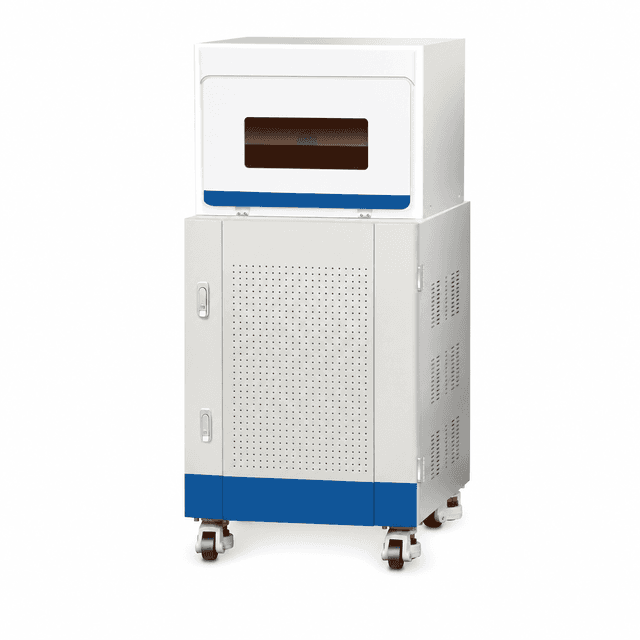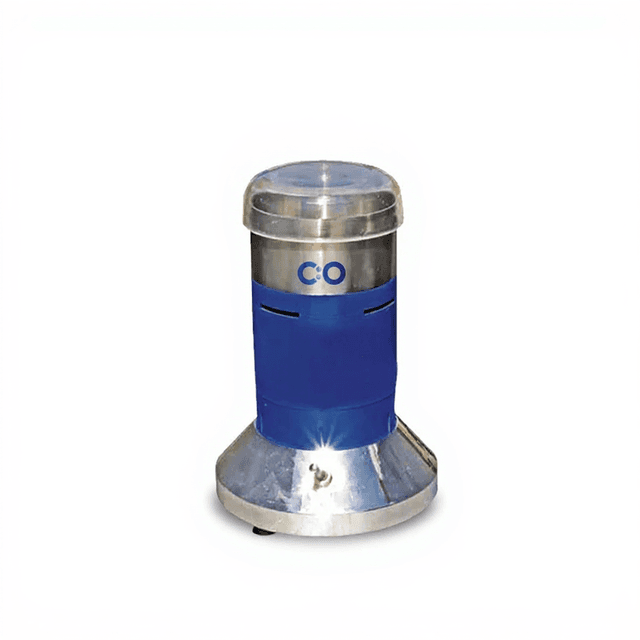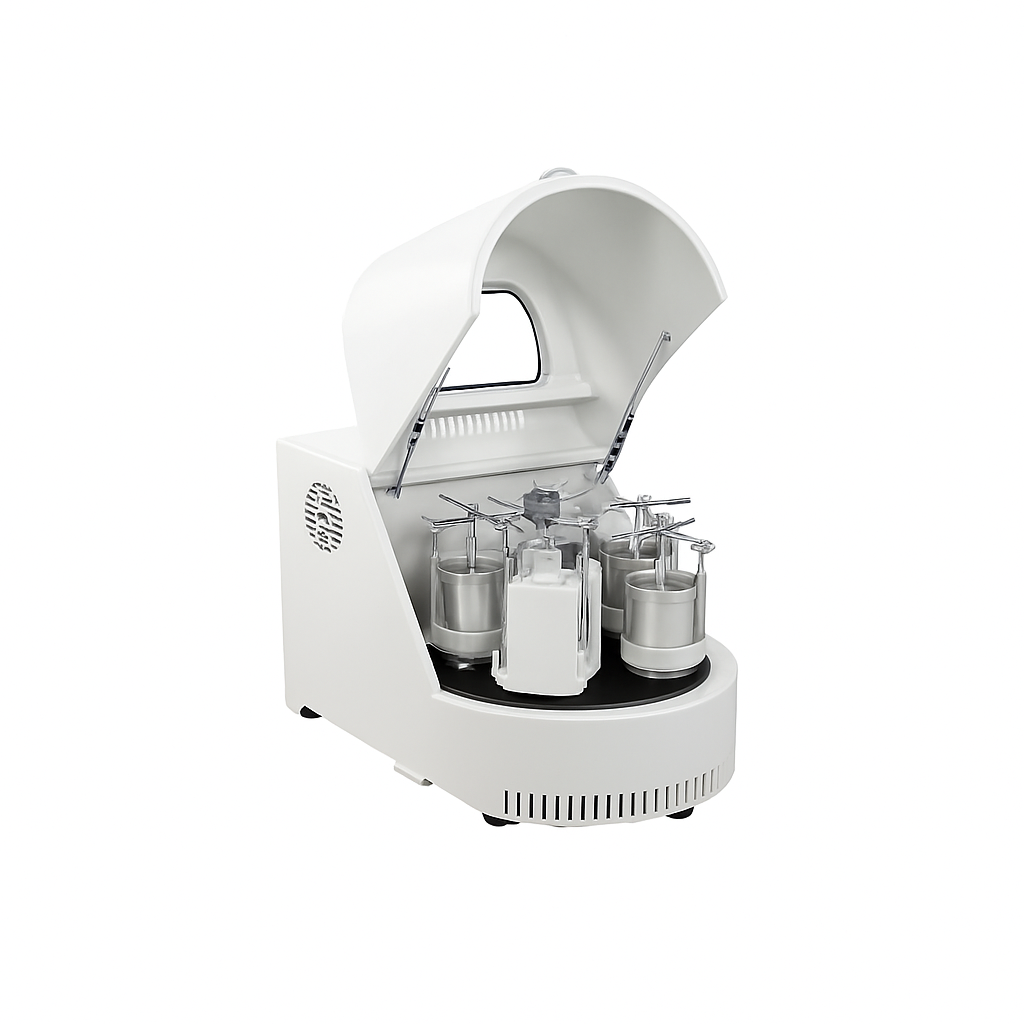
Vertical Planetary Ball Mill(Semi-circle Type)
Vertical planetary ball mill with semi-circle 3D curve chassis design and low-noise gear transmission.
Two models: 0.4 L (4 × 50–100 mL pots) and 2 L (4 × 50–500 mL pots). Minimum output 0.1 µm; dry and wet grinding; frequency-converter speed control.

Louise Corscadden, PhD
Director of Science · ConductScience
Ask Louise about Vertical Planetary Ball Mill(Semi-circle Type) fit, setup, configuration, or quote prep.
Already working with us? Sign in to connect this with My Scientist.
Key Specifications
Full details →- Model fit
- Configured during quote
- SKU family
- BIO-0661
- Shipping box
- 42.0 x 43.6 x 38.0 cm
- Ordering
- Online checkout and quote request available
- Category
- Solid Processing
- Build notes
- Confirm accessories, station layout, and support needs before purchase
This vertical planetary ball mill uses a 3D curve semi-circle chassis with
low-noise special gearing. Four ball grinding tanks installed on a rotating turntable
undergo planetary movement — turntable rotation plus individual tank axis rotation —
creating high-speed impacts that grind materials to a minimum of 0.1 µm. Dry and wet
grinding methods are both supported, and a frequency converter provides stepless speed
regulation. Available in 0.4 L and 2 L total capacity configurations.
Technical Specifications
| Parameter | BKBM-V0.4 | BKBM-V2 |
|---|---|---|
| Total Capacity | 0.4 L | 2 L |
| Individual Pot Volume | 50–100 mL | 50–500 mL |
| Pot Quantity | 4 | 4 |
| Revolution Speed | 45–435 rpm | 35–335 rpm |
| Rotation Speed | 90–870 rpm | 70–670 rpm |
| Noise Level | 58 ±5 dB | 60 ±5 dB |
| Feed Size | Soft/crispy <10 mm; other <3 mm | |
| Output Granularity | Min 0.1 µm | |
| Power Consumption | 0.25 kW | 0.75 kW |
| Power Supply | AC 110/220 V ±10%, 50/60 Hz | |
| External Dimensions (W×D×H) | 530×300×340 mm | 750×470×565 mm |
| Net Weight | 29 kg | 80 kg |
| Gross Weight | 50 kg | 100 kg |
How It Works
The planetary ball mill operates through a dual-axis rotation system that generates complex three-dimensional motion patterns. The grinding bowls rotate around their individual axes while simultaneously revolving around the main central axis in the opposite direction. This planetary motion creates alternating centrifugal and centripetal forces that cause the grinding media (typically steel or ceramic balls) to impact the sample material with high kinetic energy.
The semi-circle bowl design optimizes the trajectory of grinding media movement, ensuring maximum impact frequency and energy transfer to the sample. As the bowls rotate, the grinding balls are pressed against the bowl wall by centrifugal force, then released to fall across the bowl diameter, creating high-energy collisions with the sample material. This process simultaneously reduces particle size through impact fracturing while promoting mixing through the complex motion patterns.
The combination of impact, friction, and shear forces generated by this motion enables effective size reduction from millimeter-scale starting materials to submicron particles, while the controlled atmosphere capability allows processing under inert conditions when required.
Features & Benefits
Automation Level
- semi-automated
Research Domain
- Analytical Chemistry
- Environmental Monitoring
- Food Science
- Materials Science
- Microbiology
- Pharmaceutical QC
Shipping weight
- 29.98 lb
Shipping box
- L: 42.0 cm
- W: 43.6 cm
- H: 38.0 cm
| Feature | This Product | Typical Alternative | Advantage |
|---|---|---|---|
| Bowl Design Configuration | Semi-circle bowl geometry for optimized grinding media trajectory | Standard cylindrical bowls are more common in entry-level models | Improved grinding efficiency and particle size uniformity through enhanced impact patterns and energy transfer. |
| Motion Mechanism | Dual-axis planetary rotation system with opposing bowl and sun wheel rotation | Single-axis or simpler planetary configurations in basic models | Generates higher impact forces and better mixing through complex three-dimensional motion patterns. |
| Safety Systems | Integrated safety interlock preventing operation with open chambers | Basic safety features or manual safety protocols | Enhanced operator protection during high-energy grinding operations with automatic safety monitoring. |
| Control System | Programmable operation cycles with automated timing control | Manual timing controls or basic preset programs | Enables reproducible processing conditions and consistent results across multiple samples and operators. |
This planetary ball mill combines semi-circle bowl geometry with dual-axis rotation and programmable controls to provide efficient size reduction capabilities. The design optimizes grinding efficiency while incorporating safety features suitable for laboratory environments.
Practical Tips
Start with shorter grinding times and lower speeds for new materials to assess sample behavior and prevent over-processing or contamination.
Why: Material properties vary significantly, and conservative initial parameters prevent sample degradation or equipment damage.
Inspect grinding bowls and media regularly for wear patterns and replace when significant material loss is observed.
Why: Worn components reduce grinding efficiency and can introduce contamination into processed samples.
Verify rotation speeds periodically using a tachometer to ensure motor performance remains within specifications.
Why: Accurate speed control is essential for reproducible results and consistent particle size distributions.
Allow adequate cooling time between grinding cycles, especially for heat-sensitive materials or extended processing times.
Why: High-energy grinding generates significant heat that can degrade samples or create safety hazards.
Document ball-to-sample ratios, grinding times, and speeds for each material type to establish reproducible protocols.
Why: Systematic parameter tracking enables optimization and ensures consistent results across multiple processing runs.
If grinding efficiency decreases, check for proper bowl alignment and secure mounting before adjusting processing parameters.
Why: Mechanical misalignment reduces energy transfer efficiency and can cause excessive vibration or equipment damage.
Use grinding media that are harder than the sample material but avoid excessive hardness differences to minimize contamination.
Why: Proper media selection balances grinding efficiency with contamination control for accurate analytical results.
Setup Guide
What’s in the Box
- Main mill unit (typical)
- Grinding bowls - stainless steel (typical)
- Grinding media set (typical)
- Safety interlock components (typical)
- Power cable (typical)
- User manual and operation guide (typical)
- Basic maintenance tools (typical)
Warranty
ConductScience provides a standard one-year manufacturer warranty covering parts and labor, with technical support available for operational questions and maintenance guidance.
Compliance
What ball-to-sample ratio should be used for optimal grinding efficiency?
The optimal ratio typically ranges from 5:1 to 20:1 (ball mass to sample mass) depending on material hardness and target particle size. Harder materials generally require higher ratios, while softer materials can be processed effectively with lower ratios.
How do I prevent contamination when processing different sample types?
Use dedicated grinding bowls and media for specific sample types, or implement thorough cleaning protocols between samples. Consider using grinding media of similar hardness to the sample to minimize contamination from media wear.
What factors determine the final particle size distribution?
Key factors include grinding time, rotation speed, ball size and material, sample properties, and ball-to-sample ratio. Longer grinding times and higher speeds generally produce finer particles, but may also increase contamination risk.
Can the mill handle temperature-sensitive materials?
The high-energy grinding process generates heat, which may affect temperature-sensitive samples. Consider using intermittent grinding cycles with cooling periods, or consult the manufacturer about cooling accessories for specific applications.
What maintenance is required for consistent performance?
Regular inspection of grinding bowls and media for wear, cleaning of all components between different sample types, and periodic lubrication of mechanical components according to the maintenance schedule in the user manual.
How does this compare to other size reduction methods?
Planetary ball milling provides more efficient size reduction than traditional ball mills due to the higher impact energies, and offers better mixing compared to jet mills or hammer mills, making it suitable for both brittle and ductile materials.
What safety considerations are important during operation?
Ensure proper bowl securing before operation, verify safety interlocks function correctly, avoid overfilling bowls, and allow adequate cooling time between cycles to prevent overheating of samples or equipment.
Have a question about this product?
Have a question? Just ask.
Send it over and we'll email you a personalized answer — no call, no scheduling.
Prefer to talk it through?