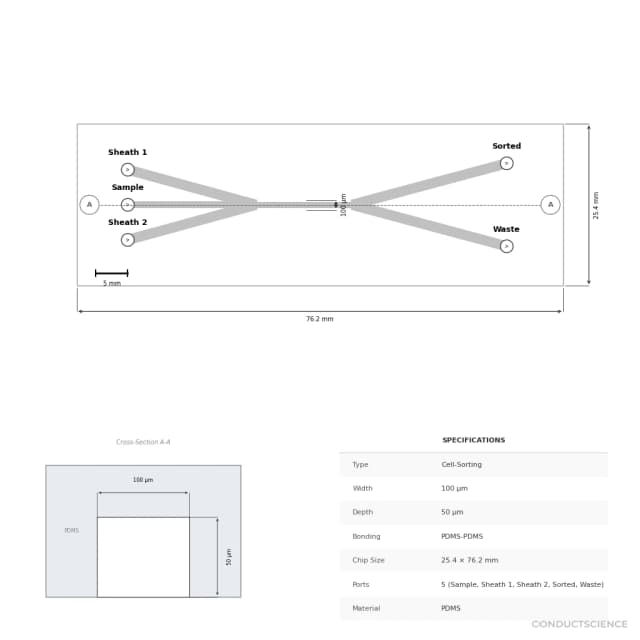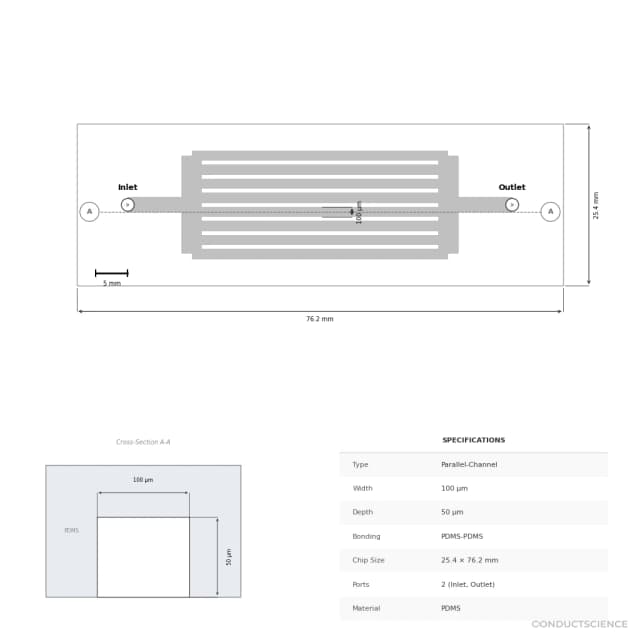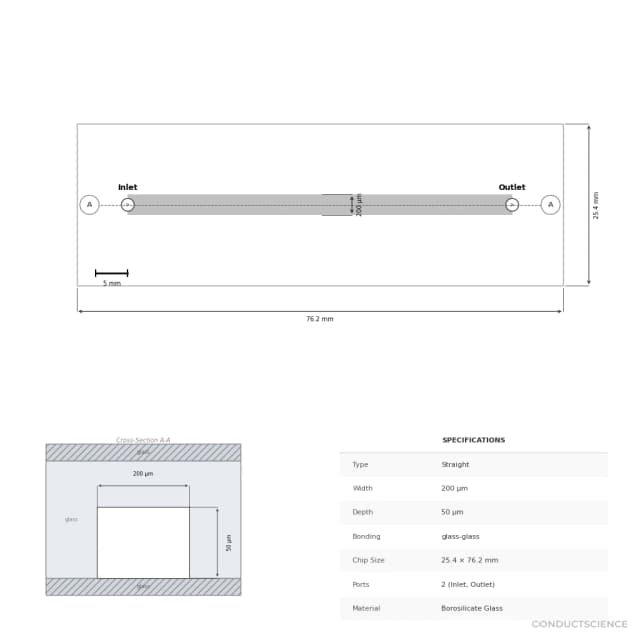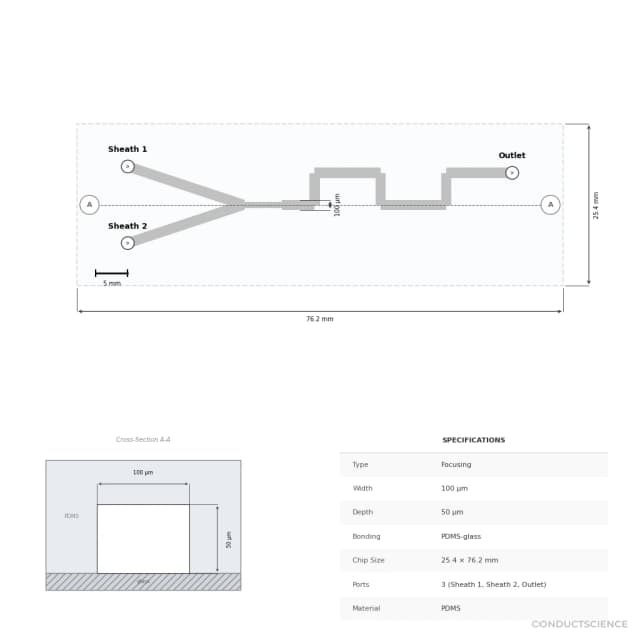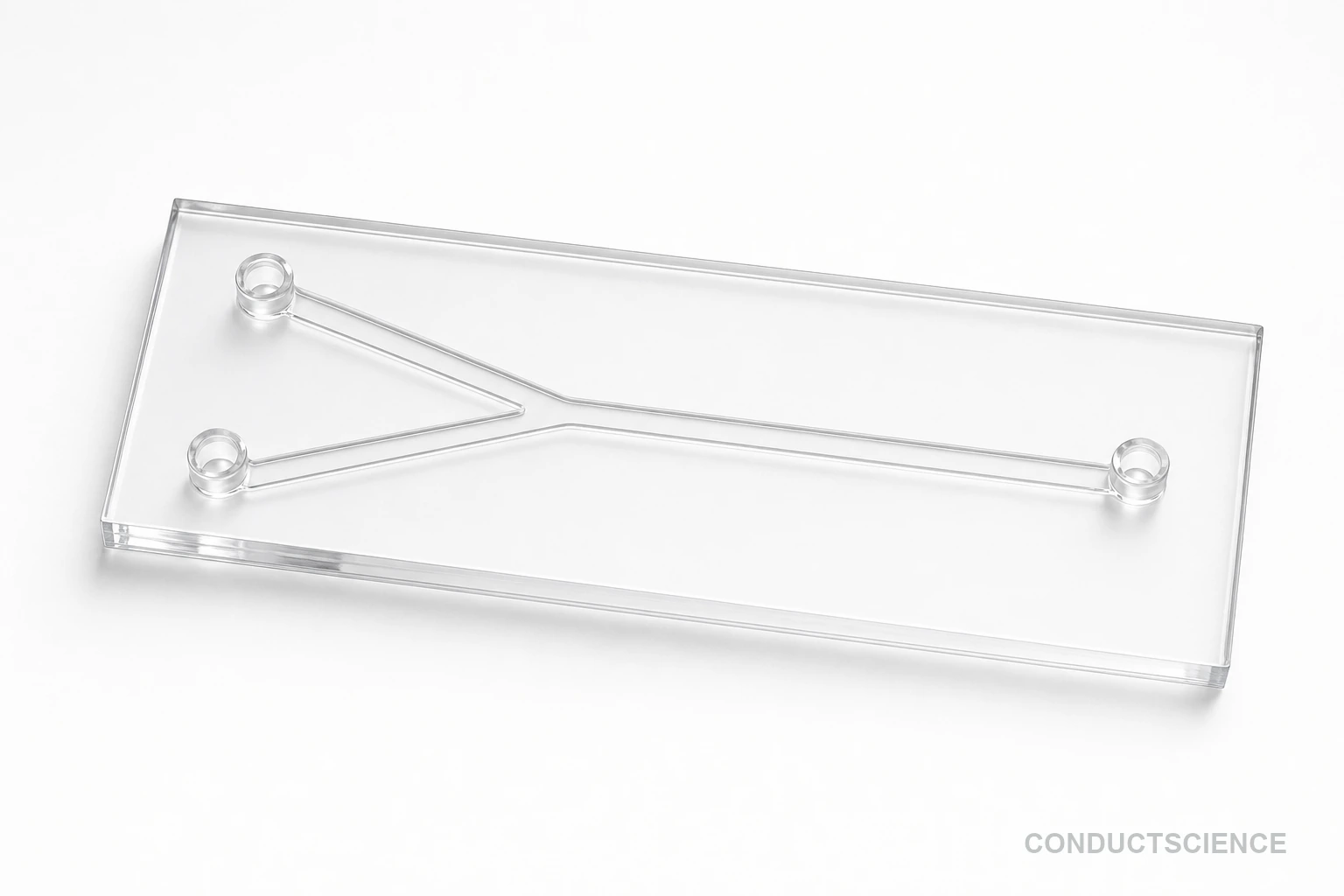
Y-Type Standard Channel Chip
Standard format microfluidic chip with Y-junction architecture for flow characterization and mixing studies, available with 4.5 mm or 9 mm channel spacing.
Reusable chip — designed for multiple experimental runs. Compatible with standard microfluidic tubing: steel pins (0.7 mm ID / 1.0 mm OD) and silicone tubing (0.8 mm ID / 1.9 mm OD). Available in bulk packs (5‑, 10‑, and 25‑unit) for lab-scale and consumable workflows.

Louise Corscadden, PhD
Director of Science · ConductScience
Ask Louise about Y-Type Standard Channel Chip fit, setup, configuration, or quote prep.
Already working with us? Sign in to connect this with My Scientist.
Key Specifications
Full details →- Model fit
- 2 selectable configurations
- SKU family
- WHM-0117
- Shipping box
- 181.8 x 136.3 x 90.9 cm
- Ordering
- Online checkout and quote request available
- Category
- Microfluidic Chips
- Build notes
- Confirm accessories, station layout, and support needs before purchase
The Y-Type Standard Channel Chip is a microfluidic device designed for flow characterization and mixing studies in laboratory settings. Manufactured in the standard microscope slide format (25 x 76 mm), this chip features Y-junction architecture that enables controlled confluence of two fluid streams. The device is available with channel spacing configurations of either 4.5 mm or 9 mm to accommodate different experimental requirements.
This microfluidic platform supports laminar flow studies, gradient generation, and fluid mixing experiments commonly employed in chemical and biological research. The Y-junction design provides a well-defined interface for studying flow dynamics, diffusion processes, and particle behavior at the microscale. The standard slide format ensures compatibility with conventional microscopy systems for real-time observation and analysis.
Key Specs
| Material | PDMS |
|---|---|
| Geometry | Y-shaped junction, 3 ports |
| Ports | 3 ports (Inlet 1, Inlet 2, Outlet) |
| Chip footprint | 25.4 x 76.2 mm standard slide format |
| Channel width | 50 um, 100 um, 150 um, 200 um |
| Channel depth | 50 um |
| Bonding | PDMS-PDMS, PDMS-glass |
| Packaging | Standard glass slide (25.4x76.2mm), stainless steel tubes (0.7x1.0x15mm), silicone tubing (0.8x1.9mm) |
| Source | suppliers/wenhao/docs/pdms-chips-catalog.json; 3.2.002.00.017, 3.2.002.00.018, 3.2.002.00.019, 3.2.002.00.020, 3.2.002.00.021, 3.2.002.00.022, 3.2.002.00.023, 3.2.002.00.024 |
This source-backed block lists available source configurations; confirm selected width/bonding when quoting.
How It Works
The Y-Type Standard Channel Chip operates on the principle of laminar flow confluence at microscale dimensions. When two fluid streams enter the Y-junction from separate inlets, they meet at the confluence point and flow side-by-side in the downstream channel. Due to the low Reynolds numbers typical in microfluidic systems (Re << 1), the flow remains laminar with minimal turbulent mixing.
Mass transfer between the two streams occurs primarily through molecular diffusion across the interface. The diffusion rate depends on the molecular diffusion coefficient, channel geometry, and flow rates. This controlled mixing environment allows researchers to create well-defined concentration profiles and study transport phenomena with high spatial and temporal resolution.
The chip architecture enables various experimental configurations including symmetric and asymmetric flow ratios by controlling inlet pressures or flow rates. The standard slide format dimensions provide optical access for microscopy-based visualization and measurement techniques.
Features & Benefits
Shipping weight
- 3.3 lb
Shipping box
- L: 181.8 cm
- W: 136.3 cm
- H: 90.9 cm
| Feature | This Product | Typical Alternative | Advantage |
|---|---|---|---|
| Slide Format Compatibility | 25 x 76 mm standard microscope slide format | Custom dimensions requiring specialized fixtures | Direct compatibility with existing microscope stages eliminates need for additional mounting hardware. |
| Channel Spacing Options | Available in 4.5 mm or 9 mm spacing configurations | Single fixed spacing configuration | Flexibility to accommodate different tubing sizes and experimental requirements in one product line. |
| Junction Geometry | Y-type confluence design | T-junction or serpentine mixing channels | Provides smoother flow transitions and reduced dead volumes compared to sharp angle junctions. |
| Application Focus | Optimized for flow characterization and mixing studies | General-purpose or droplet-focused designs | Geometry specifically designed for laminar flow analysis and gradient generation applications. |
This chip combines standard slide format compatibility with specialized Y-junction geometry for flow characterization applications. The dual spacing options and reusable design provide experimental flexibility while maintaining compatibility with existing laboratory equipment.
| Model | SKU | Listed price | Status | Shipping box |
|---|---|---|---|---|
| 25-Pack | WHM-0117-25PK | Quote | Available | 181.8 x 136.3 x 90.9 cm |
| 10-Pack | WHM-0117-10PK | $1,490.00 | Available | 181.8 x 136.3 x 90.9 cm |
Practical Tips
Pre-wet channels with the carrier fluid before introducing samples to ensure complete channel filling and eliminate air pockets.
Why: Proper wetting prevents flow instabilities and ensures reproducible results.
Use fluorescent beads or dyes with known diffusion coefficients to calibrate mixing measurements and validate flow models.
Why: Known standards enable quantitative analysis and model validation.
Inspect channels under microscopy after each cleaning cycle to check for debris or damage that could affect flow patterns.
Why: Early detection of channel degradation maintains experimental accuracy.
If flow appears asymmetric, check that inlet pressures are balanced and tubing lengths are equal between inlets.
Why: Pressure imbalances create unequal flow rates and skewed mixing patterns.
Allow sufficient time for flow to reach steady state before beginning measurements, typically 5-10 residence times.
Why: Transient effects can introduce artifacts in mixing and flow characterization data.
Use appropriate personal protective equipment when working with organic solvents or biological samples in microfluidic experiments.
Why: Small volumes can still present exposure risks through splashing or vapor formation.
Setup Guide
What’s in the Box
- Y-Type Standard Channel Chip
- User manual (typical)
- Connection specifications guide (typical)
Warranty
ConductScience provides a one-year manufacturer warranty covering defects in materials and workmanship. Technical support is available for setup guidance and troubleshooting assistance.
Compliance
What flow rate range is recommended for stable laminar flow?
Flow rates typically range from 0.1 to 100 μL/min depending on channel geometry and fluid properties. Consult product datasheet for specific recommendations based on your application.
How do I clean the chip between different experiments?
Flush channels with appropriate cleaning solvents (water, ethanol, or compatible organic solvents) followed by drying with compressed air or nitrogen. Avoid harsh chemicals that may damage the chip material.
Can I use this chip with organic solvents?
The chip is compatible with most common organic solvents used in microfluidic applications. Verify chemical compatibility for specific solvents with the manufacturer before use.
What microscopy techniques work best for flow visualization?
Bright-field microscopy works well for particle tracking, while fluorescence microscopy is ideal for concentration gradient studies using fluorescent tracers. Phase contrast can enhance visualization of refractive index differences.
How many times can the chip be reused?
With proper cleaning and handling, chips can typically be reused dozens of times. Lifespan depends on the fluids used, cleaning protocols, and mechanical stress from connections.
What causes flow instabilities in the Y-junction?
Common causes include air bubbles, unequal inlet pressures, channel blockages, or excessive flow rates leading to inertial effects. Ensure proper priming and balanced flow conditions.
How do I calculate mixing efficiency in this geometry?
Mixing efficiency can be quantified by analyzing fluorescence intensity profiles across the channel width downstream of the junction. Compare measured profiles to theoretical diffusion models.
Have a question about this product?
Have a question? Just ask.
Send it over and we'll email you a personalized answer — no call, no scheduling.
Prefer to talk it through?