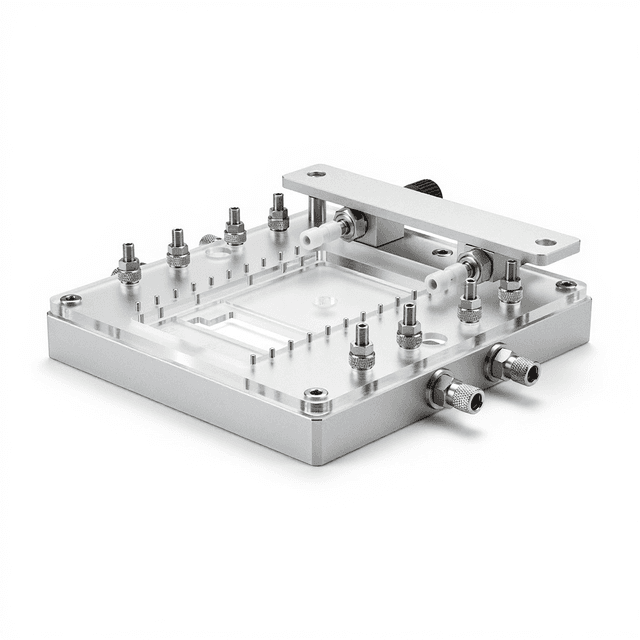
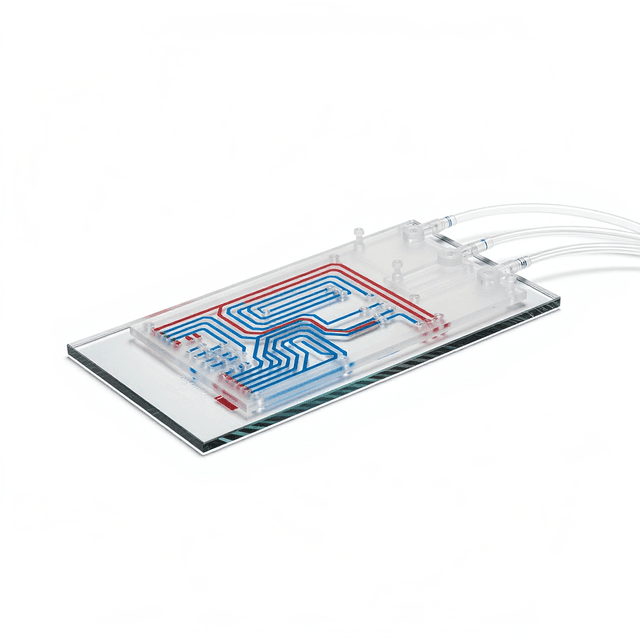
Droplet Formation and Curing Microfluidic Chip
Precision microfluidic chip with 100 μm channels for controlled droplet formation and in-situ curing, enabling reproducible microparticle synthesis.
Reusable chip — designed for multiple experimental runs. Compatible with standard microfluidic tubing: steel pins (0.7 mm ID / 1.0 mm OD) and silicone tubing (0.8 mm ID / 1.9 mm OD). Available in bulk packs (5‑, 10‑, and 25‑unit) for lab-scale and consumable workflows.

Louise Corscadden, PhD
Director of Science · ConductScience
Ask Louise about Droplet Formation and Curing Microfluidic Chip fit, setup, configuration, or quote prep.
Already working with us? Sign in to connect this with My Scientist.
Key Specifications
Full details →- Model fit
- 3 selectable configurations
- SKU family
- WHM-0022
- Shipping box
- 25.0 x 15.0 x 3.0 cm
- Ordering
- Online checkout and quote request available
- Category
- Lab Equipment
- Build notes
- Confirm accessories, station layout, and support needs before purchase
The Droplet Formation and Curing Microfluidic Chip is a precision-engineered device designed for controlled generation and polymerization of monodisperse droplets in microfluidic environments. This chip features 100 μm channel depth optimized for droplet formation and subsequent curing processes, enabling researchers to produce uniform microparticles with precise size control and consistent morphology.
The device operates on flow-focusing principles to generate droplets with high reproducibility, making it suitable for applications requiring uniform particle size distributions. The integrated curing functionality allows for real-time polymerization of generated droplets, facilitating the production of solid microparticles directly within the microfluidic environment without requiring additional processing steps.
How It Works
The microfluidic chip operates on flow-focusing principles where immiscible fluids converge at a junction to generate uniform droplets. The dispersed phase containing monomers or pre-polymers flows through the central channel while the continuous phase flows through side channels. At the junction, hydrodynamic forces cause the dispersed phase to break up into discrete droplets with size determined by flow rate ratios and fluid properties.
The 100 μm channel depth provides optimal balance between droplet size control and flow resistance, allowing for generation of droplets typically ranging from 10-200 μm depending on flow conditions. Following droplet formation, the particles flow through a downstream curing zone where polymerization is initiated through UV exposure, thermal treatment, or chemical crosslinking, depending on the specific chemistry employed.
The curing process transforms liquid droplets into solid microparticles while maintaining their spherical geometry and size uniformity. This integrated approach eliminates the need for separate collection and curing steps, improving process efficiency and particle quality.
Features & Benefits
Shipping weight
- 0.03 lb
Shipping box
- L: 25.0 cm
- W: 15.0 cm
- H: 3.0 cm
| Feature | This Product | Typical Alternative | Advantage |
|---|---|---|---|
| Channel Depth | 100 μm engineered depth | Basic chips often use 50-75 μm depths | Larger channel depth reduces clogging risk and enables production of larger particles when needed. |
| Integrated Curing | Built-in droplet curing functionality | Most chips require separate collection and polymerization steps | Eliminates handling losses and improves particle uniformity by preventing coalescence during collection. |
| Application Focus | Specialized for droplet formation and microparticle production | General-purpose microfluidic devices lack curing optimization | Purpose-built design ensures optimal conditions for both droplet generation and polymerization processes. |
| Form Factor | Compact 25 x 15 x 3 mm dimensions | Larger format chips may be 50+ mm in length | Fits standard microscope stages while maintaining necessary channel length for complete curing. |
| Quality Control | ConductScience engineering standards | Quality varies significantly across suppliers | Consistent channel geometry ensures reproducible droplet formation between devices and batches. |
This chip combines precision droplet formation with integrated curing capability in a compact format optimized for microparticle synthesis. The 100 μm channel depth and specialized design provide reliable operation for applications requiring uniform particle production.
| Model | SKU | Listed price | Status | Shipping box |
|---|---|---|---|---|
| 25-Pack | WHM-0022-25PK | Quote | Available | 25.0 x 15.0 x 3.0 cm |
| 10-Pack | WHM-0022-10PK | $1,490.00 | Available | 25.0 x 15.0 x 3.0 cm |
| 5-Pack | WHM-0022-5PK | Quote | Available | 25.0 x 15.0 x 3.0 cm |
Practical Tips
Start droplet formation with conservative flow rates and gradually optimize to prevent channel blockage during initial setup.
Why: Aggressive initial conditions can cause droplet coalescence or channel fouling that requires extensive cleaning.
Flush channels immediately after use with appropriate solvent to prevent polymer residue buildup.
Why: Cured polymer deposits are difficult to remove and can permanently alter channel geometry.
Measure droplet size at multiple flow rate ratios to establish a calibration curve for your specific fluid system.
Why: Flow-size relationships are fluid-dependent and enable predictable particle size control.
Allow system to reach steady state for 2-3 minutes before collecting particles for analysis.
Why: Initial droplets may show size variations as flow profiles stabilize in the channels.
If droplet formation becomes irregular, check for air bubbles in inlet lines and re-prime if necessary.
Why: Air bubbles disrupt flow patterns and cause unpredictable droplet breakup at the junction.
Ensure adequate ventilation when using UV curing systems and wear appropriate eye protection.
Why: UV exposure and monomer vapors present health hazards that require proper safety precautions.
Setup Guide
What’s in the Box
- Droplet formation and curing microfluidic chip
- Protective storage case (typical)
- User manual with operating protocols (typical)
- Quality control certificate (typical)
Warranty
ConductScience provides a one-year manufacturer warranty covering defects in materials and workmanship. Technical support includes application guidance and troubleshooting assistance.
Compliance
What droplet size range can be achieved with 100 μm channels?
Droplet size typically ranges from 10-200 μm depending on flow rate ratios, fluid properties, and channel geometry. Consult product datasheet for specific size optimization protocols.
What types of polymerization chemistry are compatible?
The chip supports UV-initiated, thermal, and chemical crosslinking systems. Choice depends on your specific monomer system and required curing kinetics.
How is droplet size controlled during operation?
Primary control is through flow rate ratios between dispersed and continuous phases. Higher continuous phase flow rates generally produce smaller droplets.
What continuous phase fluids are recommended?
Selection depends on dispersed phase chemistry. Common choices include mineral oils, fluorinated oils, or aqueous solutions with appropriate surfactants.
Can the chip be cleaned and reused?
Yes, channels can be flushed with appropriate solvents between runs. Avoid harsh chemicals that may damage channel surfaces or affect surface energy.
What microscopy is needed for monitoring?
Standard inverted microscope with 10x-40x objectives provides adequate resolution for droplet observation. High-speed cameras help optimize formation parameters.
How does this compare to batch emulsification methods?
Microfluidic generation provides superior size uniformity (CV typically <5%) compared to batch methods, with better control over particle properties.
Have a question about this product?
Have a question? Just ask.
Send it over and we'll email you a personalized answer — no call, no scheduling.
Prefer to talk it through?
Replacement Parts & Consumables
Upgrade Options