
Try ConductPheno on your own computer
ConductPheno follows each mouse in its home cage around the clock and shows how far it moves, when it rests and sleeps, and when it visits its food and water.
The free demo runs on Windows 10 and 11 without a camera or graphics card.
It needs no sign-up and installs nothing.
What’s in the demo
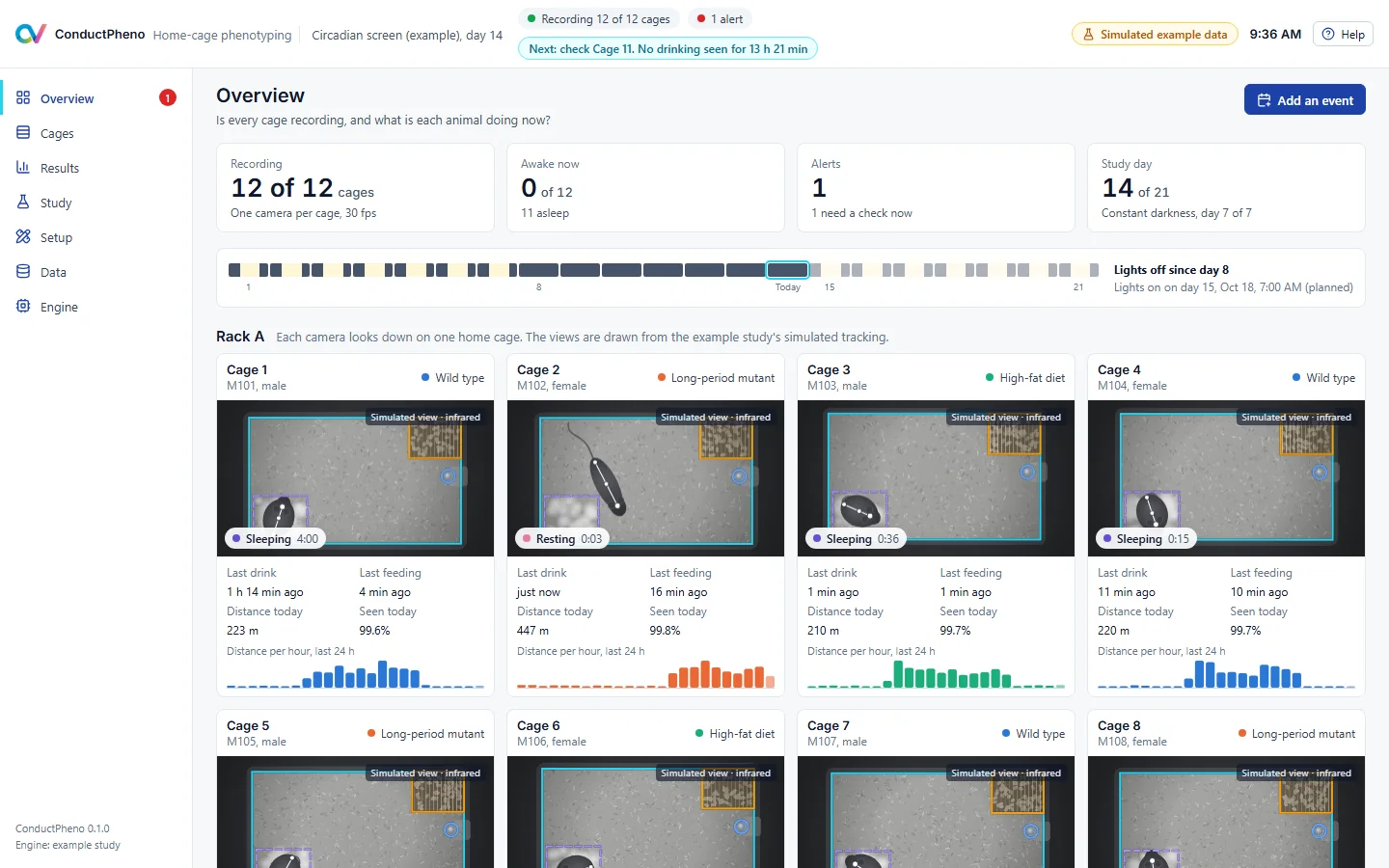
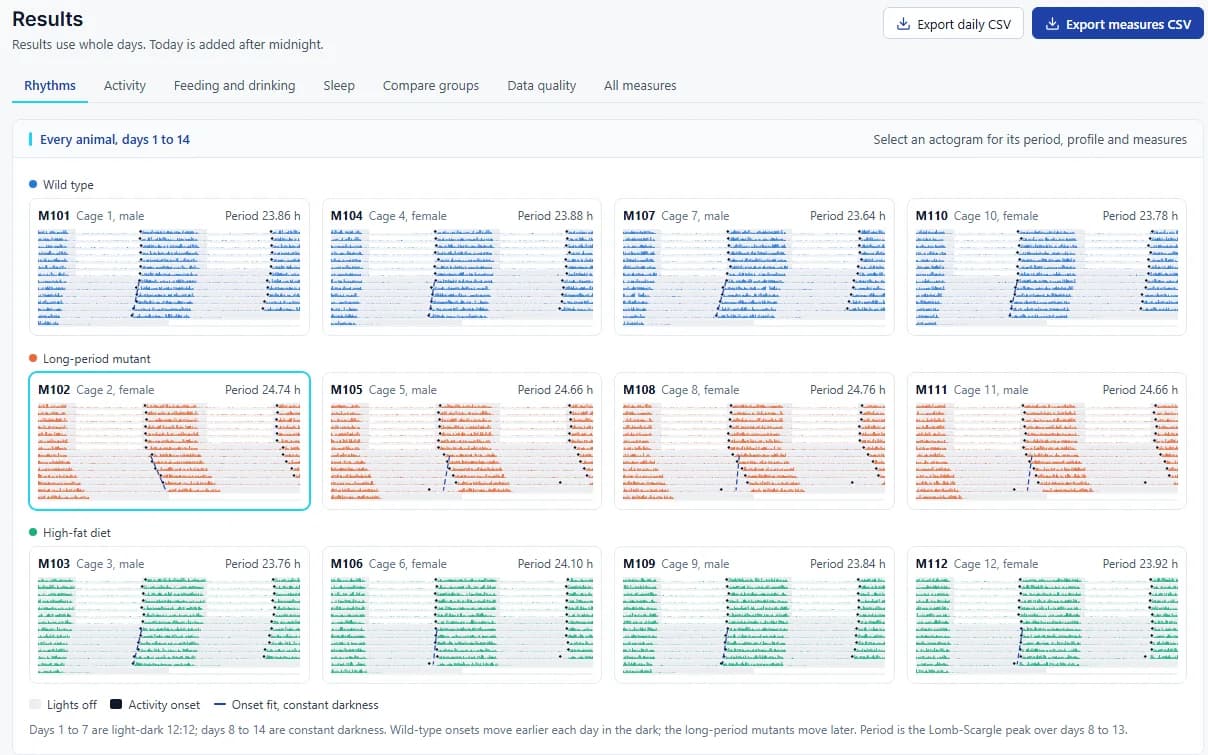
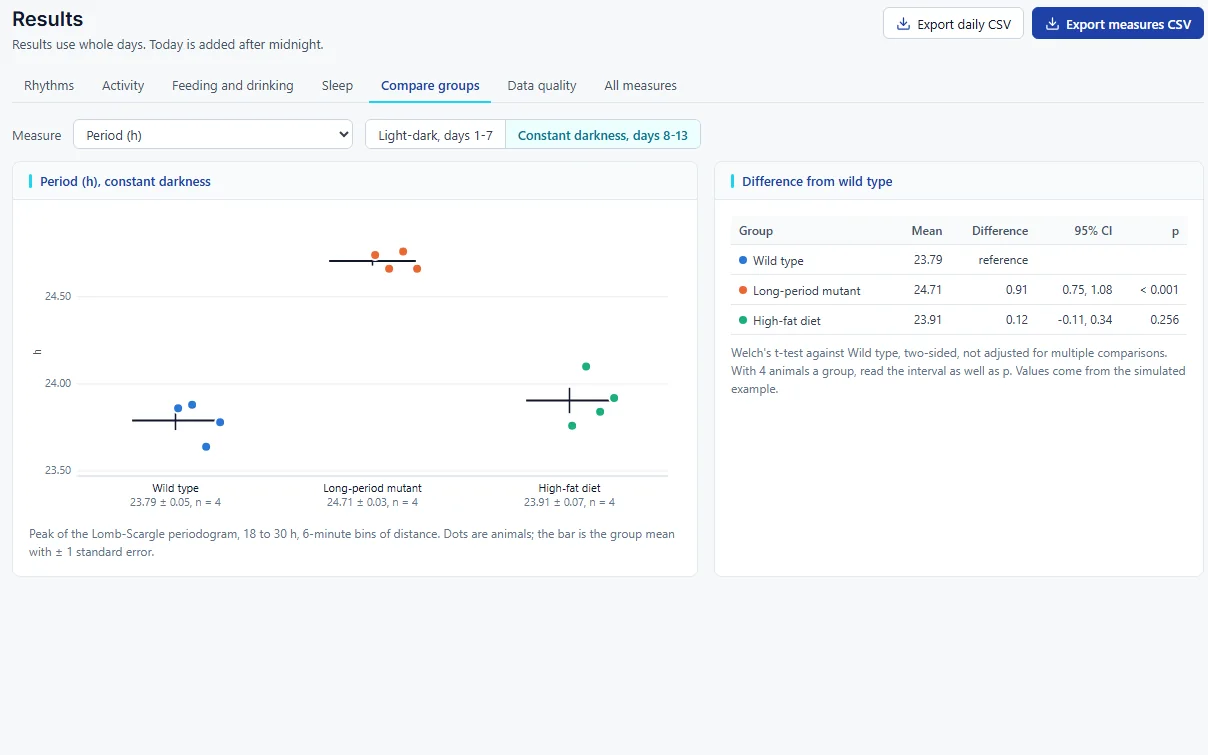
The demo opens on a simulated study of 12 mice, one per cage, in three groups: wild type, a long-period mutant line and a high-fat diet group. The mice spend the first 7 days on a 12-hour light-dark cycle and the next 7 in constant darkness, where each mouse’s free-running rhythm shows.
On day 10, one of the simulated cameras drops out for part of the day, and ConductPheno marks the gap in the data. One mouse has stopped drinking, and ConductPheno flags it. Every screen and export marks the data as simulated.
One cage, minute by minute
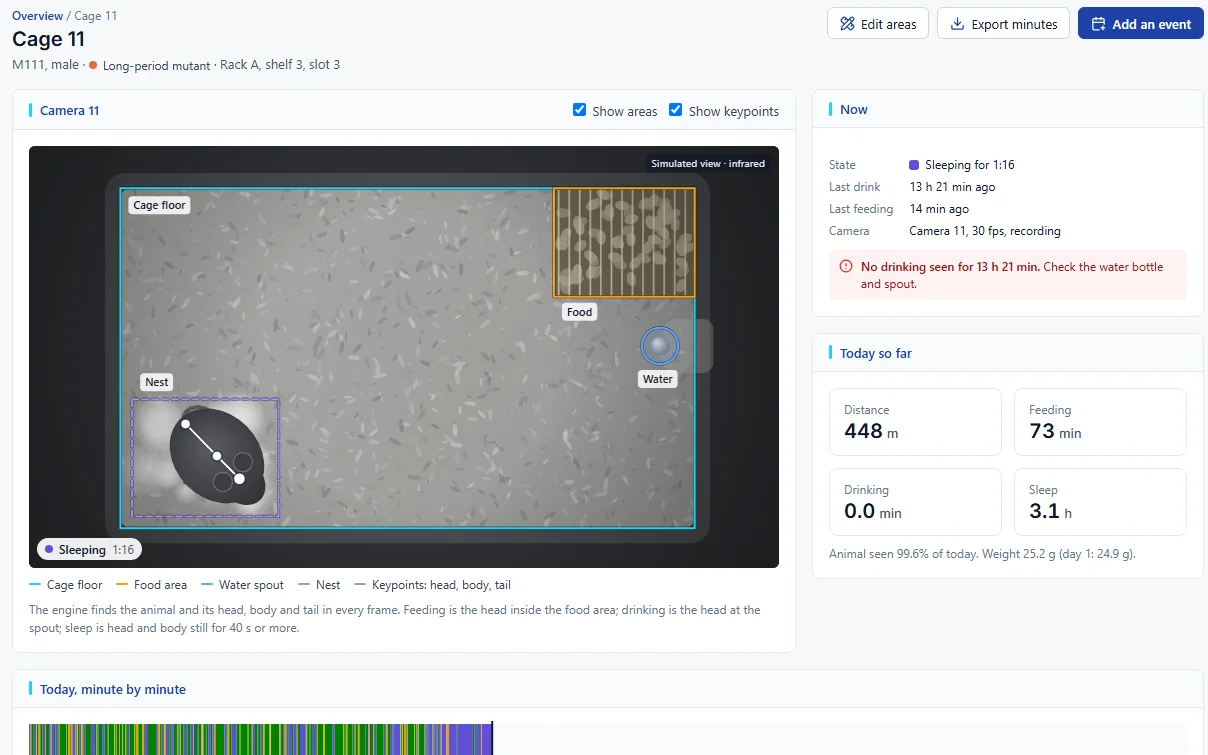
The camera view with its food, water and nest areas, and each minute of the day labeled by what the mouse was doing.
Daily rhythms
An actogram for every mouse, with its activity onsets and its free-running period in constant darkness.
Food and water through the day
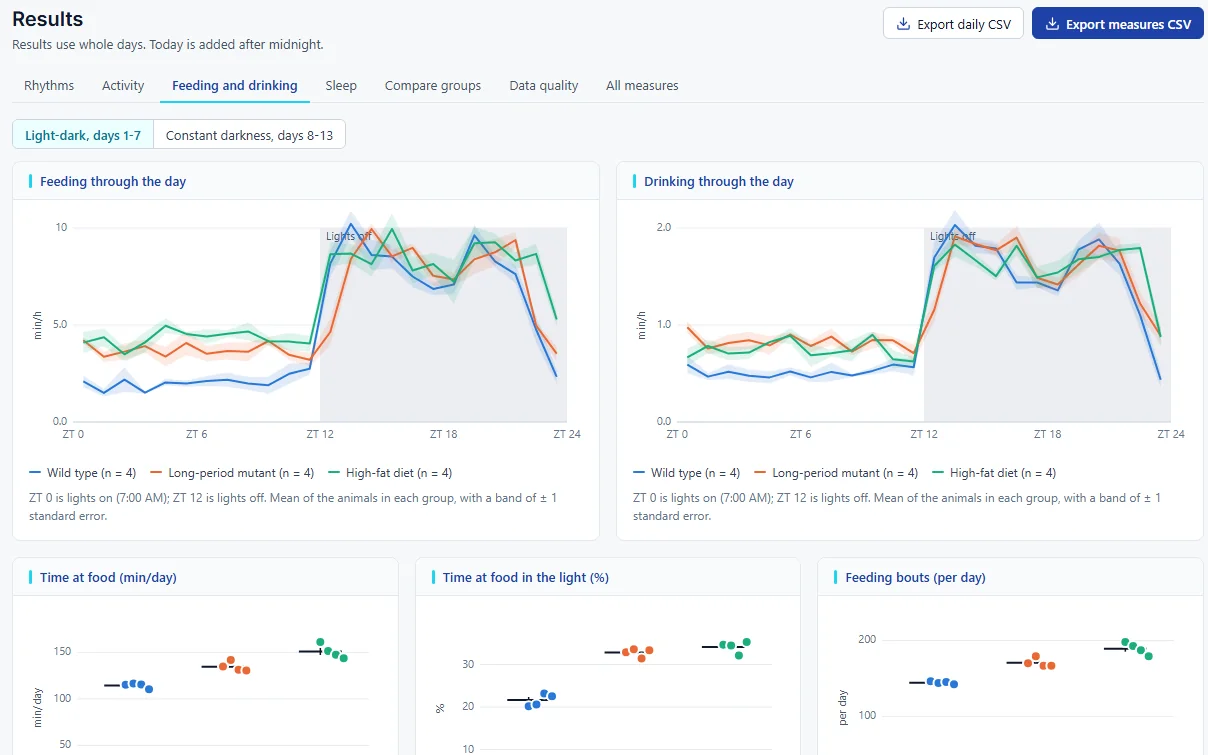
Each group’s time in the food area and at the water spout across the 24-hour day, and its feeding bouts per day.
Group comparisons
Each measure by group, with the difference from wild type, its 95% confidence interval and a Welch's t-test.
What ConductPheno measures and flags
Every measure comes from three keypoints on each mouse: head, body and tail. ConductPheno’s tracking engine or DeepLabCut finds them in the video.
- Activity
- How far the body moves each minute. ConductPheno counts a new position only when the body keypoint is 0.5 cm or more from the last one it counted, so small tracking jitter adds no distance.
- Sleep and rest
- A mouse counts as asleep when its head and body stay within 0.5 cm of where they were for 40 seconds or more. Shorter stillness counts as rest.
- Food and water visits
- Time with the head in the food area or at the water spout. Food-area visits 5 seconds apart or less join into one feeding bout, and water-spout visits 3 seconds apart or less into one drinking bout.
- Not seen
- Seconds when the camera can’t see the mouse, kept as their own state and never counted as rest or sleep.
- Period
- Each mouse’s cycle length, taken from the peak of a Lomb-Scargle periodogram between 18 and 30 hours. A chi-square periodogram is shown beside the Lomb-Scargle one.
- Rhythm structure
- Interdaily stability, intradaily variability and relative amplitude.
- Rhythm timing
- The daily activity onset, and the time of peak activity from a cosinor fit.
- Alerts
- ConductPheno flags a mouse after 8 hours without drinking or feeding, or after 2 minutes out of view. It also flags a camera that sees its mouse for less than 90% of the day and, on light-dark days, dark-phase activity below 32% of the mouse’s own baseline for 3 hours.
What the demo needs
Windows 10 or 11, 64-bit
No internet after the download
ConductPheno runs on your computer and keeps your data there.
Download and open the demo
Download the demo
It is a single program file.
Open the file
Windows may show "Windows protected your PC", as it does for apps it doesn't recognize yet. If it does, choose More info, then Run anyway.
Start at the overview
The overview shows day 14 of the study. Start with its alert, then open any cage.
Frequently asked questions
Can I analyze my own tracking data?
Yes, keypoint files from DeepLabCut or from ConductPheno’s tracking engine. You draw each cage’s food, water and nest areas, and the demo measures the keypoints against them. The demo does not track video itself.
Can it follow more than one mouse in a cage?
No, it follows one mouse per cage.
Does the demo expire?
No, it has no time limit.
Track your own cages
Talk to our team about running ConductPheno’s tracking engine on your cages.