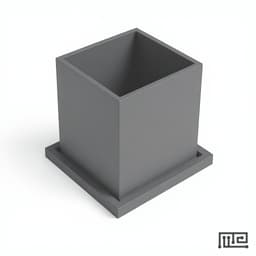
Open Field Test
From $540.00
Research data · Measure
Locomotor activity is how much an animal moves around during a test, often tracked as distance or beam breaks in an open field.
A drop in activity within a session or across repeated sessions in the same arena is read as habituation.1,2
Video tracking records the animal's path and sums its length, and photobeam cages count each beam the animal breaks.
Papers report it for the whole session or in short time bins, which show how activity changes as the arena becomes familiar.
It is also a check on other tests, because a rise in general activity can give a false positive result in the forced swim test.3
We count a paper when its title or abstract names the measure. Many papers name their measures only in the full text, so each count is a minimum. The chart counts the test's papers from 2021 to 2025.
Papers that name locomotor activity, year by year
The chart shows papers each year.
Open field
Locomotor activity
890 papers, 15.4% of the test's 5,767 papers
| Test | Measure | 2021 | 2022 | 2023 | 2024 | 2025 |
|---|---|---|---|---|---|---|
| Open field | Locomotor activity | 18.2% | 16.4% | 15.9% | 13.0% | 14.2% |
| Test | Measure | Papers | 2021 | 2022 | 2023 | 2024 | 2025 |
|---|---|---|---|---|---|---|---|
| Open field | Locomotor activity | 890 | 196 | 177 | 166 | 145 | 206 |
Each table shows one measure from one Mouse Phenome Database (MPD) project, for one sex. Compare strains within a table, because the same strain's values can differ from project to project.
All of these tables come from open field tests.
Hover over or tap a strain to see its values, or use Tab and the arrow keys.
Common inbred strains come first, in bold, then the rest; each group runs A to Z.
| Strain | Mice | Mean (count) | SD (count) | Range across mice (count) |
|---|---|---|---|---|
| 129S1/SvImJ | 14 | 1,023 | 730 | 73.8 to 2,032 |
| A/J | 14 | 601 | 410 | 58.4 to 1,421 |
| AKR/J | 16 | 4,031 | 1,398 | 1,014 to 7,726 |
| BALB/cByJ | 13 | 2,442 | 427 | 1,806 to 3,282 |
| C3H/HeJ | 15 | 2,172 | 545 | 1,242 to 3,415 |
| C57BL/6J | 27 | 3,311 | 773 | 2,209 to 5,776 |
| CBA/J | 15 | 2,302 | 345 | 1,538 to 2,861 |
| DBA/2J | 14 | 2,064 | 473 | 1,207 to 3,131 |
| FVB/NJ | 14 | 3,869 | 816 | 2,450 to 5,405 |
| NOD/ShiLtJ | 18 | 4,068 | 1,087 | 2,863 to 7,120 |
| SJL/J | 16 | 2,495 | 468 | 1,674 to 3,446 |
Source: Wiltshire T, Tarantino LM (2010). Measurement of exploratory behavior and activity in 38 inbred strains of mice. Mouse Phenome Database (RRID:SCR_003212), project Wiltshire1, measure 21401, data accessed 20 Nov 2026, https://phenome.jax.org/projects/Wiltshire1.
Download all of this section's tables, each with its source, as one CSV file. The CSV is part of "Behavioral tests in published research", a free data set. Add it to your free ConductScience account to download it.
Each bar counts the test's papers from 2021 to 2025 that name a measure. One paper can name several measures.
Papers from 2021 to 2025, and their percent of the test's 5,767 papers
Our store sells four products for this test.
Habituation across sessions is the drop in locomotor or exploratory activity from one session in the same open field to the next, called intersession habituation.1,2 The drop within a single session is intrasession habituation, and the two types seem to involve partly different genes.1 Compare the distance traveled in the same time window of each session.
Bolivar VJ. Neurobiology of Learning and Memory, 2009.
Habituation in rodents: a review of behavior, neurobiology, and genetics
Leussis MP, Bolivar VJ. Neuroscience and Biobehavioral Reviews, 2006.
Using the rat forced swim test to assess antidepressant-like activity in rodents
Slattery DA, Cryan JF. Nature Protocols, 2012.
Mouse strain values: Mouse Phenome Database (MPD), RRID:SCR_003212, and the MPD projects named under each table.
A paper counts toward a measure when its title or abstract names it.
The full method, with each source and its terms of use, is on the page Behavioral tests in published research.
The mouse strain values come from the Mouse Phenome Database (MPD). Each table holds what one MPD project measured in one sex. A strain with fewer than 5 mice is left out, because so few mice give an unsteady mean. Where MPD has no mouse-by-mouse data, the SD is worked out from the standard error that MPD posts. The common inbred strains come first in each table: 129S1/SvImJ, A/J, AKR/J, BALB/cByJ, BALB/cJ, C3H/HeJ, C57BL/6J, CBA/J, DBA/2J, FVB/NJ, NOD/ShiLtJ and SJL/J. They are the classical inbred strains that appear in at least 40 of the 130 MPD behavior projects with strain means, plus BALB/cJ, which appears in 30.
ConductScience. (2026, November 22). Locomotor activity [Data set]. https://conductscience.com/data/measures/locomotor-activity
@misc{conductscience_measure_locomotor_activity_2026,
  author = {{ConductScience}},
  title = {Locomotor activity},
  year = {2026},
  month = nov,
  url = {https://conductscience.com/data/measures/locomotor-activity},
  note = {Data set, released November 22, 2026},
}
For a strain value, cite the MPD project named under its table.


