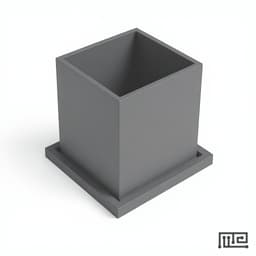
Open Field Test
From $540.00
Research data · Measure
Thigmotaxis is an animal's tendency to stay near the walls of an open space, measured in the open field as the time it spends near the walls.
More thigmotaxis is read as more anxiety-like behavior, because anxiolytic drugs reduce it in rats and mice.1,2
Tracking software or an observer divides the arena floor into a wall zone and a center zone, then records the time, share of time or distance in the wall zone.
Report the width of the wall zone, because results depend on it.
In mice, thigmotaxis is highest on entering the arena and falls over the first minutes, and that early level is read as an index of anxiety.2
Researchers also score thigmotaxis in the water maze and in zebrafish, but the counts here cover the open field only.
We count a paper when its title or abstract names the measure. Many papers name their measures only in the full text, so each count is a minimum. The chart counts the test's papers from 2021 to 2025.
Papers that name thigmotaxis, year by year
The chart shows papers each year.
Open field
Time near the walls
94 papers, 1.6% of the test's 5,767 papers
| Test | Measure | 2021 | 2022 | 2023 | 2024 | 2025 |
|---|---|---|---|---|---|---|
| Open field | Time near the walls | 1.9% | 2.3% | 1.1% | 1.3% | 1.5% |
| Test | Measure | Papers | 2021 | 2022 | 2023 | 2024 | 2025 |
|---|---|---|---|---|---|---|---|
| Open field | Time near the walls | 94 | 21 | 25 | 12 | 14 | 22 |
ConductVision, our video-tracking software, reports this measure from video of your sessions.
In the open field, ConductVision reports it as Wall Zone Time.
Each table shows one measure from one Mouse Phenome Database (MPD) project, for one sex. Compare strains within a table, because the same strain's values can differ from project to project.
All of these tables come from open field tests.
Hover over or tap a strain to see its values, or use Tab and the arrow keys.
Common inbred strains come first, in bold, then the rest; each group runs A to Z.
| Strain | Mice | Mean (s) | SD (s) | Range across mice (s) |
|---|---|---|---|---|
| 129S1/SvImJ | 9 | 296 | 9.30 | 274 to 300 |
| A/J | 14 | 291 | 33.5 | 175 to 300 |
| AKR/J | 9 | 294 | 8.52 | 274 to 300 |
| BALB/cByJ | 8 | 291 | 11.5 | 273 to 300 |
| BALB/cJ | 18 | 300 | 0.259 | 299 to 300 |
| C3H/HeJ | 16 | 285 | 15.4 | 251 to 300 |
| C57BL/6J | 242 | 265 | 21.0 | 151 to 298 |
| CBA/J | 10 | 294 | 9.38 | 271 to 300 |
| DBA/2J | 9 | 291 | 10.7 | 272 to 300 |
| FVB/NJ | 15 | 272 | 11.0 | 254 to 298 |
| NOD/ShiLtJ | 16 | 274 | 13.8 | 251 to 294 |
| SJL/J | 38 | 286 | 13.6 | 246 to 300 |
Source: Kumar V (2021). Grooming behavior and locomotor activity in 51 inbred strains of mice and 11 F1 hybrid lines. Mouse Phenome Database (RRID:SCR_003212), project Kumar3, measure 112921, data accessed 20 Nov 2026, https://phenome.jax.org/projects/Kumar3.
Download all of this section's tables, each with its source, as one CSV file. The CSV is part of "Behavioral tests in published research", a free data set. Add it to your free ConductScience account to download it.
Each bar counts the test's papers from 2021 to 2025 that name a measure. One paper can name several measures.
Papers from 2021 to 2025, and their percent of the test's 5,767 papers
Our store sells four products for this test.
Thigmotaxis as a test for anxiolytic activity in rats
Treit D, Fundytus M. Pharmacology Biochemistry and Behavior, 1988.
Thigmotaxis as an index of anxiety in mice. Influence of dopaminergic transmissions
Simon P, Dupuis R, Costentin J. Behavioural Brain Research, 1994.
Mouse strain values: Mouse Phenome Database (MPD), RRID:SCR_003212, and the MPD projects named under each table.
A paper counts toward a measure when its title or abstract names it.
The full method, with each source and its terms of use, is on the page Behavioral tests in published research.
The mouse strain values come from the Mouse Phenome Database (MPD). Each table holds what one MPD project measured in one sex. A strain with fewer than 5 mice is left out, because so few mice give an unsteady mean. Where MPD has no mouse-by-mouse data, the SD is worked out from the standard error that MPD posts. The common inbred strains come first in each table: 129S1/SvImJ, A/J, AKR/J, BALB/cByJ, BALB/cJ, C3H/HeJ, C57BL/6J, CBA/J, DBA/2J, FVB/NJ, NOD/ShiLtJ and SJL/J. They are the classical inbred strains that appear in at least 40 of the 130 MPD behavior projects with strain means, plus BALB/cJ, which appears in 30.
ConductScience. (2026, November 22). Thigmotaxis [Data set]. https://conductscience.com/data/measures/thigmotaxis
@misc{conductscience_measure_thigmotaxis_2026,
  author = {{ConductScience}},
  title = {Thigmotaxis},
  year = {2026},
  month = nov,
  url = {https://conductscience.com/data/measures/thigmotaxis},
  note = {Data set, released November 22, 2026},
}
For a strain value, cite the MPD project named under its table.


