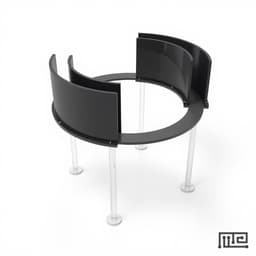
Elevated Plus Maze
From $1,890.00
Research data · Measure
Open arm time is how long a rodent spends on the open, unwalled arms of an elevated plus maze, or in the open sections of an elevated zero maze.
A higher share of time on the open arms, and more entries into them, is read as less anxiety-like behavior.1,2
In a standard protocol, a video-tracking system and an observer record the entries into each arm and the time on each arm over 5 minutes.2
The maze was validated in rats with the percentage of time on the open arms and the number of entries into them, which rose only with clinically effective anxiolytics.1
Open arm time (%) = time on the open arms ÷ (time on the open arms + time on the closed arms) × 1001
Open arm entries (%) = entries into the open arms ÷ (entries into the open arms + entries into the closed arms) × 1001
In the elevated zero maze, a raised ring with two open and two closed sections, the same measure is the time in the open sections.
We count a paper when its title or abstract names the measure. Many papers name their measures only in the full text, so each count is a minimum. Each chart counts one test's papers from 2021 to 2025.
Papers that name open arm time, open arm entries or time in the open sections, year by year
The three charts show papers each year and share one scale.
Elevated plus maze
Time in the open arms
427 papers, 15.0% of the test's 2,854 papers
Elevated plus maze
Entries into the open arms
186 papers, 6.5% of the test's 2,854 papers
Elevated zero maze
Time in the open sections
15 papers, 11.2% of the test's 134 papers
| Test | Measure | 2021 | 2022 | 2023 | 2024 | 2025 |
|---|---|---|---|---|---|---|
| Elevated plus maze | Time in the open arms | 13.8% | 17.3% | 16.1% | 14.3% | 13.7% |
| Elevated plus maze | Entries into the open arms | 6.4% | 7.0% | 7.0% | 7.4% | 5.1% |
| Elevated zero maze | Time in the open sections | 10.3% | 24.0% | 11.5% | 12.0% | 0.0% |
| Test | Measure | Papers | 2021 | 2022 | 2023 | 2024 | 2025 |
|---|---|---|---|---|---|---|---|
| Elevated plus maze | Time in the open arms | 427 | 80 | 98 | 83 | 77 | 89 |
| Elevated plus maze | Entries into the open arms | 186 | 37 | 40 | 36 | 40 | 33 |
| Elevated zero maze | Time in the open sections | 15 | 3 | 6 | 3 | 3 | 0 |
ConductVision, our video-tracking software, reports this measure from video of your sessions.
In the elevated plus maze, ConductVision reports both, as Time in Open Arms and Open Arm Entries.
In the elevated zero maze, ConductVision reports it as Time in Open Quadrants.
Each table shows one measure from one Mouse Phenome Database (MPD) project, for one sex. Compare strains within a table, because the same strain's values can differ from project to project.
Hover over or tap a strain to see its values, or use Tab and the arrow keys.
Common inbred strains come first, in bold, then the rest; each group runs A to Z.
| Strain | Mice | Mean (%) | SD (%) | Range across mice (%) |
|---|---|---|---|---|
| 129S1/SvImJ | 7 | 65.6 | 38.9 | 10.9 to 99.8 |
| A/J | 8 | 6.78 | 17.6 | 0 to 50.1 |
| AKR/J | 8 | 17.9 | 9.05 | 2.22 to 27.8 |
| BALB/cByJ | 10 | 33.0 | 28.3 | 0 to 86.2 |
| C3H/HeJ | 8 | 32.0 | 21.1 | 0.270 to 62.7 |
| C57BL/6J | 8 | 43.2 | 13.3 | 20.6 to 59.1 |
| DBA/2J | 8 | 15.9 | 11.5 | 1.72 to 35.8 |
| FVB/NJ | 10 | 38.1 | 15.2 | 11.0 to 57.5 |
| NOD/ShiLtJ | 12 | 47.2 | 31.8 | 1.46 to 100 |
| SJL/J | 8 | 30.4 | 20.0 | 0.380 to 60.3 |
| BTBR T+ Itpr3tf/J | 12 | 49.8 | 19.8 | 13.5 to 81.7 |
| C57L/J | 10 | 28.3 | 12.5 | 10.9 to 53.8 |
| C58/J | 8 | 47.8 | 26.1 | 11.6 to 93.4 |
| CAST/EiJ | 8 | 64.1 | 29.4 | 3.43 to 98.2 |
| MOLF/EiJ | 8 | 19.3 | 7.44 | 5.79 to 31.4 |
| NZB/BlNJ | 6 | 30.1 | 18.0 | 0 to 46.4 |
| PERA/EiJ | 10 | 39.3 | 19.6 | 8.61 to 68.3 |
| PL/J | 12 | 41.8 | 23.5 | 0.420 to 89.3 |
| SM/J | 14 | 59.7 | 18.4 | 14.2 to 88.1 |
| SPRET/EiJ | 6 | 29.1 | 44.1 | 0 to 100 |
| SWR/J | 9 | 53.4 | 13.2 | 41.9 to 79.9 |
Source: Wahlsten D, Crabbe JC (2003). Survey of motor activity, behavior, and forebrain morphometry in 21 inbred strains of mice across two laboratories. Mouse Phenome Database (RRID:SCR_003212), project Wahlsten1, measure 10852, data accessed 20 Nov 2026, https://phenome.jax.org/projects/Wahlsten1. Papers: PMIDs 12691836, 17053075.
Download all of this section's tables, each with its source, as one CSV file. The CSV is part of "Behavioral tests in published research", a free data set. Add it to your free ConductScience account to download it.
Each bar counts the test's papers from 2021 to 2025 that name a measure. One paper can name several measures.
Papers from 2021 to 2025, and their percent of the test's 2,854 papers
Papers from 2021 to 2025, and their percent of the test's 134 papers
Validation of open:closed arm entries in an elevated plus-maze as a measure of anxiety in the rat
Pellow S, Chopin P, File SE, et al. Journal of Neuroscience Methods, 1985.
The use of the elevated plus maze as an assay of anxiety-related behavior in rodents
Walf AA, Frye CA. Nature Protocols, 2007.
Mouse strain values: Mouse Phenome Database (MPD), RRID:SCR_003212, and the MPD projects named under each table.
A paper counts toward a measure when its title or abstract names it.
The full method, with each source and its terms of use, is on the page Behavioral tests in published research.
The mouse strain values come from the Mouse Phenome Database (MPD). Each table holds what one MPD project measured in one sex. A strain with fewer than 5 mice is left out, because so few mice give an unsteady mean. Where MPD has no mouse-by-mouse data, the SD is worked out from the standard error that MPD posts. The common inbred strains come first in each table: 129S1/SvImJ, A/J, AKR/J, BALB/cByJ, BALB/cJ, C3H/HeJ, C57BL/6J, CBA/J, DBA/2J, FVB/NJ, NOD/ShiLtJ and SJL/J. They are the classical inbred strains that appear in at least 40 of the 130 MPD behavior projects with strain means, plus BALB/cJ, which appears in 30.
ConductScience. (2026, November 22). Open arm time [Data set]. https://conductscience.com/data/measures/open-arm-time
@misc{conductscience_measure_open_arm_time_2026,
  author = {{ConductScience}},
  title = {Open arm time},
  year = {2026},
  month = nov,
  url = {https://conductscience.com/data/measures/open-arm-time},
  note = {Data set, released November 22, 2026},
}
For a strain value, cite the MPD project named under its table.