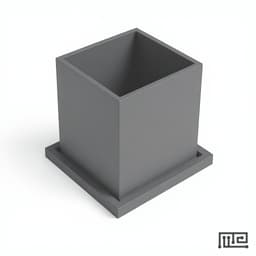
Open Field Test
From $540.00
Research data · Measure
Distance traveled is the length of the path an animal covers during a test, measured by video tracking in open fields and tanks.
More distance means more locomotion, and distance falls as an animal habituates to a new arena.1
Tracking software finds the animal's position in each video frame and adds up the distance between positions.
In the novel tank test, papers report the distance a zebrafish swims, often with its speed.
Small jitters in the tracked position add false distance, so tracking software smooths the path or ignores tiny moves.
We count a paper when its title or abstract names the measure. Many papers name their measures only in the full text, so each count is a minimum. Each chart counts one test's papers from 2021 to 2025.
Papers that name distance traveled, year by year
The two charts show papers each year and share one scale.
Open field
Distance traveled
229 papers, 4.0% of the test's 5,767 papers
Novel tank test (zebrafish)
Swimming distance and speed
56 papers, 23.5% of the test's 238 papers
| Test | Measure | 2021 | 2022 | 2023 | 2024 | 2025 |
|---|---|---|---|---|---|---|
| Open field | Distance traveled | 3.8% | 3.7% | 4.3% | 4.3% | 3.8% |
| Novel tank test (zebrafish) | Swimming distance and speed | 15.9% | 13.0% | 23.1% | 31.4% | 31.1% |
| Test | Measure | Papers | 2021 | 2022 | 2023 | 2024 | 2025 |
|---|---|---|---|---|---|---|---|
| Open field | Distance traveled | 229 | 41 | 40 | 45 | 48 | 55 |
| Novel tank test (zebrafish) | Swimming distance and speed | 56 | 7 | 6 | 9 | 11 | 23 |
ConductVision, our video-tracking software, reports this measure from video of your sessions.
In the open field, ConductVision reports it as Total Distance.
In the novel tank test, ConductVision reports it as Total Distance.
Each table shows one measure from one Mouse Phenome Database (MPD) project, for one sex. Compare strains within a table, because the same strain's values can differ from project to project.
All of these tables come from open field tests.
Hover over or tap a strain to see its values, or use Tab and the arrow keys.
Common inbred strains come first, in bold, then the rest; each group runs A to Z.
| Strain | Mice | Mean (cm) | SD (cm) | Range across mice (cm) |
|---|---|---|---|---|
| 129S1/SvImJ | 9 | 782 | 607 | 302 to 2,051 |
| A/J | 14 | 511 | 133 | 296 to 832 |
| AKR/J | 9 | 1,976 | 568 | 1,371 to 2,996 |
| BALB/cByJ | 8 | 1,607 | 890 | 450 to 2,904 |
| BALB/cJ | 18 | 703 | 319 | 367 to 1,705 |
| C3H/HeJ | 16 | 1,505 | 402 | 686 to 2,069 |
| C57BL/6J | 242 | 2,453 | 542 | 1,004 to 4,247 |
| CBA/J | 10 | 1,161 | 282 | 696 to 1,647 |
| DBA/2J | 9 | 1,498 | 369 | 874 to 2,216 |
| FVB/NJ | 15 | 3,039 | 394 | 2,285 to 3,648 |
| NOD/ShiLtJ | 16 | 3,421 | 625 | 2,395 to 4,694 |
| SJL/J | 38 | 1,933 | 524 | 679 to 3,358 |
Source: Kumar V (2021). Grooming behavior and locomotor activity in 51 inbred strains of mice and 11 F1 hybrid lines. Mouse Phenome Database (RRID:SCR_003212), project Kumar3, measure 112918, data accessed 20 Nov 2026, https://phenome.jax.org/projects/Kumar3.
Download all of this section's tables, each with its source, as one CSV file. The CSV is part of "Behavioral tests in published research", a free data set. Add it to your free ConductScience account to download it.
Each bar counts the test's papers from 2021 to 2025 that name a measure. One paper can name several measures.
Papers from 2021 to 2025, and their percent of the test's 5,767 papers
Papers from 2021 to 2025, and their percent of the test's 238 papers

From $1,990.00
Bolivar VJ. Neurobiology of Learning and Memory, 2009.
Mouse strain values: Mouse Phenome Database (MPD), RRID:SCR_003212, and the MPD projects named under each table.
A paper counts toward a measure when its title or abstract names it.
The full method, with each source and its terms of use, is on the page Behavioral tests in published research.
The mouse strain values come from the Mouse Phenome Database (MPD). Each table holds what one MPD project measured in one sex. A strain with fewer than 5 mice is left out, because so few mice give an unsteady mean. Where MPD has no mouse-by-mouse data, the SD is worked out from the standard error that MPD posts. The common inbred strains come first in each table: 129S1/SvImJ, A/J, AKR/J, BALB/cByJ, BALB/cJ, C3H/HeJ, C57BL/6J, CBA/J, DBA/2J, FVB/NJ, NOD/ShiLtJ and SJL/J. They are the classical inbred strains that appear in at least 40 of the 130 MPD behavior projects with strain means, plus BALB/cJ, which appears in 30.
ConductScience. (2026, November 22). Distance traveled [Data set]. https://conductscience.com/data/measures/distance-traveled
@misc{conductscience_measure_distance_traveled_2026,
  author = {{ConductScience}},
  title = {Distance traveled},
  year = {2026},
  month = nov,
  url = {https://conductscience.com/data/measures/distance-traveled},
  note = {Data set, released November 22, 2026},
}
For a strain value, cite the MPD project named under its table.


