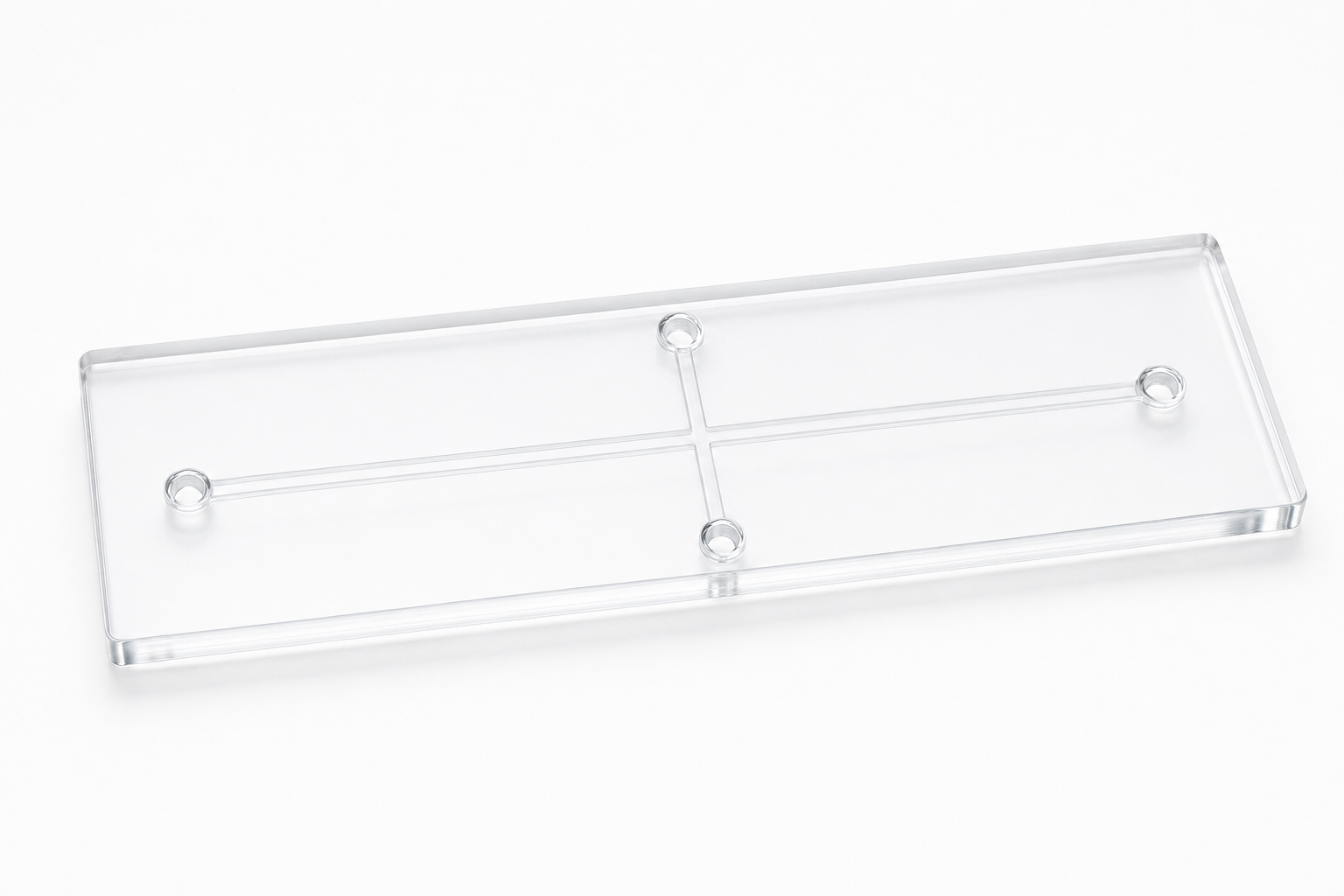
4-Channel Parallel Droplet Generator Chip
PDMS microfluidic chip with four parallel 200 × 200 μm channels for high-throughput monodisperse droplet generation.
Reusable chip — designed for multiple experimental runs. Compatible with standard microfluidic tubing: steel pins (0.7 mm ID / 1.0 mm OD) and silicone tubing (0.8 mm ID / 1.9 mm OD). Available in bulk packs (5‑, 10‑, and 25‑unit) for lab-scale and consumable workflows.

Louise Corscadden, PhD
Director of Science · ConductScience
Ask Louise about 4-Channel Parallel Droplet Generator Chip fit, setup, configuration, or quote prep.
Already working with us? Sign in to connect this with My Scientist.
Key Specifications
Full details →- Model fit
- 3 selectable configurations
- SKU family
- WHM-0094
- Shipping box
- 181.8 x 136.3 x 90.9 cm
- Ordering
- Online checkout and quote request available
- Category
- Droplet Generator Chips
- Build notes
- Confirm accessories, station layout, and support needs before purchase
The 4-Channel Parallel Droplet Generator Chip is a PDMS-based microfluidic device designed for high-throughput monodisperse droplet production. Each channel features 200 × 200 μm dimensions, enabling simultaneous generation of multiple droplet streams with consistent size distribution. The parallel channel architecture increases throughput compared to single-channel devices while maintaining droplet uniformity across all channels.
This chip utilizes flow-focusing geometry to generate droplets through controlled hydrodynamic flow interactions between dispersed and continuous phases. The PDMS construction provides optical transparency for real-time monitoring and chemical compatibility with a wide range of aqueous and organic solvents commonly used in microfluidic applications.
How It Works
The chip operates on flow-focusing principles where three fluid streams converge at each junction: a central dispersed phase flanked by two continuous phase streams. The 200 × 200 μm channel geometry creates a controlled hydrodynamic environment where interfacial tension forces and flow rate ratios determine droplet size and generation frequency.
As the dispersed phase stream encounters the converging continuous phase flows, it forms a narrowing jet that becomes unstable due to Rayleigh-Plateau instability. This instability causes periodic pinch-off, generating uniform droplets whose diameter depends on the flow rate ratio, fluid viscosities, and interfacial tension. The parallel channel design enables simultaneous generation of four independent droplet streams, quadrupling throughput compared to single-channel devices while maintaining size uniformity across channels.
PDMS material properties provide several operational advantages: optical transparency enables real-time visualization of droplet formation, inherent hydrophobicity facilitates water-in-oil emulsions, and chemical inertness ensures compatibility with biological samples and organic solvents.
Features & Benefits
Shipping weight
- 3.3 lb
Shipping box
- L: 181.8 cm
- W: 136.3 cm
- H: 90.9 cm
| Feature | This Product | Typical Alternative | Advantage |
|---|---|---|---|
| Number of Parallel Channels | 4 parallel channels | Most entry-level devices offer 1-2 channels | Higher throughput reduces experiment time for applications requiring large quantities of uniform droplets. |
| Channel Cross-Section | 200 × 200 μm square channels | Smaller devices often use 50-100 μm dimensions | Larger channels accommodate higher viscosity fluids and reduce clogging risk with particle-containing samples. |
| Material Construction | PDMS polymer | Some alternatives use glass or thermoplastics | PDMS provides cost-effective disposable operation with excellent optical clarity and chemical compatibility. |
| Droplet Size Range | 50-500 μm diameter capability | Smaller geometry devices typically generate <100 μm droplets | Larger droplet range suitable for single cell encapsulation and materials synthesis applications requiring higher volumes. |
| Surface Properties | Native hydrophobic PDMS surface | Some devices require permanent surface coatings | Naturally hydrophobic surface facilitates water-in-oil droplet formation without additional treatments. |
This 4-channel device offers higher throughput than single-channel alternatives while maintaining the cost-effectiveness and optical properties of PDMS construction. The 200 μm channel dimensions provide flexibility for larger droplet applications and compatibility with viscous samples.
| Model | SKU | Listed price | Status | Shipping box |
|---|---|---|---|---|
| 25-Pack | WHM-0094-25PK | Quote | Available | 181.8 x 136.3 x 90.9 cm |
| 10-Pack | WHM-0094-10PK | $1,490.00 | Available | 181.8 x 136.3 x 90.9 cm |
| 5-Pack | WHM-0094-5PK | Quote | Available | 181.8 x 136.3 x 90.9 cm |
Practical Tips
Establish flow rate calibration curves for your specific fluid combinations by measuring droplet diameter across different flow rate ratios.
Why: Fluid viscosity and interfacial tension affect droplet size relationships, requiring empirical calibration for predictable results.
Flush channels with appropriate solvents immediately after experiments to prevent protein adsorption or chemical residue buildup.
Why: Protein fouling or chemical deposits can alter surface properties and affect subsequent droplet formation consistency.
Use syringe pumps with low pulsation for both phases to maintain steady droplet generation frequency across all channels.
Why: Flow pulsations create droplet size variability and can cause temporary cessation of droplet formation at junctions.
If one channel stops producing droplets while others continue, check for air bubbles or partial blockages in that specific channel's tubing.
Why: Parallel channel designs can develop individual channel issues while others remain functional, requiring isolated troubleshooting.
Collect droplet size measurements from multiple time points during long experiments to verify consistent generation.
Why: Solvent evaporation, temperature changes, or gradual fouling can cause droplet size drift over extended operation periods.
Operate at pressures below 2 bar to prevent PDMS deformation or bond failure at channel interfaces.
Why: Excessive pressure can cause irreversible channel deformation or delamination of the PDMS layers, compromising device integrity.
Monitor junction temperature if using temperature-sensitive samples, as flow friction can generate localized heating.
Why: Temperature variations affect fluid viscosity and interfacial tension, potentially altering droplet formation characteristics.
Pre-wet channels with continuous phase before introducing dispersed phase to establish stable interfaces at all junctions.
Why: Proper wetting prevents irregular droplet formation during startup and ensures consistent performance across parallel channels.
Setup Guide
What’s in the Box
- 4-Channel Parallel Droplet Generator Chip
- User manual with operating protocols (typical)
- Quality control certificate (typical)
Warranty
ConductScience provides a standard manufacturer warranty covering defects in materials and workmanship. Technical support is available for setup protocols and troubleshooting assistance.
Compliance
What droplet size range can this chip generate?
Droplet diameter typically ranges from 50-500 μm depending on flow rate ratios, fluid viscosities, and interfacial tension. Smaller droplets are achieved with higher continuous phase flow rates relative to dispersed phase.
How do I ensure uniform droplet generation across all four channels?
Maintain equal flow rates and pressures to each channel, verify symmetric channel geometry, and monitor junction performance visually. Small variations in tubing length or fittings can create flow imbalances.
What surface treatments are recommended for different emulsion types?
Native PDMS is hydrophobic, suitable for water-in-oil droplets. For oil-in-water droplets, apply oxygen plasma treatment or surface modification with hydrophilic coatings to reverse wetting properties.
How often should chips be replaced during extended experiments?
Replace chips when droplet formation becomes irregular, channels show visible contamination, or surface properties change due to chemical exposure. Single-use operation is recommended for biological applications.
What flow rate ratios provide optimal droplet monodispersity?
Flow rate ratios of 1:10 to 1:20 (dispersed:continuous) typically provide coefficient of variation <5% for droplet diameter. Higher ratios improve monodispersity but reduce droplet generation frequency.
Can this chip handle viscous fluids or particle suspensions?
Yes, but higher viscosities require increased driving pressures and may affect droplet formation dynamics. Particle suspensions should have particle diameter <10% of channel dimension to prevent clogging.
How do I prevent channel clogging during operation?
Filter all fluids through 0.22 μm filters, avoid air bubbles, maintain steady flow rates, and flush channels with appropriate solvents between experiments. Monitor pressure for sudden increases indicating blockages.
What microscopy setup is recommended for monitoring droplet formation?
Use inverted microscope with 10x-20x objectives for real-time monitoring. High-speed cameras enable measurement of droplet formation frequency and size distribution analysis.
Have a question about this product?
Have a question? Just ask.
Send it over and we'll email you a personalized answer — no call, no scheduling.
Prefer to talk it through?