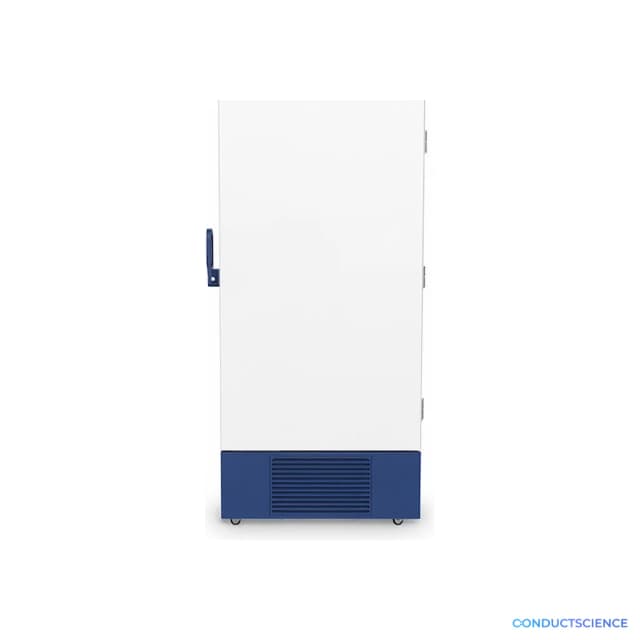
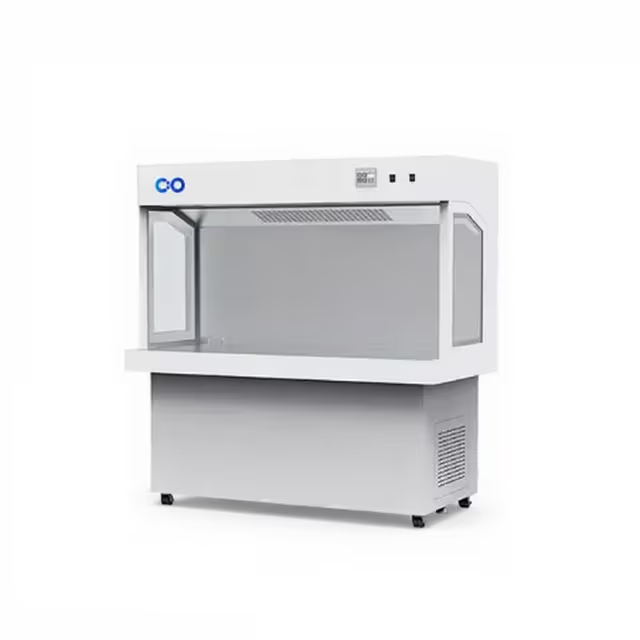
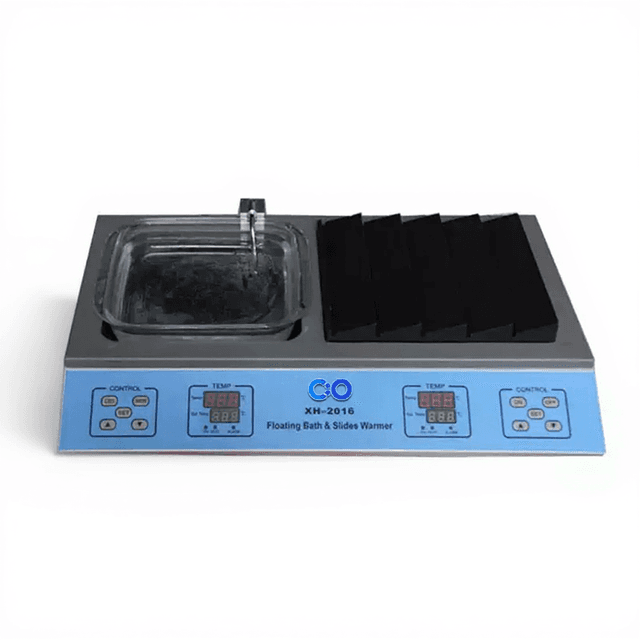
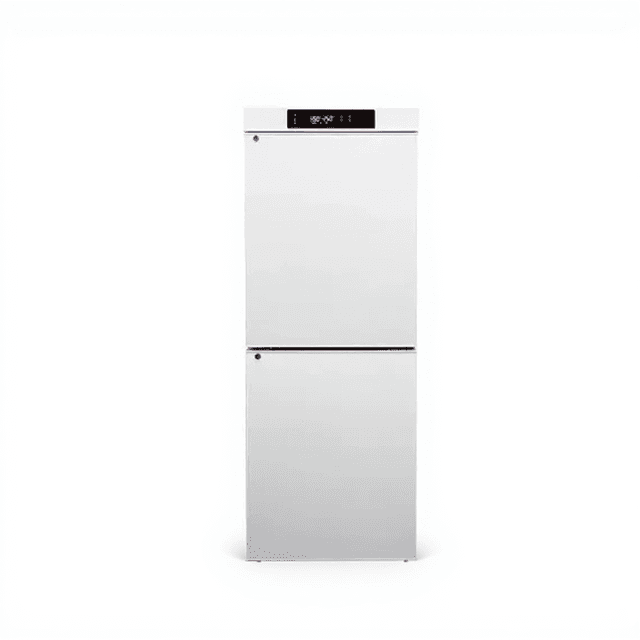
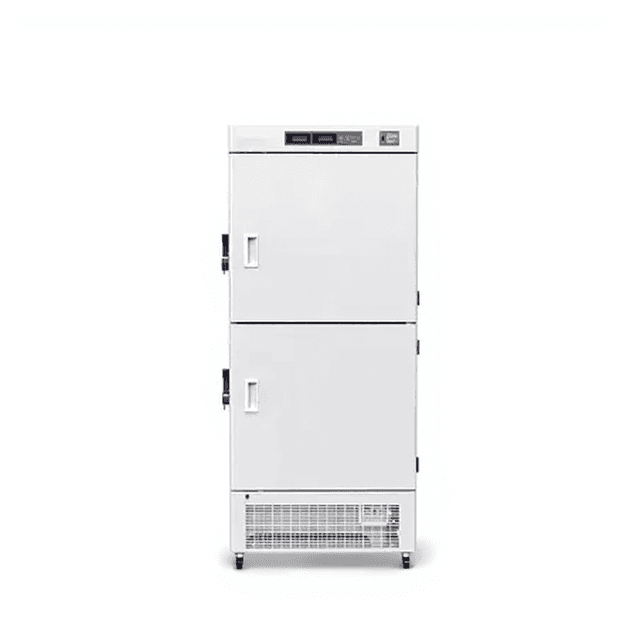
86℃ Freezer BDF-86V158 (Customized)
Ultra-low temperature freezer providing -86°C storage for long-term biological sample preservation and cryopreservation protocols in research laboratories.

Louise Corscadden, PhD
Neuroscience · ConductScience
Ask Louise about 86℃ Freezer BDF-86V158 (Customized) fit, setup, configuration, or quote prep.
Already working with us? Sign in to connect this with My Scientist.
The BDF-86V158 Ultra-Low Temperature Freezer provides -86°C storage capacity for long-term preservation of biological samples, reagents, and temperature-sensitive materials in research laboratories. This customized unit features precise temperature control and monitoring systems designed to maintain stable ultra-low temperatures required for cryopreservation protocols and biobanking applications.
The freezer incorporates advanced insulation technology and refrigeration systems to achieve and maintain temperatures suitable for preserving enzyme activity, protein stability, and nucleic acid integrity over extended storage periods. With dimensions of 82.0 × 46.5 × 45.5 cm, the unit provides compact storage capacity while delivering the temperature stability required for critical sample preservation in research environments.
How It Works
Ultra-low temperature freezers achieve -86°C operation through cascaded refrigeration systems utilizing multiple compressors and refrigerant circuits. The primary refrigeration circuit pre-cools the chamber, while a secondary ultra-low temperature circuit achieves the final target temperature through staged cooling processes.
Temperature stability is maintained through advanced insulation materials, typically polyurethane foam with vacuum panels, which minimize heat transfer and temperature fluctuations. Microprocessor-based control systems monitor internal temperatures through multiple sensors and adjust compressor operation to maintain setpoint temperatures within specified tolerances.
The freezer incorporates safety features including temperature alarms, backup systems, and insulated construction designed to maintain sample integrity during power interruptions or equipment maintenance procedures.
Features & Benefits
Automation Level
- semi-automated
Research Domain
- Analytical Chemistry
- Cancer Research
- Cell Biology
- Clinical Diagnostics
- Environmental Monitoring
- Microbiology
- Pharmaceutical QC
Weight
- 168.0 kg
Dimensions
- L: 82.0 mm
- W: 46.5 mm
- H: 45.5 mm
| Feature | This Product | Typical Alternative | Advantage |
|---|---|---|---|
| Operating Temperature | -86°C ultra-low temperature capability | Standard models often operate at -80°C | Lower temperature provides enhanced preservation of temperature-sensitive biological materials and enzymes |
| Footprint | Compact 82 × 46.5 × 45.5 cm dimensions | Larger units require more laboratory space | Space-efficient design fits in laboratories with limited floor space while maintaining storage capacity |
| Customization | Customized configuration for specific requirements | Standard models offer fixed specifications | Tailored features meet specific laboratory protocols and workflow needs |
| Temperature Control | Digital monitoring and control system | Basic models may have analog controls | Precise temperature management and real-time monitoring for critical sample protection |
The BDF-86V158 offers -86°C temperature capability in a compact, customized design suited for laboratories requiring ultra-low temperature storage with space efficiency. The unit combines precise temperature control with tailored specifications for specific research applications.
Practical Tips
Verify temperature accuracy using calibrated reference thermometer placed in chamber geometric center during monthly calibration checks.
Why: Center placement provides most representative temperature reading for overall chamber performance assessment.
Clean condenser coils quarterly and replace air filters according to manufacturer schedule to maintain cooling efficiency.
Why: Dirty coils and filters reduce cooling capacity and increase energy consumption while stressing refrigeration components.
Pre-cool samples to -20°C before transferring to ultra-low freezer to minimize temperature recovery time.
Why: Gradual temperature reduction reduces thermal shock to both samples and freezer refrigeration system.
If temperature alarms activate, check door seals and minimize door openings while monitoring temperature recovery.
Why: Door seal integrity is critical for maintaining ultra-low temperatures and preventing excessive compressor cycling.
Document door opening events and duration in temperature logs to correlate with any temperature fluctuations.
Why: Temperature excursions from door openings can affect sample integrity and should be tracked for quality control.
Ensure adequate ventilation around the unit and check that emergency alarm systems are connected to laboratory monitoring.
Why: Proper ventilation prevents overheating while alarm connectivity ensures immediate response to temperature failures.
Setup Guide
What’s in the Box
- BDF-86V158 ultra-low temperature freezer (typical)
- Power cable (typical)
- Temperature probe and sensor cables (typical)
- User manual and operation guide (typical)
- Temperature monitoring chart recorder (typical)
- Sample storage racks and dividers (typical)
Warranty
ConductScience provides standard manufacturer warranty coverage including one year parts and labor protection with technical support for installation and operational guidance.
Compliance
References
Background reading relevant to this product:
What is the temperature stability and uniformity throughout the chamber?
Consult product datasheet for specific temperature uniformity specifications and acceptable temperature variation ranges within the storage chamber.
How long does initial cooldown take to reach -86°C?
Typical cooldown time is 24-48 hours depending on ambient conditions, though exact timing should be verified from manufacturer specifications.
What backup systems are included for power failures?
Consult product datasheet for specific backup power options, battery backup duration, and temperature hold-time during power interruptions.
What is the internal storage capacity and shelf configuration?
Storage capacity and shelf arrangements depend on customized configuration - consult product specifications for exact internal dimensions and rack systems.
How often does the unit require maintenance and service?
Routine maintenance typically includes condenser cleaning, filter replacement, and temperature calibration verification - consult maintenance schedule for specific intervals.
What data logging and monitoring capabilities are available?
Temperature recording and alarm notification features vary by model - consult product datasheet for specific data logging intervals and connectivity options.
Can the unit maintain temperature during frequent door openings?
Recovery time after door openings depends on ambient conditions and door opening duration - minimize opening time to maintain temperature stability.
Have a question about this product?