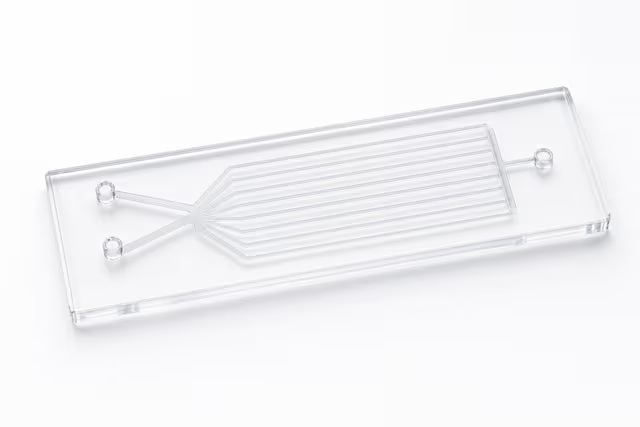
Centrifugal Heavy Metal Monitoring Chip
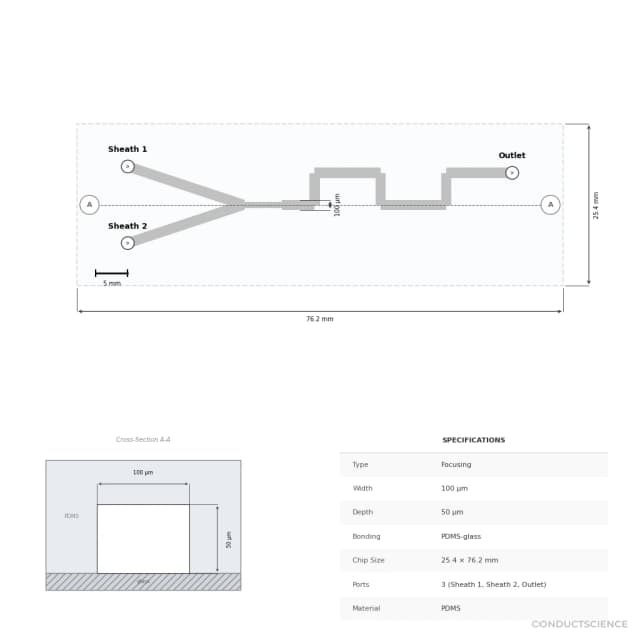
Centrifugal microfluidic chip for pump-free heavy metal detection with integrated sample preparation capabilities, designed for field-based environmental monitoring applications.
Reusable chip — designed for multiple experimental runs. Compatible with standard microfluidic tubing: steel pins (0.7 mm ID / 1.0 mm OD) and silicone tubing (0.8 mm ID / 1.9 mm OD). Available in bulk packs (5‑, 10‑, and 25‑unit) for lab-scale and consumable workflows.

Louise Corscadden, PhD
Director of Science · ConductScience
Ask Louise about Centrifugal Heavy Metal Monitoring Chip fit, setup, configuration, or quote prep.
Already working with us? Sign in to connect this with My Scientist.
Key Specifications
Full details →- Model fit
- 3 selectable configurations
- SKU family
- WHM-0133
- Shipping box
- 181.8 x 136.3 x 90.9 cm
- Ordering
- Online checkout and quote request available
- Category
- Environmental Detection Chips
- Build notes
- Confirm accessories, station layout, and support needs before purchase
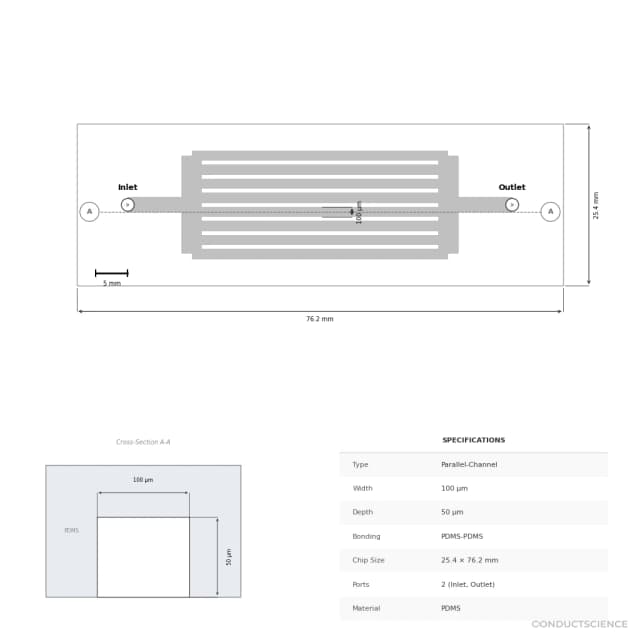
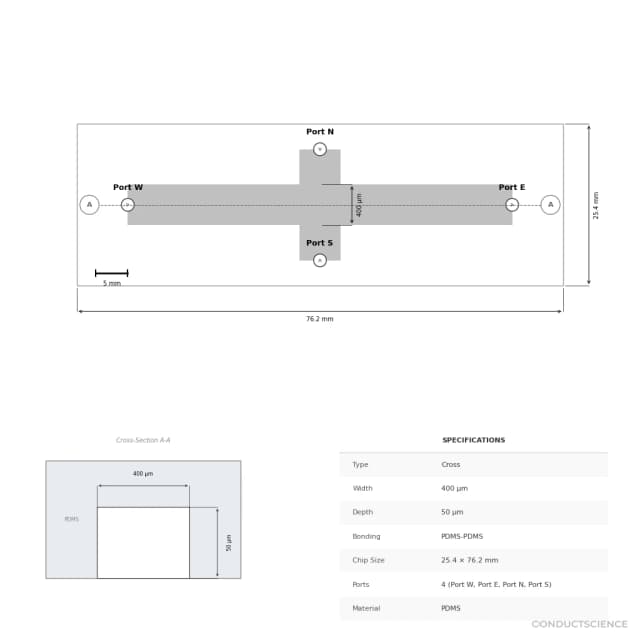
The Centrifugal Heavy Metal Monitoring Chip utilizes centrifugal force-based microfluidics to enable pump-free sample preparation and heavy metal detection in field environments. This lab-on-chip platform integrates sample processing and analysis functions within a single device featuring 1000 x 1000 μm channel dimensions for consistent fluid handling.
The chip eliminates the need for external pumping systems by leveraging centrifugal forces to drive fluid movement and mixing, making it suitable for portable environmental monitoring applications. The integrated sample preparation capability allows direct processing of environmental samples without extensive pre-treatment, while the microfluidic architecture provides controlled reaction conditions for heavy metal analysis workflows.
How It Works
The chip operates on centrifugal microfluidics principles, where controlled spinning generates centrifugal forces that drive fluid movement through the channel network without requiring external pumps or pressure sources. Sample introduction occurs at the center of the chip, with centrifugal force directing fluids outward through the 1000 x 1000 μm channels toward detection zones.
The integrated sample preparation functionality utilizes the controlled fluid dynamics within the microchannels to perform mixing, separation, or concentration steps necessary for heavy metal analysis. The centrifugal force creates predictable flow patterns that ensure consistent contact between samples and detection reagents or surfaces.
Heavy metal detection likely occurs through colorimetric, electrochemical, or fluorescence-based mechanisms within designated detection zones on the chip. The microfluidic architecture provides controlled reaction volumes and residence times, while the pump-free operation enables deployment in field environments where power and equipment constraints limit traditional analytical approaches.
Features & Benefits
Shipping weight
- 3.3 lb
Shipping box
- L: 181.8 cm
- W: 136.3 cm
- H: 90.9 cm
| Feature | This Product | Typical Alternative | Advantage |
|---|---|---|---|
| Sample Preparation Integration | Integrated sample preparation within the chip platform | Many field testing devices require separate sample preparation steps | Reduces handling steps and contamination risk while simplifying field protocols. |
| Pumping Requirements | Pump-free centrifugal operation | Most microfluidic devices require external pumps or pressure sources | Eliminates complex fluidic equipment and reduces power requirements for portable use. |
| Channel Dimensions | 1000 x 1000 μm channel dimensions | Channel sizes vary widely depending on application requirements | Provides good balance between flow control and clogging resistance for environmental samples. |
| Field Deployment | Designed specifically for field testing applications | Many heavy metal analysis methods require laboratory infrastructure | Enables on-site monitoring for time-sensitive environmental assessments. |
This chip offers integrated sample preparation and pump-free operation specifically designed for field deployment in heavy metal monitoring applications. The 1000 x 1000 μm channels provide practical flow characteristics while the centrifugal approach eliminates external pumping requirements.
| Model | SKU | Listed price | Status | Shipping box |
|---|---|---|---|---|
| 25-Pack | WHM-0133-25PK | Quote | Available | 181.8 x 136.3 x 90.9 cm |
| 10-Pack | WHM-0133-10PK | $1,490.00 | Available | 181.8 x 136.3 x 90.9 cm |
| 5-Pack | WHM-0133-5PK | Quote | Available | 181.8 x 136.3 x 90.9 cm |
Practical Tips
Filter environmental samples through appropriate membrane filters before introduction to prevent channel clogging from particulates.
Why: Large particles can block microchannels and interfere with proper flow patterns.
Run calibration standards with each batch of samples to account for day-to-day variation in detection response.
Why: Environmental conditions and reagent aging can affect detection sensitivity.
Store chips in dry conditions away from temperature extremes to prevent channel deformation or reagent degradation.
Why: Moisture and temperature cycling can affect microfluidic performance and assay reliability.
Handle environmental samples with appropriate PPE as heavy metal contamination poses health risks through skin contact.
Why: Many heavy metals are toxic and can be absorbed through skin contact.
Document centrifuge settings and environmental conditions for each analysis to enable result reproducibility.
Why: Centrifugal force and temperature can affect reaction kinetics and detection performance.
If flow patterns appear irregular, check for proper chip mounting and balance in the centrifuge system.
Why: Unbalanced or improperly mounted chips can create uneven centrifugal forces affecting fluid movement.
Setup Guide
What’s in the Box
- Centrifugal heavy metal monitoring chip
- Sample introduction accessories (typical)
- User manual with protocols
- Quality control documentation (typical)
Warranty
ConductScience provides a one-year manufacturer warranty covering defects in materials and workmanship, with technical support for protocol optimization and troubleshooting assistance.
Compliance
What types of heavy metals can this chip detect?
Consult product datasheet for specific metal detection capabilities and sensitivity ranges, as detection targets depend on the integrated assay chemistry.
What sample volumes are required for analysis?
Sample volume requirements depend on the channel network design and detection method - refer to protocol documentation for specific volumes.
Can the chip be reused or is it single-use?
The reusability depends on the chip construction and detection method used - consult manufacturer specifications for usage guidelines.
What centrifuge specifications are required?
Specific rotation speed and acceleration requirements depend on the chip design - refer to technical documentation for compatible centrifuge parameters.
How long does analysis take from sample to result?
Analysis time depends on the integrated assay protocol and required incubation steps - typical microfluidic assays range from minutes to an hour.
What detection equipment is needed to read results?
Detection method requirements depend on the assay chemistry used - may include optical readers, spectrophotometers, or electrochemical detection systems.
Are calibration standards included or available separately?
Calibration standard availability varies - contact supplier for information about reference materials and quality control options.
Have a question about this product?
Have a question? Just ask.
Send it over and we'll email you a personalized answer — no call, no scheduling.
Prefer to talk it through?