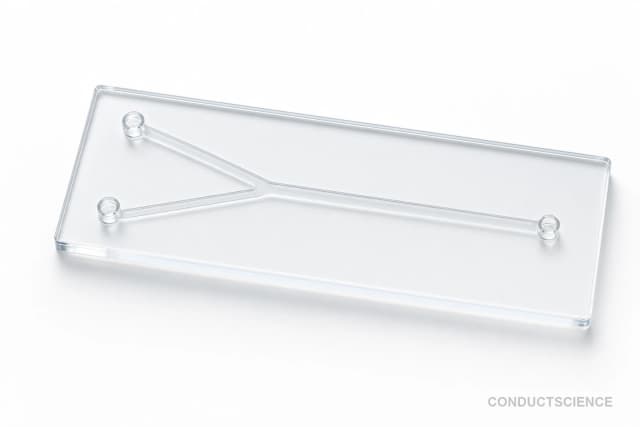
Curved-Channel Droplet Formation Chip
PDMS microfluidic chip with curved serpentine channels (100 x 100 μm) for uniform droplet generation and enhanced intra-droplet mixing through Dean flow effects.
Reusable chip — designed for multiple experimental runs. Compatible with standard microfluidic tubing: steel pins (0.7 mm ID / 1.0 mm OD) and silicone tubing (0.8 mm ID / 1.9 mm OD). Available in bulk packs (5‑, 10‑, and 25‑unit) for lab-scale and consumable workflows.

Louise Corscadden, PhD
Director of Science · ConductScience
Ask Louise about Curved-Channel Droplet Formation Chip fit, setup, configuration, or quote prep.
Already working with us? Sign in to connect this with My Scientist.
Key Specifications
Full details →- Model fit
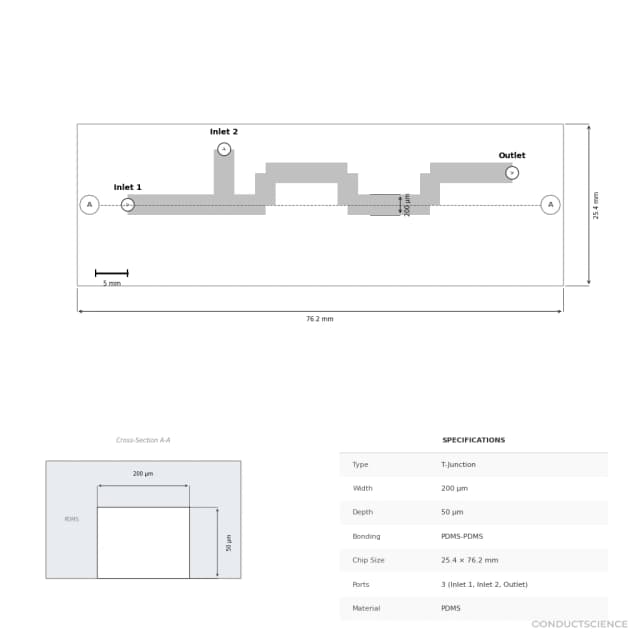
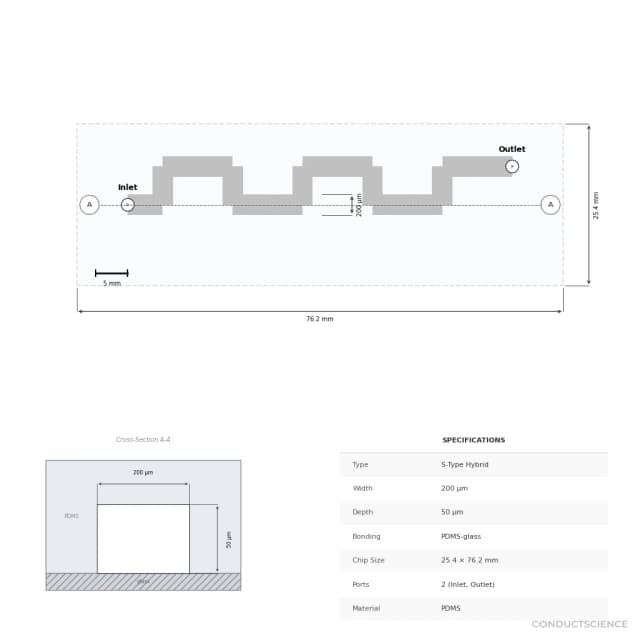
- 3 selectable configurations
- SKU family
- WHM-0091
- Shipping box
- 181.8 x 136.3 x 90.9 cm
- Ordering
- Online checkout and quote request available
- Category
- Droplet Generator Chips
- Build notes
- Confirm accessories, station layout, and support needs before purchase
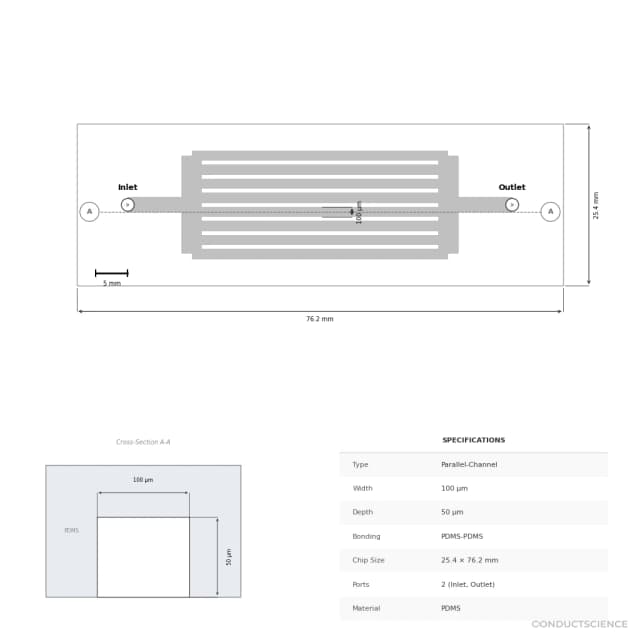
The Curved-Channel Droplet Formation Chip is a PDMS microfluidic device featuring a serpentine channel geometry designed for controlled droplet generation and intra-droplet mixing applications. The chip incorporates 100 x 100 μm channels arranged in a curved serpentine pattern that leverages Dean flow effects to enhance mixing efficiency within generated droplets.
This microfluidic platform enables researchers to produce uniform droplets while simultaneously achieving enhanced mixing through the curved channel architecture. The serpentine geometry creates secondary flow patterns that promote rapid mixing of reagents within individual droplets, making it particularly valuable for applications requiring both precise droplet formation and efficient reagent combination.
How It Works
The chip operates on microfluidic flow-focusing principles where immiscible fluids are brought together at a junction to form uniform droplets. The continuous phase fluid flows through the outer channels while the dispersed phase is introduced through the central channel, creating droplets at the intersection through interfacial tension forces and shear stress.
The curved serpentine channel geometry induces Dean flow effects, characterized by secondary flow patterns perpendicular to the main flow direction. These helical flow patterns arise from centrifugal forces as fluid navigates the curved sections, creating mixing vortices within individual droplets. This enhances mass transfer and reduces mixing times compared to straight-channel geometries.
The 100 x 100 μm channel dimensions provide optimal flow conditions for droplet sizes typically ranging from 50-200 μm depending on flow rate ratios, fluid properties, and channel wetting characteristics. The PDMS material offers optical transparency for real-time monitoring and can be easily bonded to glass substrates for integration with microscopy systems.
Features & Benefits
Shipping weight
- 3.3 lb
Shipping box
- L: 181.8 cm
- W: 136.3 cm
- H: 90.9 cm
| Feature | This Product | Typical Alternative | Advantage |
|---|---|---|---|
| Channel Geometry | Curved serpentine design with Dean flow mixing | Straight channels with limited mixing capability | Enables simultaneous droplet formation and mixing without additional downstream components |
| Channel Dimensions | 100 x 100 μm square channels | Varies by model, often circular or rectangular cross-sections | Square geometry provides predictable flow profiles and uniform shear conditions |
| Material Construction | PDMS with optical transparency | Glass, silicon, or polymer materials | Combines flexibility for easy bonding with excellent optical properties for real-time monitoring |
| Application Focus | Droplet generation with intra-droplet mixing | Droplet formation without integrated mixing | Reduces system complexity by combining two critical functions in a single device |
This chip provides integrated droplet formation and mixing capabilities through its curved serpentine design. The 100 x 100 μm PDMS channels offer good optical access while the geometry enhances mixing efficiency compared to straight-channel alternatives.
| Model | SKU | Listed price | Status | Shipping box |
|---|---|---|---|---|
| 25-Pack | WHM-0091-25PK | Quote | Available | 181.8 x 136.3 x 90.9 cm |
| 10-Pack | WHM-0091-10PK | $1,490.00 | Available | 181.8 x 136.3 x 90.9 cm |
| 5-Pack | WHM-0091-5PK | Quote | Available | 181.8 x 136.3 x 90.9 cm |
Practical Tips
Prime all channels thoroughly with continuous phase fluid before introducing the dispersed phase to ensure stable droplet formation.
Why: Air bubbles in channels can disrupt flow patterns and cause irregular droplet formation.
Start with flow rate ratios of 5:1 (continuous:dispersed) and adjust incrementally while monitoring droplet size and frequency.
Why: This ratio typically provides stable droplet formation conditions for most fluid systems.
Flush channels immediately after each experiment to prevent protein adsorption or particle accumulation that can alter channel dimensions.
Why: Residual materials can change surface properties and affect droplet formation reproducibility.
Allow the system to reach steady-state for at least 10 droplet formation cycles before collecting experimental data.
Why: Initial droplets may show size variations as flow conditions stabilize within the channels.
If droplet formation becomes irregular, check for channel blockages and verify that surface wetting conditions match your emulsion type.
Why: Changes in wetting can shift the droplet formation regime from dripping to jetting mode.
Use appropriate chemical compatibility guidelines when working with organic solvents that may cause PDMS swelling.
Why: Swollen PDMS can alter channel dimensions and compromise droplet uniformity.
Setup Guide
What’s in the Box
- Curved-channel droplet formation chip
- User manual with operational protocols (typical)
- Quality control documentation (typical)
Warranty
ConductScience provides a standard 1-year manufacturer warranty covering defects in materials and workmanship. Technical support is available for setup optimization and troubleshooting.
Compliance
What droplet size range can be achieved with this chip?
Droplet sizes typically range from 50-200 μm depending on flow rate ratios, fluid properties, and surface wetting conditions. Size is primarily controlled by adjusting the ratio of continuous to dispersed phase flow rates.
How does the curved geometry improve mixing compared to straight channels?
The serpentine curves induce Dean flow effects, creating secondary circulation patterns within the channels that enhance mixing through convective transport. This can reduce mixing times by 2-5 fold compared to diffusion-limited mixing in straight channels.
What flow rate ranges are recommended for stable droplet formation?
Consult the product datasheet for specific flow rate recommendations, as optimal ranges depend on your fluid system. Generally, continuous phase flow rates should be 2-10 times higher than dispersed phase rates to maintain stable droplet formation.
Can the chip be used with organic solvents?
PDMS has limited compatibility with organic solvents that can cause swelling. Test compatibility with your specific solvents or consider surface treatments to improve chemical resistance.
How should the chip be cleaned between experiments?
Flush channels thoroughly with appropriate solvents (typically starting with the continuous phase solvent) followed by air drying. For biological applications, use ethanol or other sterilizing agents as needed.
What surface treatments are available to modify wetting properties?
Plasma oxidation increases hydrophilicity while silanization treatments can render surfaces hydrophobic. Choice depends on your emulsion type (water-in-oil vs oil-in-water).
How many droplets can be generated per minute?
Droplet generation frequency depends on flow rates and channel geometry but typically ranges from hundreds to thousands of droplets per second. Consult product documentation for specific performance curves.
Have a question about this product?
Have a question? Just ask.
Send it over and we'll email you a personalized answer — no call, no scheduling.
Prefer to talk it through?