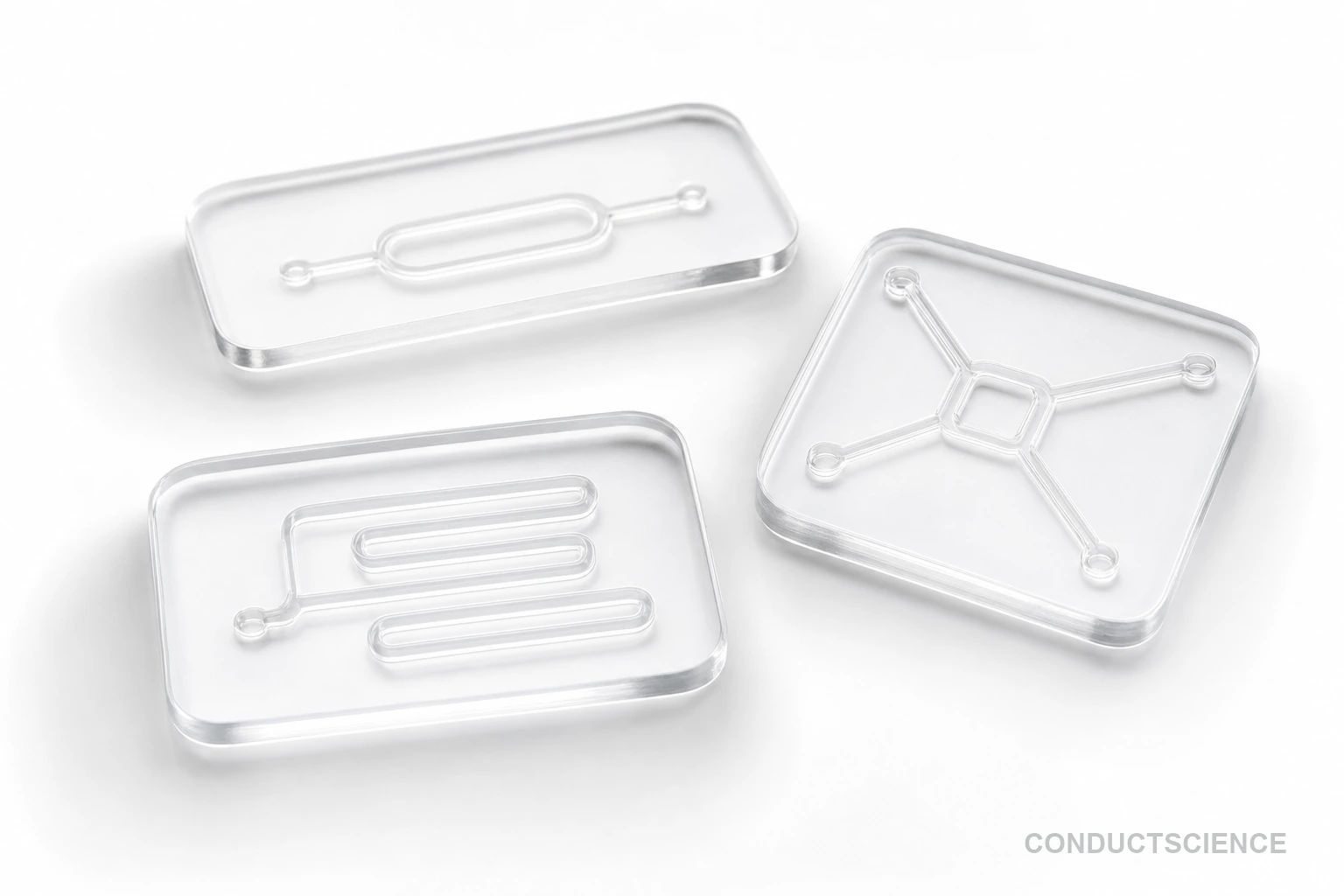
Customizable PDMS Soft Chip
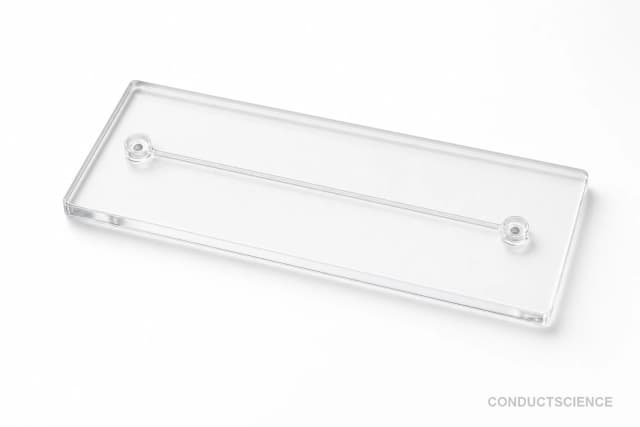
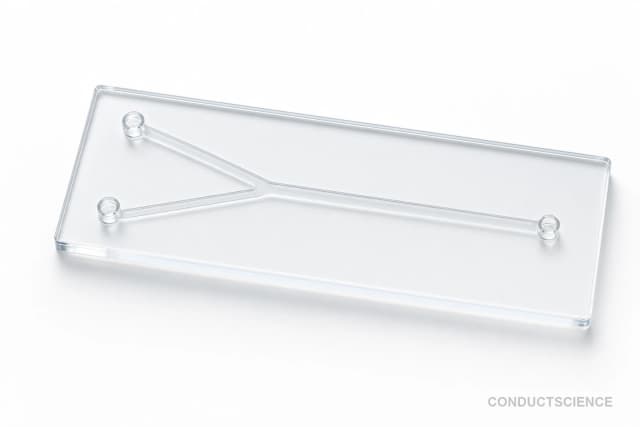
Customizable PDMS microfluidic chip for rapid prototyping and proof-of-concept studies with tailored microchannel layouts.
Reusable chip — designed for multiple experimental runs. Compatible with standard microfluidic tubing: steel pins (0.7 mm ID / 1.0 mm OD) and silicone tubing (0.8 mm ID / 1.9 mm OD). Available in bulk packs (5‑, 10‑, and 25‑unit) for lab-scale and consumable workflows.

Louise Corscadden, PhD
Director of Science · ConductScience
Ask Louise about Customizable PDMS Soft Chip fit, setup, configuration, or quote prep.
Already working with us? Sign in to connect this with My Scientist.
Key Specifications
Full details →- Model fit
- 3 selectable configurations
- SKU family
- WHM-0130
- Shipping box
- 181.8 x 136.3 x 90.9 cm
- Ordering
- Online checkout and quote request available
- Category
- Microfluidic Chips
- Build notes
- Confirm accessories, station layout, and support needs before purchase
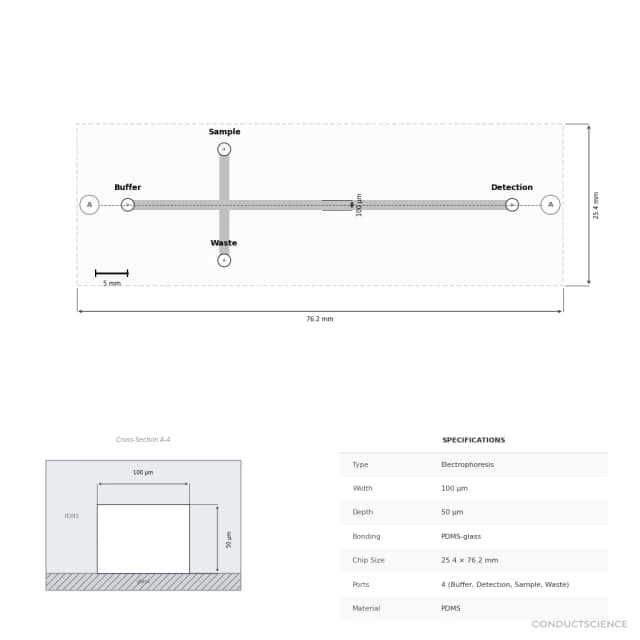
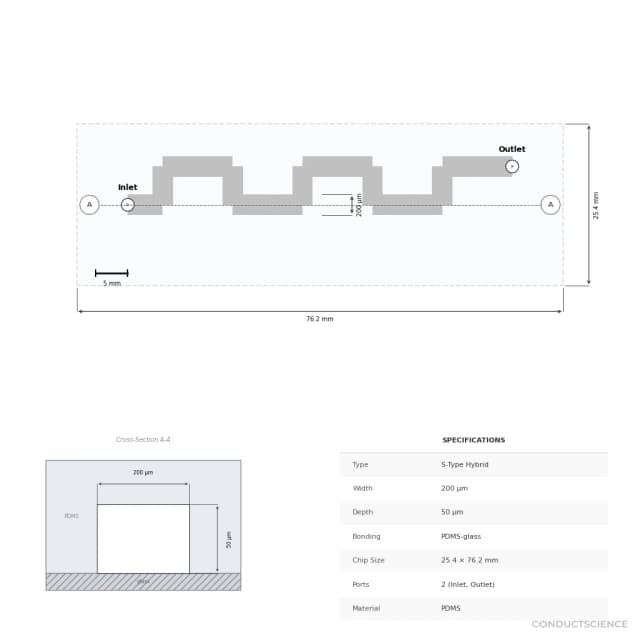
The Customizable PDMS Soft Chip is a polydimethylsiloxane-based microfluidic platform designed for rapid prototyping and proof-of-concept studies. This soft lithography device enables researchers to implement custom microchannel layouts tailored to specific experimental requirements, facilitating the development of novel microfluidic systems without the time and cost constraints of traditional photolithography processes.
PDMS material properties provide optical transparency, gas permeability, and biocompatibility essential for cell culture applications, particle manipulation, and fluid dynamics studies. The customizable design allows researchers to iterate quickly through design variations, test novel channel geometries, and validate microfluidic concepts before committing to hard master fabrication.
How It Works
PDMS microfluidic chips operate through precise control of fluid flow within microscale channels, leveraging laminar flow conditions where Reynolds numbers are typically below 1. At these scales, fluid mixing occurs primarily through molecular diffusion rather than turbulent convection, enabling predictable and reproducible fluid behavior. The PDMS material exhibits excellent optical properties with refractive index matching to water, facilitating high-resolution microscopic observation of processes within channels.
Channel dimensions and geometries determine flow characteristics according to Poiseuille's law, where volumetric flow rate is proportional to the fourth power of channel width. Custom layouts enable researchers to design specific pressure drops, residence times, and shear rates required for particular applications. The soft, elastomeric nature of PDMS allows for pneumatic valve integration and channel deformation under applied pressure, enabling active flow control and particle manipulation.
Surface chemistry can be modified through plasma treatment to alter hydrophobicity, protein adsorption, and cell adhesion properties. The gas-permeable nature of PDMS maintains oxygen and CO2 exchange essential for cell viability in long-term culture applications, while the biocompatible material minimizes toxic effects on biological samples.
Features & Benefits
Shipping weight
- 3.3 lb
Shipping box
- L: 181.8 cm
- W: 136.3 cm
- H: 90.9 cm
| Feature | This Product | Typical Alternative | Advantage |
|---|---|---|---|
| Material Properties | PDMS construction with optical transparency and gas permeability | Glass or silicon devices offer higher chemical resistance but lack gas permeability | Gas exchange is essential for maintaining cell viability in long-term culture applications. |
| Fabrication Timeline | Rapid prototyping capability for custom layouts | Traditional photolithography requires weeks for mask fabrication and clean room processing | Accelerates design iteration cycles and reduces time-to-data for proof-of-concept studies. |
| Design Flexibility | Custom layout design for application-specific requirements | Commercial chips offer fixed geometries with limited customization options | Enables optimization of channel dimensions and flow patterns for specific experimental needs. |
| Bonding Method | Reversible bonding and pneumatic valve integration capability | Glass devices require permanent bonding that limits reconfiguration options | Allows experimental setup modifications and device reuse for different applications. |
This PDMS microfluidic chip combines custom design capability with rapid prototyping advantages, making it suitable for researchers developing novel microfluidic concepts. The material properties support both cell culture applications and optical analysis requirements.
| Model | SKU | Listed price | Status | Shipping box |
|---|---|---|---|---|
| 25-Pack | WHM-0130-25PK | Quote | Available | 181.8 x 136.3 x 90.9 cm |
| 10-Pack | WHM-0130-10PK | $1,490.00 | Available | 181.8 x 136.3 x 90.9 cm |
| 5-Pack | WHM-0130-5PK | Quote | Available | 181.8 x 136.3 x 90.9 cm |
Practical Tips
Prime channels with surfactant solutions before introducing biological samples to reduce protein adsorption and improve flow stability.
Why: Surface conditioning prevents cell adhesion in undesired locations and maintains consistent flow characteristics.
Store chips in PBS or deionized water when not in use to prevent channel collapse from surface tension forces.
Why: Keeping channels hydrated maintains their geometry and prevents irreversible bonding of channel walls.
Measure actual flow rates using timed volume collection rather than relying solely on pump settings.
Why: Channel resistance can vary from theoretical calculations due to fabrication tolerances and surface effects.
Use fluorescent microspheres to visualize flow patterns and identify dead zones or recirculation areas in complex geometries.
Why: Particle tracking reveals actual flow behavior that may differ from computational fluid dynamics predictions.
Allow 5-10 channel volumes to flush through the system before data collection to achieve steady-state conditions.
Why: Initial flow transients can affect experimental results, particularly in chemical gradient or mixing studies.
Use appropriate chemical compatibility charts when introducing organic solvents, as PDMS can swell in certain chemicals.
Why: Solvent swelling can alter channel dimensions and compromise experimental reproducibility or device integrity.
Setup Guide
What’s in the Box
- Customized PDMS microfluidic chip
- Protective storage container (typical)
- Technical specification sheet (typical)
- Usage guidelines document (typical)
Warranty
ConductScience provides a one-year manufacturer warranty covering material defects and fabrication quality. Technical support is available for device optimization and troubleshooting.
Compliance
What channel depth tolerances can be achieved with PDMS molding?
Channel depth precision depends on master fabrication method and PDMS curing conditions. Consult product datasheet for specific dimensional tolerances achievable with your custom design parameters.
How many reuses are possible before channel degradation?
PDMS chip lifetime depends on applied pressures, chemical exposure, and cleaning protocols. Typical usage ranges from 10-50 experiments with proper handling and storage.
What surface treatments are compatible with PDMS?
Oxygen plasma treatment increases hydrophilicity, while silanization can create hydrophobic or functionalized surfaces. UV-ozone treatment also modifies surface chemistry for specific applications.
Can the chip be autoclaved for sterilization?
PDMS is autoclave-compatible but may experience dimensional changes. Alternative sterilization methods include UV irradiation, gamma sterilization, or chemical disinfection.
What maximum pressure can the channels withstand?
Pressure tolerance depends on channel dimensions, bonding strength, and PDMS thickness. Consult product specifications for pressure limits specific to your custom design.
How is the custom design specified when ordering?
Provide CAD files, channel dimensions, inlet/outlet specifications, and overall chip dimensions. Design review ensures manufacturability and performance requirements are met.
Have a question about this product?
Have a question? Just ask.
Send it over and we'll email you a personalized answer — no call, no scheduling.
Prefer to talk it through?