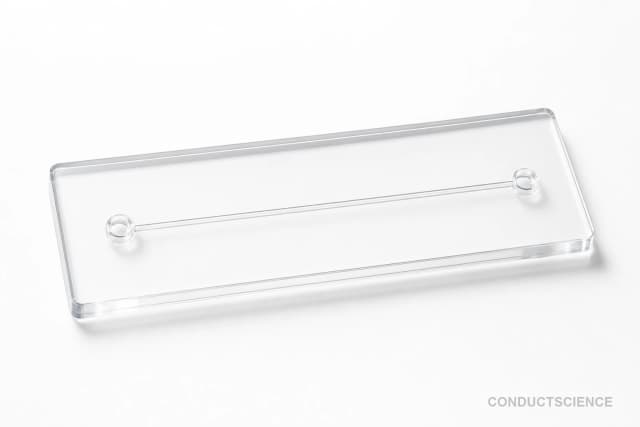
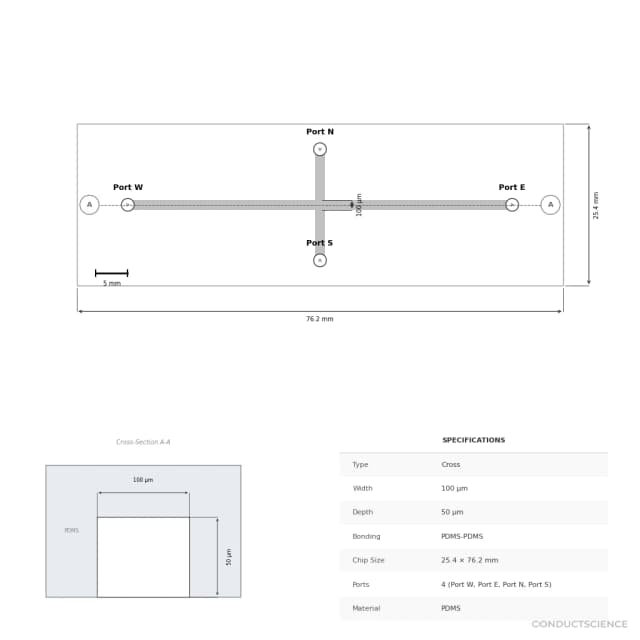
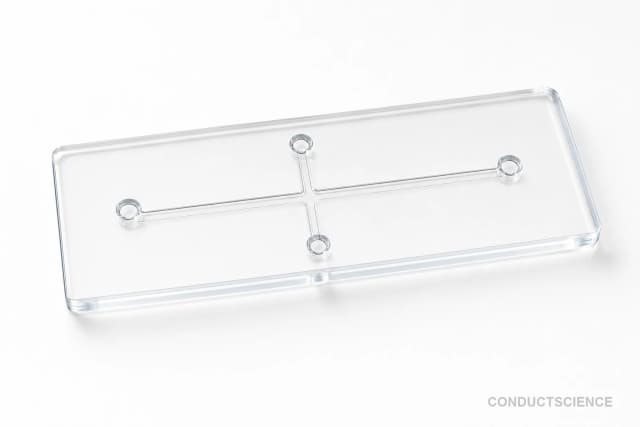
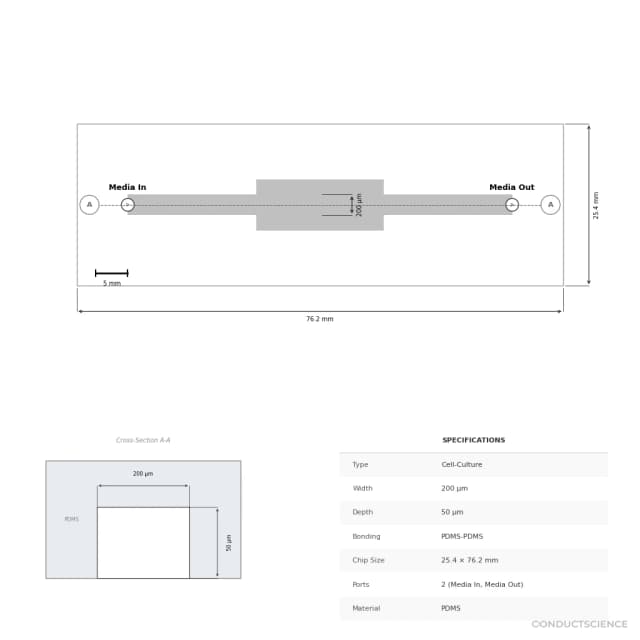
Double-Sided Y-Type Chip (1000 um)
Precision microfluidic chip with dual Y-junction geometry and 1000 μm channels, engineered for high-flow applications with viscous fluids.
Reusable chip — designed for multiple experimental runs. Compatible with standard microfluidic tubing: steel pins (0.7 mm ID / 1.0 mm OD) and silicone tubing (0.8 mm ID / 1.9 mm OD). Available in bulk packs (5‑, 10‑, and 25‑unit) for lab-scale and consumable workflows.

Louise Corscadden, PhD
Director of Science · ConductScience
Ask Louise about Double-Sided Y-Type Chip (1000 um) fit, setup, configuration, or quote prep.
Already working with us? Sign in to connect this with My Scientist.
Key Specifications
Full details →- Model fit
- 3 selectable configurations
- SKU family
- WHM-0115
- Shipping box
- 181.8 x 136.3 x 90.9 cm
- Ordering
- Online checkout and quote request available
- Category
- Microfluidic Chips
- Build notes
- Confirm accessories, station layout, and support needs before purchase
The Double-Sided Y-Type Chip (1000 μm) is a precision microfluidic device engineered for high-flow applications involving viscous fluids. This chip features dual Y-junction geometry with 1000 × 1000 μm channel dimensions, providing substantial flow capacity for demanding microfluidic experiments. The double-sided configuration enables complex fluid manipulation protocols requiring multiple inlet streams and enhanced mixing capabilities.
Designed for research applications requiring robust fluid handling, this chip accommodates viscous samples that would challenge smaller channel geometries. The Y-junction architecture facilitates controlled fluid merging, droplet generation, and multi-phase flow studies. Researchers working with cell suspensions, polymer solutions, or other high-viscosity fluids will find the generous channel dimensions prevent clogging while maintaining precise flow control.
How It Works
The Double-Sided Y-Type Chip operates on the principle of controlled hydrodynamic focusing within microchannels. Fluid streams enter through separate inlets and converge at the Y-junction, where flow rates and viscosity ratios determine mixing behavior and droplet formation characteristics. The 1000 × 1000 μm channel cross-section provides sufficient space for viscous fluids to flow without excessive pressure buildup while maintaining laminar flow conditions.
The double-sided configuration allows for complex flow patterns including multi-phase systems and sequential mixing operations. At the junction point, fluid streams interact based on their relative flow rates, viscosities, and surface tension properties. For droplet generation applications, the dispersed phase forms droplets within the continuous phase, with droplet size controlled by flow rate ratios and channel geometry. The large channel dimensions accommodate particles, cells, or other suspended materials that require gentle handling.
Features & Benefits
Shipping weight
- 3.3 lb
Shipping box
- L: 181.8 cm
- W: 136.3 cm
- H: 90.9 cm
| Feature | This Product | Typical Alternative | Advantage |
|---|---|---|---|
| Channel Dimensions | 1000 × 1000 μm | Entry-level chips often feature 100-500 μm channels | Larger channels prevent clogging with viscous fluids and accommodate particle-laden samples that would block smaller devices. |
| Junction Configuration | Double-sided Y-junction | Single-sided junctions with fewer inlet options | Multiple inlet pathways enable complex multi-phase experiments and sequential mixing protocols. |
| Flow Capacity | High-flow design for viscous fluids | Standard designs optimized for low-viscosity aqueous solutions | Enables processing of polymer solutions, cell suspensions, and other challenging materials at practical flow rates. |
| Application Focus | Engineered specifically for viscous fluid handling | General-purpose designs with limited viscosity tolerance | Specialized geometry prevents the flow instabilities and pressure buildup common when using viscous fluids in standard microfluidic devices. |
This chip offers specialized capabilities for high-viscosity fluid applications through its generous channel dimensions and double-sided Y-junction configuration. The design prioritizes flow capacity and clogging resistance while maintaining the controlled environment benefits of microfluidic technology.
| Model | SKU | Listed price | Status | Shipping box |
|---|---|---|---|---|
| 25-Pack | WHM-0115-25PK | Quote | Available | 181.8 x 136.3 x 90.9 cm |
| 10-Pack | WHM-0115-10PK | $1,490.00 | Available | 181.8 x 136.3 x 90.9 cm |
| 5-Pack | WHM-0115-5PK | Quote | Available | 181.8 x 136.3 x 90.9 cm |
Practical Tips
Pre-warm viscous fluids to reduce viscosity during initial channel priming and improve flow stability.
Why: Lower viscosity during setup reduces bubble formation and ensures complete channel filling.
Flush channels immediately after each use with appropriate cleaning solvents to prevent residue buildup.
Why: Viscous fluids can leave films that accumulate over time and affect channel performance.
Establish pressure-flow relationships for each fluid type before beginning experiments.
Why: Viscous fluids exhibit non-linear pressure-flow behavior that must be characterized for reproducible results.
Monitor flow stability continuously rather than relying on initial flow rate settings.
Why: Viscous fluids can show time-dependent flow behavior due to temperature changes or settling effects.
If droplet formation becomes irregular, check for partial blockages or air bubble accumulation at junction points.
Why: The large channels can mask partial obstructions that still affect flow symmetry and droplet consistency.
Use appropriate chemical-resistant materials for all fluid connections when working with organic solvents or aggressive chemicals.
Why: Viscous fluid applications often require solvents or reactive chemicals that can degrade standard tubing materials.
Setup Guide
What’s in the Box
- Double-Sided Y-Type Chip (1000 μm)
- Technical specification sheet (typical)
- Handling and storage instructions (typical)
Warranty
ConductScience provides a one-year manufacturer warranty covering defects in materials and workmanship. Technical support includes application guidance and troubleshooting assistance.
Compliance
What is the maximum viscosity this chip can handle effectively?
The 1000 μm channel dimensions accommodate high-viscosity fluids, but maximum viscosity depends on available pump pressure and desired flow rates. Consult product datasheet for specific viscosity-flow rate relationships and pressure requirements.
How do I prevent bubble formation in viscous fluid applications?
Prime channels slowly with degassed fluids, maintain consistent back-pressure, and consider pre-warming viscous solutions to reduce viscosity during initial filling. Use hydrophilic surface treatments if bubble adhesion becomes problematic.
What flow rate ratios work best for droplet generation?
Optimal ratios depend on fluid properties, but typically range from 1:5 to 1:20 (dispersed:continuous). Start with 1:10 ratio and adjust based on desired droplet size and formation frequency while monitoring pressure stability.
Can this chip handle particle-laden suspensions?
Yes, the 1000 μm channels accommodate suspended particles and cells much larger than conventional microfluidic devices. Ensure particle size remains well below channel dimensions to prevent settling or aggregation issues.
How do I clean the chip between different fluid types?
Flush with appropriate cleaning solvents based on fluid compatibility, followed by DI water rinse. For protein or cell-based applications, consider enzymatic cleaning solutions before solvent washing to remove biological residues.
What pressure ranges are typical for this chip geometry?
Operating pressures vary with fluid viscosity and flow rates. The large channel cross-section minimizes pressure drop compared to smaller devices. Consult product datasheet for pressure-flow relationships with different fluid types.
How does this compare to smaller channel microfluidic devices?
This chip offers higher throughput and viscous fluid compatibility at the cost of some mixing efficiency compared to sub-100 μm devices. Choose based on whether sample volume and viscosity handling outweigh the benefits of smaller-scale mixing.
Have a question about this product?
Have a question? Just ask.
Send it over and we'll email you a personalized answer — no call, no scheduling.
Prefer to talk it through?