Droplet Reaction and Collection Chip
Standard format microfluidic chip with integrated reaction chambers and collection zones for droplet incubation and analysis workflows.
Reusable chip — designed for multiple experimental runs. Compatible with standard microfluidic tubing: steel pins (0.7 mm ID / 1.0 mm OD) and silicone tubing (0.8 mm ID / 1.9 mm OD). Available in bulk packs (5‑, 10‑, and 25‑unit) for lab-scale and consumable workflows.

Louise Corscadden, PhD
Director of Science · ConductScience
Ask Louise about Droplet Reaction and Collection Chip fit, setup, configuration, or quote prep.
Already working with us? Sign in to connect this with My Scientist.
Key Specifications
Full details →- Model fit
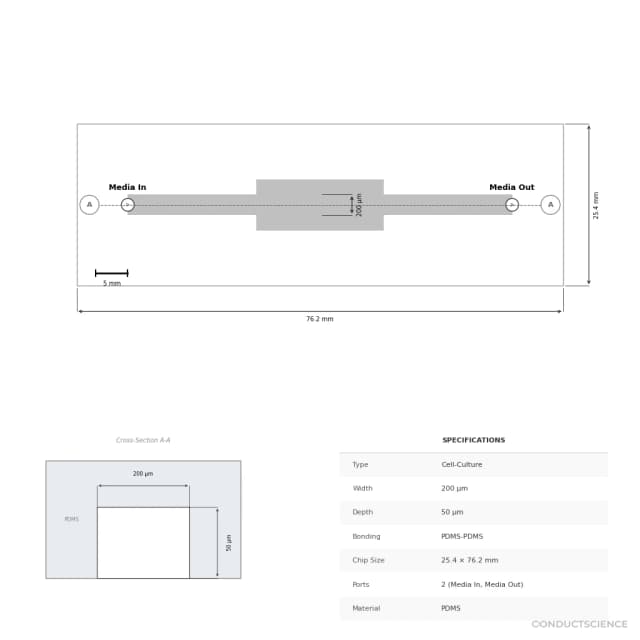
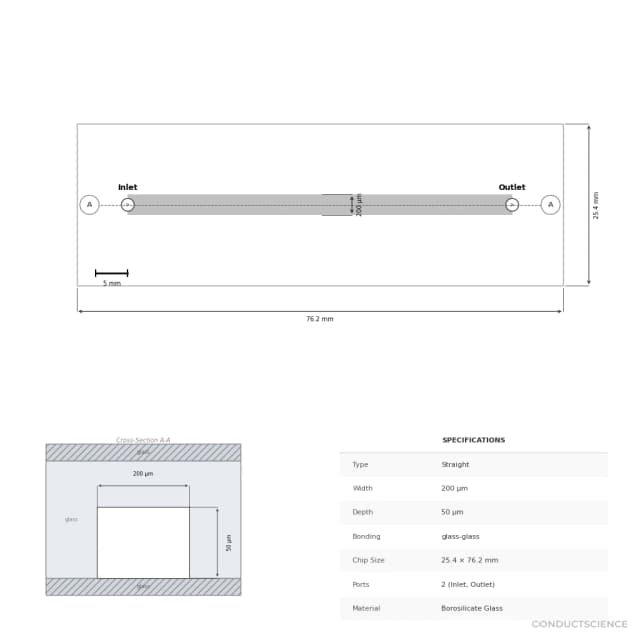
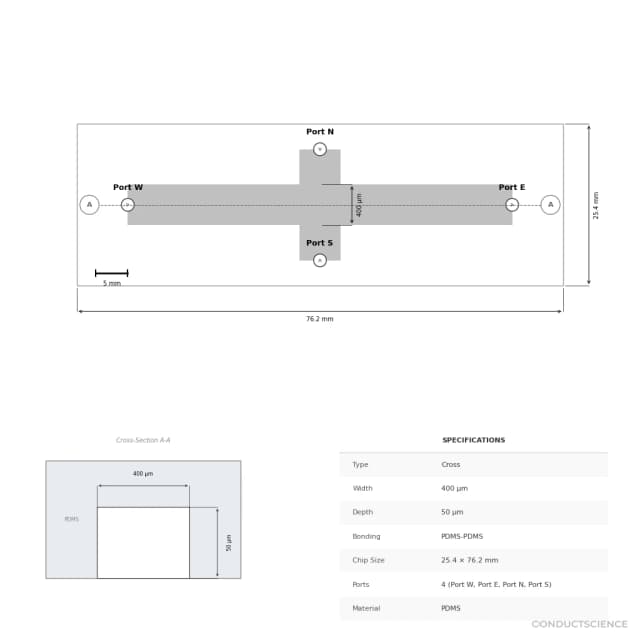
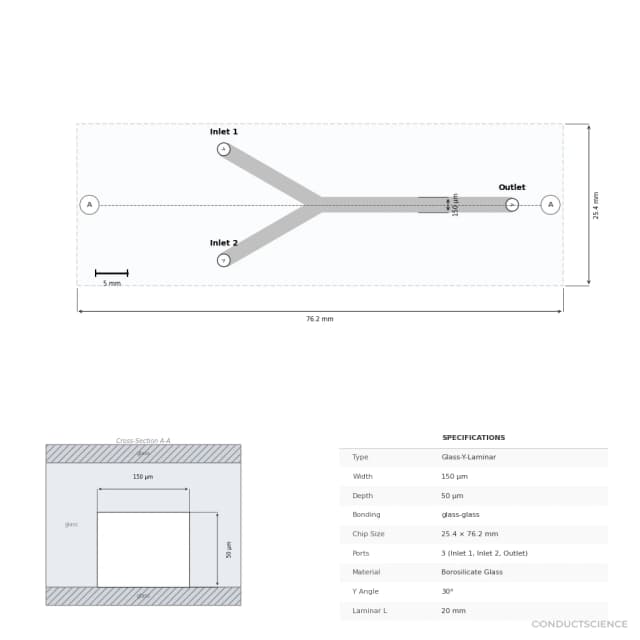
- 3 selectable configurations
- SKU family
- WHM-0099
- Shipping box
- 181.8 x 136.3 x 90.9 cm
- Ordering
- Online checkout and quote request available
- Category
- Droplet Generator Chips
- Build notes
- Confirm accessories, station layout, and support needs before purchase
The Droplet Reaction and Collection Chip is a specialized microfluidic device designed for compartmentalized droplet-based reactions and analysis. Manufactured in standard microscope slide format (25 x 76 mm), this chip provides dedicated reaction chambers coupled with collection zones to enable controlled droplet incubation and subsequent analysis workflows.
The chip features configurable channel spacing at either 4.5 mm or 9 mm intervals, allowing researchers to adapt the device to their specific experimental requirements and imaging systems. The integrated reaction chambers and collection zones support droplet manipulation protocols where precise control over reaction conditions and sample recovery is essential for downstream analysis.
How It Works
The Droplet Reaction and Collection Chip operates on the principle of compartmentalized microfluidic reactions within discrete droplet volumes. Aqueous samples are encapsulated in immiscible carrier oil to form monodisperse droplets that serve as individual reaction vessels. Each droplet functions as an isolated microreactor, preventing cross-contamination between reactions while maintaining uniform reaction conditions.
The chip architecture incorporates dedicated reaction chambers where droplets are temporarily held for incubation periods, allowing biochemical reactions to proceed under controlled conditions. The collection zones enable selective recovery of droplets based on reaction outcomes or predetermined criteria. This design facilitates temporal control over reaction kinetics and enables downstream analysis of individual droplet contents.
Channel spacing at 4.5 mm or 9 mm intervals provides compatibility with standard microscopy and detection systems, allowing real-time monitoring of droplet-based reactions through optical methods including fluorescence, brightfield, and phase contrast imaging.
Features & Benefits
Shipping weight
- 3.3 lb
Shipping box
- L: 181.8 cm
- W: 136.3 cm
- H: 90.9 cm
| Feature | This Product | Typical Alternative | Advantage |
|---|---|---|---|
| Device Format | Standard microscope slide format (25 x 76 mm) | Custom formats often require specialized holders | Direct integration with existing microscopy and automation systems without additional hardware. |
| Channel Spacing | Configurable 4.5 mm or 9 mm spacing | Fixed spacing limits compatibility | Adaptable to different optical configurations and detection requirements. |
| Integrated Design | Combined reaction chambers and collection zones | Separate devices for reaction and collection | Streamlined workflow reduces handling steps and potential sample loss. |
| Application Scope | Droplet incubation and analysis workflows | Single-purpose devices for either generation or analysis | Complete droplet workflow capability in a single device reduces system complexity. |
This chip combines reaction and collection capabilities in a standard slide format with configurable channel spacing. The integrated design supports complete droplet workflows while maintaining compatibility with existing laboratory systems.
| Model | SKU | Listed price | Status | Shipping box |
|---|---|---|---|---|
| 25-Pack | WHM-0099-25PK | Quote | Available | 181.8 x 136.3 x 90.9 cm |
| 10-Pack | WHM-0099-10PK | $1,490.00 | Available | 181.8 x 136.3 x 90.9 cm |
| 5-Pack | WHM-0099-5PK | Quote | Available | 181.8 x 136.3 x 90.9 cm |
Practical Tips
Maintain consistent temperature during droplet incubation to ensure reproducible reaction kinetics across all compartments.
Why: Temperature variations can lead to different reaction rates between droplets, affecting data consistency.
Flush channels with appropriate cleaning solutions between different sample types to prevent carryover contamination.
Why: Residual materials from previous experiments can interfere with subsequent analyses and compromise data quality.
Verify droplet size distribution using optical measurement before each experimental series.
Why: Consistent droplet volumes are essential for accurate quantitative analysis and reproducible results.
Monitor droplet stability during extended incubation periods to detect coalescence or evaporation effects.
Why: Droplet integrity directly impacts reaction compartmentalization and final data interpretation.
If droplet formation becomes irregular, check for channel blockages or air bubbles in the fluidic connections.
Why: Flow irregularities can disrupt droplet monodispersity and affect downstream collection efficiency.
Use appropriate personal protective equipment when handling organic carrier oils and cleaning solvents.
Why: Chemical exposure risks require proper safety protocols during device operation and maintenance.
Setup Guide
What’s in the Box
- Droplet Reaction and Collection Chip
- Product specification sheet
- Handling and storage instructions (typical)
Warranty
ConductScience provides standard manufacturer warranty coverage with technical support for proper device functionality under normal laboratory use conditions.
Compliance
What droplet size range can be generated with this chip?
Droplet size depends on flow rate ratios and channel geometry. Consult product datasheet for specific size ranges achievable with your experimental conditions.
Is the chip compatible with organic solvents?
Material compatibility varies by solvent type and concentration. Contact technical support for specific solvent compatibility information before use.
How many droplets can be processed simultaneously?
Processing capacity depends on channel configuration and experimental protocol. The reaction chambers and collection zones can accommodate multiple droplets based on your specific workflow requirements.
Can the chip be reused for multiple experiments?
Reusability depends on experimental conditions and cleaning protocols. Proper cleaning and inspection procedures should be followed between uses.
What imaging systems are compatible with this chip format?
The standard slide format (25 x 76 mm) is compatible with most inverted and upright microscopy systems. Channel spacing options accommodate different objective configurations.
What is the maximum operating pressure for this chip?
Operating pressure limits depend on device fabrication and materials. Consult product specifications for pressure rating information.
How do I optimize collection efficiency from the collection zones?
Collection efficiency depends on flow dynamics, droplet properties, and timing protocols. Empirical optimization of flow rates and collection timing is typically required.
Have a question about this product?
Have a question? Just ask.
Send it over and we'll email you a personalized answer — no call, no scheduling.
Prefer to talk it through?