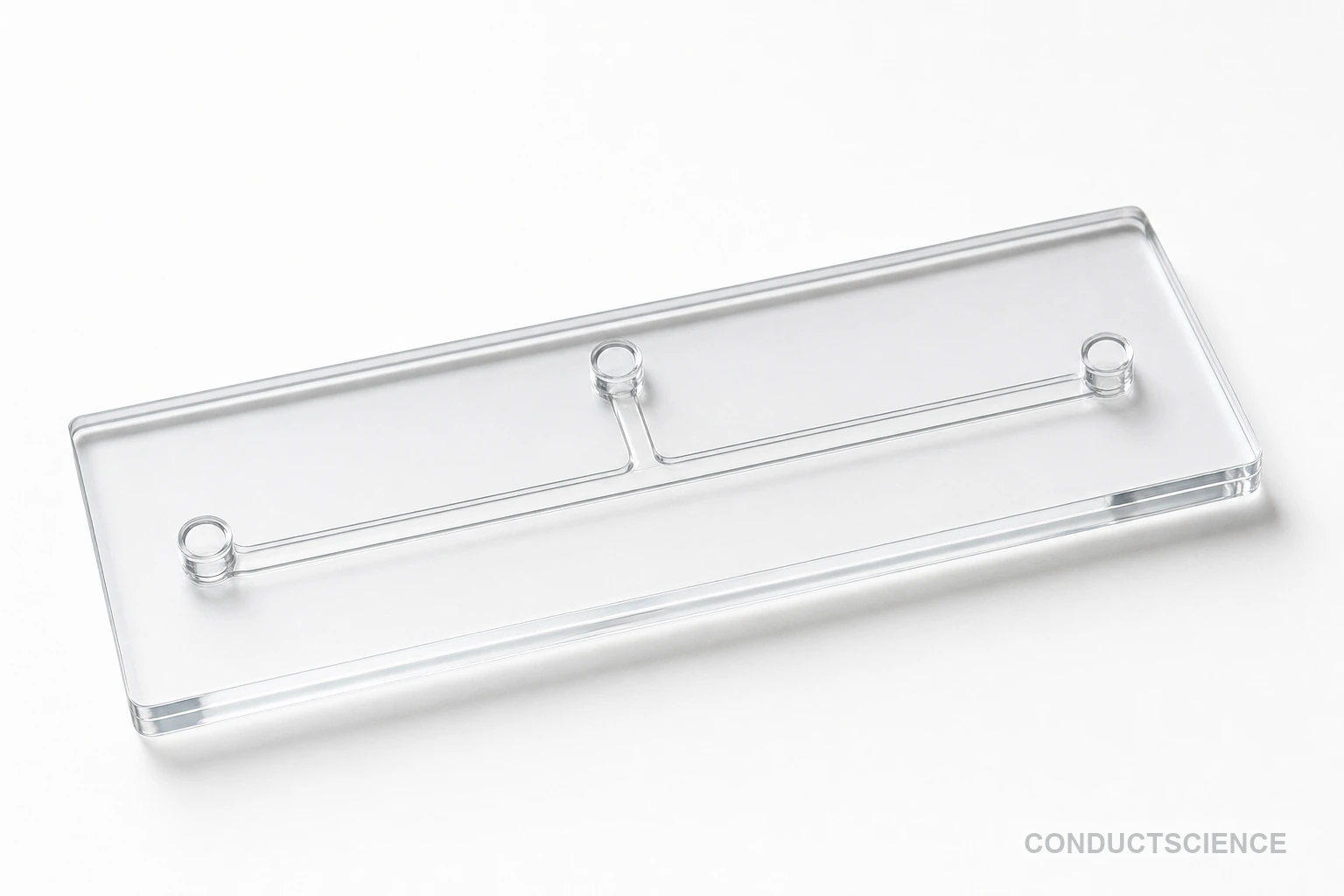
T-Channel Droplet Generator Glass Chip
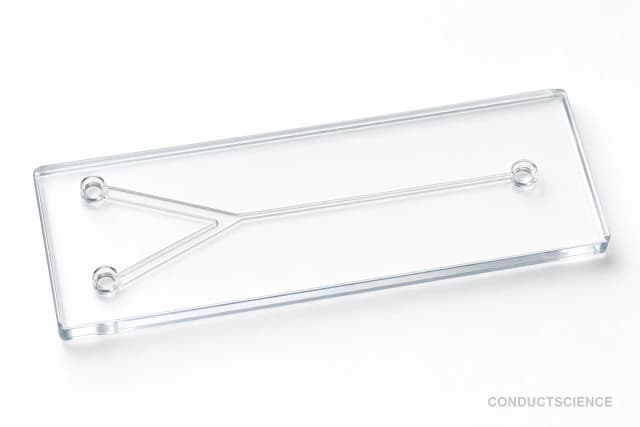
Borosilicate glass microfluidic chip with T-junction design for generating monodisperse droplets from 10-250 μm diameter with <3% coefficient of variation.
Reusable chip — designed for multiple experimental runs. Compatible with standard microfluidic tubing: steel pins (0.7 mm ID / 1.0 mm OD) and silicone tubing (0.8 mm ID / 1.9 mm OD). Available in bulk packs (5‑, 10‑, and 25‑unit) for lab-scale and consumable workflows.

Louise Corscadden, PhD
Director of Science · ConductScience
Ask Louise about T-Channel Droplet Generator Glass Chip fit, setup, configuration, or quote prep.
Already working with us? Sign in to connect this with My Scientist.
Key Specifications
Full details →- Model fit
- 3 selectable configurations
- SKU family
- WHM-0003
- Shipping box
- 22.5 x 15.0 x 4.0 cm
- Ordering
- Online checkout and quote request available
- Category
- Glass Chips
- Build notes
- Confirm accessories, station layout, and support needs before purchase
The T-Channel Droplet Generator Glass Chip is a precision microfluidic device designed for monodisperse droplet formation in laboratory applications. Constructed from borosilicate glass, this chip features a T-junction geometry that enables controlled generation of uniform droplets ranging from 10 to 250 micrometers in diameter with coefficient of variation below 3%.
The device operates at pressures up to 10 bar and incorporates two inlet ports for continuous and dispersed phases, with a single outlet for droplet collection. The compact 22.5 x 15 x 4 mm form factor facilitates integration into existing microfluidic systems while maintaining precise flow control and droplet consistency required for quantitative research applications.
Key Specs
| Material | Borosilicate glass (glass-glass bonding) |
|---|---|
| Geometry | T-junction droplet generator with separate continuous/dispersed phase widths |
| Ports | 3 ports (Continuous Phase, Dispersed Phase, Outlet) |
| Chip footprint | 25.4 x 76.2mm standard glass slide |
| Channel width | 110 um, 150 um, 160 um, 200 um, 250 um, 300 um, 350 um, 400 um |
| Channel depth | 30 um, 50 um, 100 um, 150 um |
| Bonding | glass-glass |
| Packaging | Standard glass chip with PEEK/stainless steel connectors |
| Source | suppliers/wenhao/docs/glass-chips-catalog.json; 3.2.001.05.0010-0017 |
This source-backed block lists available source configurations; confirm selected width/bonding when quoting.
How It Works
The T-channel droplet generator operates on the principle of flow-focusing in a T-junction geometry. Two immiscible fluids are introduced through separate inlet channels - typically an aqueous continuous phase and an oil-based dispersed phase. At the T-junction, the dispersed phase stream is sheared by the continuous phase flow, creating periodic droplet breakoff driven by surface tension forces and viscous shear stress.
Droplet size is controlled by adjusting the flow rate ratio between the continuous and dispersed phases, with higher continuous phase flow rates producing smaller droplets. The channel geometry and surface properties of the borosilicate glass facilitate reproducible droplet formation through consistent wetting characteristics and uniform flow profiles.
The narrow size distribution (CV <3%) results from the laminar flow regime within the microchannels, which eliminates turbulent mixing and ensures uniform shear conditions at the droplet formation point. Generated droplets exit through the single outlet port for downstream collection or analysis.
Features & Benefits
Shipping weight
- 0.05 lb
Shipping box
- L: 22.5 cm
- W: 15.0 cm
- H: 4.0 cm
| Feature | This Product | Typical Alternative | Advantage |
|---|---|---|---|
| Droplet Size Range | 10-250 μm diameter | Many devices limited to narrower ranges or larger minimum sizes | Broad size range accommodates diverse experimental requirements from single-cell studies to materials applications |
| Size Distribution | <3% coefficient of variation | Standard microfluidic devices often achieve 3-5% CV | Superior monodispersity critical for quantitative analysis and reproducible experimental conditions |
| Pressure Rating | 10 bar maximum | PDMS devices typically limited to 2-3 bar | Higher pressure capability enables processing of viscous fluids and faster production rates |
| Construction Material | Borosilicate glass | Polymer-based devices common in market | Glass provides superior chemical resistance and optical clarity for diverse solvent compatibility |
| Junction Design | T-Channel configuration | Flow-focusing geometries also available | T-junction offers predictable droplet control and stable formation across wide flow rate ranges |
This glass microfluidic chip combines broad droplet size capability with exceptional monodispersity and chemical resistance. The 10 bar pressure rating and T-junction design provide reliable droplet formation for demanding laboratory applications requiring precise size control.
| Model | SKU | Listed price | Status | Shipping box |
|---|---|---|---|---|
| 25-Pack | WHM-0003-25PK | Quote | Available | 22.5 x 15.0 x 4.0 cm |
| 10-Pack | WHM-0003-10PK | $1,490.00 | Available | 22.5 x 15.0 x 4.0 cm |
| 5-Pack | WHM-0003-5PK | Quote | Available | 22.5 x 15.0 x 4.0 cm |
Practical Tips
Establish droplet size calibration curves for your specific fluid systems and flow rate ranges before starting experiments.
Why: Calibration ensures reproducible droplet sizes and facilitates protocol optimization across different experimental conditions.
Flush channels with appropriate cleaning solvents immediately after each use and store filled with compatible storage solution.
Why: Prompt cleaning prevents protein adsorption or chemical deposits that can alter surface properties and droplet formation.
Use precision syringe pumps with pulse-free flow delivery for optimal droplet uniformity and formation stability.
Why: Flow rate fluctuations directly impact droplet size consistency and can compromise the <3% coefficient of variation specification.
If droplet formation becomes irregular, check for air bubbles in inlet lines and verify consistent flow rates at both inlets.
Why: Air bubbles or flow instabilities disrupt the laminar flow conditions required for stable droplet breakoff at the T-junction.
Collect droplet size measurements from at least 100 droplets to accurately characterize size distribution and verify coefficient of variation.
Why: Statistical significance requires adequate sample size to distinguish true size variation from measurement uncertainty.
Handle glass chips with appropriate care and inspect for cracks before each use, especially after exposure to temperature cycling.
Why: Glass fracture can create sharp fragments and compromise experimental safety, particularly under pressure.
Pre-wet channels with continuous phase fluid before introducing dispersed phase to establish proper wetting conditions.
Why: Consistent wetting ensures predictable droplet formation and prevents irregular breakoff patterns during startup.
Store chips in dust-free environment and protect channel openings from contamination between uses.
Why: Particle contamination can cause channel blockage or irregular droplet formation, compromising experimental reproducibility.
Setup Guide
What’s in the Box
- T-Channel Droplet Generator Glass Chip
- User manual (typical)
- Certificate of inspection (typical)
Warranty
ConductScience provides a standard 1-year manufacturer warranty covering defects in materials and workmanship. Technical support includes application guidance and troubleshooting assistance for optimal droplet generation performance.
Compliance
What flow rate ratios typically produce droplets in the 50-100 μm range?
Consult product datasheet for specific flow rate recommendations. Droplet size generally decreases with increasing continuous phase flow rate relative to dispersed phase flow rate.
Is the chip compatible with organic solvents like hexane or chloroform?
Borosilicate glass construction provides broad chemical compatibility. Verify solvent compatibility with any sealing materials used in your specific fluidic connections.
How do I prevent channel clogging during operation?
Filter all fluids through appropriate membrane filters before use. Maintain consistent flow rates and avoid air bubbles in the system. Clean channels immediately after use.
Can I use this chip for water-in-oil emulsions?
Yes, the T-junction design accommodates both oil-in-water and water-in-oil emulsion formation depending on wetting characteristics and flow conditions.
What microscopy setup is recommended for droplet monitoring?
Standard inverted microscope with appropriate magnification for your droplet size range. High-speed camera capability beneficial for monitoring formation dynamics.
How many droplets can be generated before cleaning is required?
Operating duration depends on fluid properties and formation rate. Monitor for size drift or formation irregularities as indicators for cleaning requirements.
What surface treatments are available for specific wetting properties?
Consult manufacturer for available surface modifications. Standard borosilicate provides hydrophilic surfaces suitable for most aqueous applications.
Have a question about this product?
Have a question? Just ask.
Send it over and we'll email you a personalized answer — no call, no scheduling.
Prefer to talk it through?