
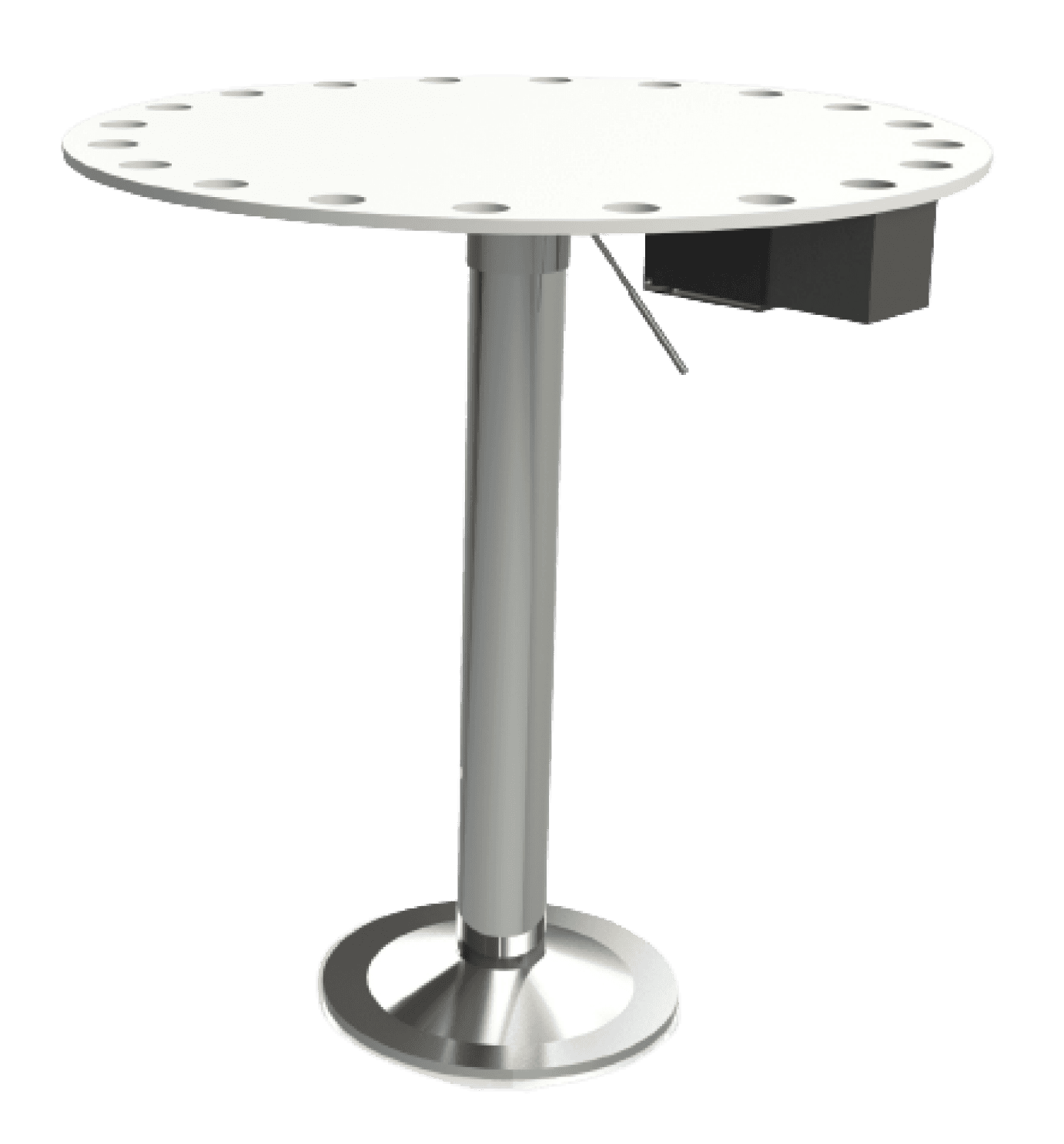
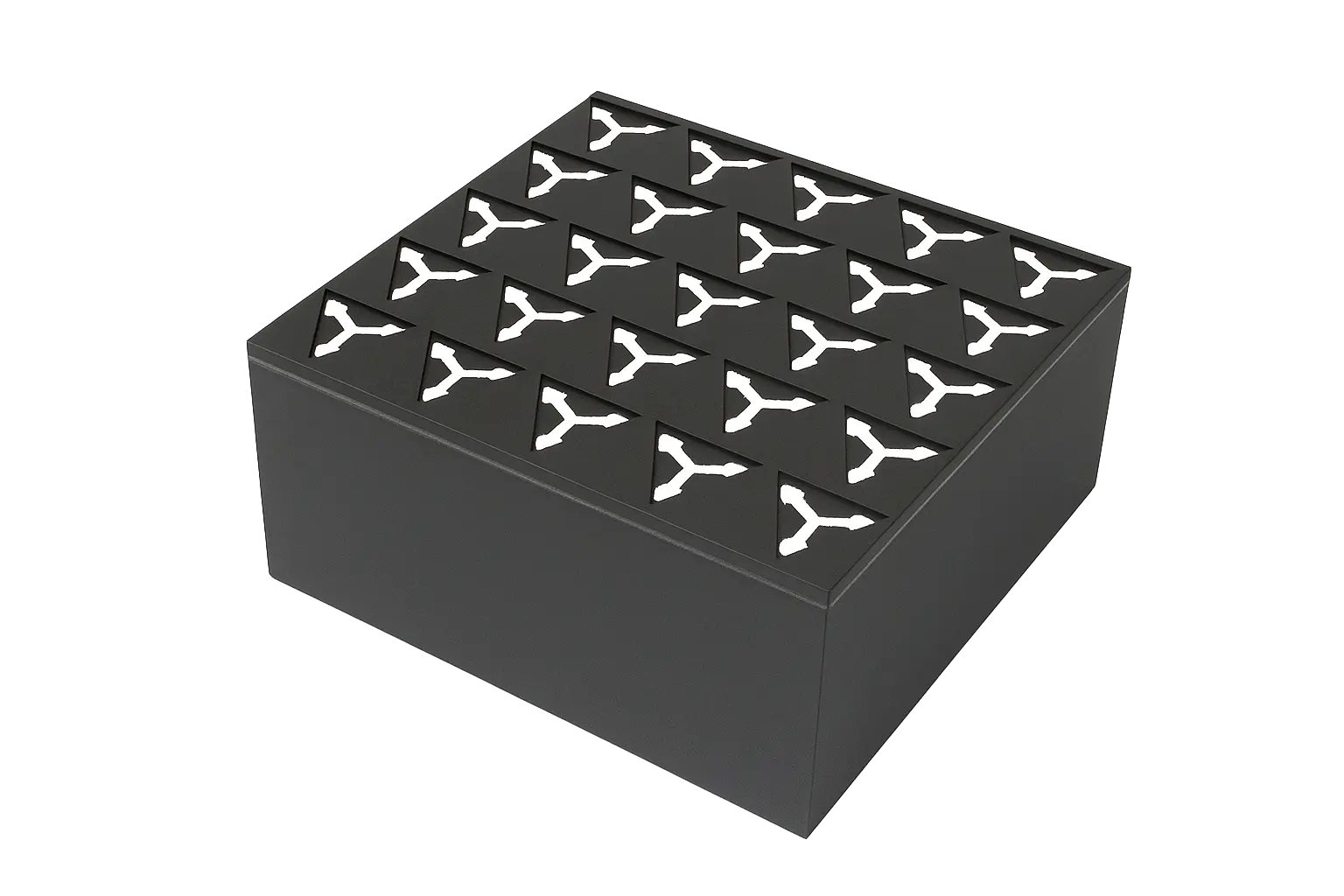
The Drosophila Maze Array is used to study the locomotor behavior of single Drosophila melanogaster flies, interactions between pairs of flies, or the complex social interaction of individual flies behaving within large groups.
Key Results Metric
Elevated Insights
Pricing
Unveiling Exploratory Behavior
Behavioral Insights from the Drosophila Maze Array
Metrics ConductVision measures for the maze array
Select the Right Package for Your Lab
Enterprise
Your institution deserves software that is customized to fit your unique needs. To ensure that our software is tailored specifically to your institution, please don't hesitate to get in touch with us today. Our team is dedicated to providing you with the highest quality service possible.


ConductVision Tools & Services
Need Assistance? Get in Touch!
Use this apparatus with
The complete Drosophila Maze Array workflow
Track behavior
Automate correct arm choices, latency, zone occupancy, path order, and event timing for Drosophila Maze Array studies.
ConductVision Drosophila Maze Array ->Run protocol
No exact ConductMaze protocol page is currently published for Drosophila Maze Array; keep this as a roadmap gap rather than linking to a guessed URL.
Supporting page not yet builtAnalyze output
No exact calculator page is currently published for Drosophila Maze Array; keep this as a roadmap gap rather than linking to a guessed URL.
Supporting page not yet builtConfiguration considerations
Common Drosophila Maze Array setup decisions
Use these notes to scope species, cohort, tracking, and automation needs. Only verified product or support routes are linked from this section.
This productStandard
Drosophila Maze Array
Parallel insect choice array for Drosophila navigation and preference assays
high-throughput fly choice, locomotor screening, odor or light preference, and route-selection behavior.
Quote
Request QuoteBuyableScaled option
Drosophila Maze Array Species Variant
Mouse, rat, aquatic, insect, or large-animal scaling as appropriate
Use species-specific dimensions and lighting so the apparatus tests the intended construct instead of body size, visibility, or handling tolerance.
Quote
View options ->SpecialtyAutomation
Drosophila Maze Array With Tracking
Camera, gates, sensors, cue control, or event logging as required
Best when the protocol needs reproducible timing, high-throughput scoring, or defensible endpoint extraction across cohorts.
Quote
Configure tracking ->§ 1
Introduction
The Drosophila Maze Array is a species-specific behavioral assay built around high-throughput fly choice, locomotor screening, odor or light preference, and route-selection behavior. Interpretable data depend on matching the apparatus geometry, subject species, trial structure, and scoring rules to the behavioral construct under study. 1
Insect maze array protocols depend on stable geometry, consistent trial timing, and pre-defined scoring rules. Without those controls, correct arm choices can be shifted by motivation, locomotion, light level, odor, cue salience, or handling rather than the intended behavioral construct. 1
This methods section summarizes setup, endpoint definitions, common confounds, sample output, adjacent assays, and reporting details needed to evaluate Drosophila Maze Array results alongside the product specifications. 1
§ 2
Methods
2.1 Procedure
Insect maze array with standardized setup, trial timing, and endpoint extraction.
Pre-test setup
- 1.Define construct — Pre-register whether the study uses Drosophila Maze Array for species-specific behavioral behavior, screening, cohort comparison, or apparatus validation.
- 2.Calibrate apparatus — Verify parallel insect choice array for drosophila navigation and preference assays, visibility, lighting, surface condition, cue placement, and camera field of view before animals enter the room.
- 3.Set scoring rules — Define correct arm choices, omissions, exclusions, latency cutoffs, and event thresholds before acquisition starts.
- 4.Control carryover — Use consistent cleaning, handling, acclimation, and inter-trial timing so odor, stress, and fatigue do not become hidden treatment variables.
Trial sequence
- 1.Start trial — Place the subject at the protocol-defined start location and begin synchronized video or event logging.
- 2.Record behavior — Capture correct arm choices, path order, latency, dwell time, and relevant zone or arm events throughout the trial.1
- 3.Apply endpoint rules — Score only committed entries or events that meet the pre-defined body-position and timing criteria.
- 4.End and reset — Stop at the maximum duration, completion criterion, or humane endpoint, then clean and reset the apparatus.
- 5.Export QC — Review tracking loss, outlier latency, immobility, omissions, and apparatus notes before group-level analysis.
Critical methodological constraints
- Fly age. Document fly age because it can shift correct arm choices independent of the intended construct.
- Humidity. Keep humidity stable across cohorts and sessions.
- Odor contamination. Audit odor contamination before interpreting group differences.
- Light gradients. Report light gradients when it changes engagement, exploration, or measurable trial completion.
- Handling and anesthesia. Flag handling and anesthesia during QA because it often explains apparent assay failure.2
2.2 Measurement & Analysis
Core Drosophila Maze Array endpoints for behavioral interpretation and apparatus quality control.
Correct arm choices
Fly choice performance
Correct arm choices is the primary endpoint for this page and should be paired with latency and quality-control flags.1
Choice latency
Latency and initiation
Choice latency helps distinguish task performance from motivation, freezing, fatigue, or handling effects.
Arm distribution
Spatial or zone strategy
Arm distribution captures how the subject solved the task, not only whether it reached the endpoint.
Non-responders
Engagement control
Non-responders identifies omissions, low exploration, sensor dropouts, or species-specific non-response.
Escapes or stuck flies
Quality-control flag
Escapes or stuck flies should be reviewed before exporting final group summaries.
+ Additional metrics: trial duration, zone dwell, event count, path efficiency, tracking confidence, exclusions, and session-level notes.
2.3 correct arm choices ratio (analysis)
A compact percentage summary for Drosophila Maze Array output.
§ 3
Results
Aggregate publication data, sample apparatus output, and recent findings from the live PubMed feed.
3.1 Publication trends
PubMed volume and co-occurring behavioral methods for Drosophila Maze Array studies.
3.2 Sample apparatus output
Representative Drosophila Maze Array output for methods review and endpoint interpretation.
3.3 Recent methods context
- May 2026Source note
Drosophila Maze Array methods refresh: endpoint definitions, QA flags, and comparator assays
ConductScience methods note prepared for citation review.
The first citation-cron pass should replace this editorial seed with current Drosophila Maze Array methods papers filtered for apparatus, protocol, and endpoint relevance.
§ 4
Discussion
Limitations of the paradigm, methodological caveats, and current directions.
4.1 Common confounds
Variables that shift Drosophila Maze Array results independent of anxiety state.
Fly age
Fly age can change apparent Drosophila Maze Array performance without reflecting the intended behavioral construct. Control it in setup and report it in methods.
Humidity
Humidity can change apparent Drosophila Maze Array performance without reflecting the intended behavioral construct. Control it in setup and report it in methods.
Odor contamination
Odor contamination can change apparent Drosophila Maze Array performance without reflecting the intended behavioral construct. Control it in setup and report it in methods.
Light gradients
Light gradients can change apparent Drosophila Maze Array performance without reflecting the intended behavioral construct. Control it in setup and report it in methods.
Handling and anesthesia
Handling and anesthesia can change apparent Drosophila Maze Array performance without reflecting the intended behavioral construct. Control it in setup and report it in methods.
4.2 Construct validity caveats
Drosophila Maze Array is strongest when endpoint definitions, apparatus settings, and exclusion rules are specified before testing. Treat a single summary metric as a screening signal, then confirm interpretation with latency, engagement, comparator assays, and quality-control review. 1
4.3 Special considerations
When should I choose Drosophila Maze Array?
Choose Drosophila Maze Array when the research question matches high-throughput fly choice, locomotor screening, odor or light preference, and route-selection behavior. and the lab can control fly age, humidity, and trial timing.
What setup variables should be specified before testing?
Specify species, cohort size, apparatus dimensions, lighting, tracking method, automation level, cleaning workflow, endpoint definitions, and exclusion criteria before data collection begins.
What makes the data interpretable?
Interpretation is strongest when the apparatus configuration, trial timing, scoring thresholds, confound controls, and comparator assays are documented together with the primary endpoint.
4.4 Current directions
Quarterly editorial review of emerging Drosophila Maze Array methodology. Q2 2026
Methods
Endpoint standardization
Define correct arm choices, latency, exclusions, and engagement flags before comparing cohorts.
Emerging
Automated scoring
Camera and event-log workflows can reduce observer burden and improve consistency when zone definitions and event thresholds are validated.
Methods
Comparator batteries
Drosophila Maze Array should link to adjacent maze, motor, or motivation assays when interpretation depends on controls.
Emerging
Integrated method reporting
Apparatus dimensions, protocol fit, tracking compatibility, and endpoint definitions should be reported together so results are easier to reproduce.
§ 5
References
10 selected methods and validation references for Drosophila Maze Array.
- Pitman JL, et al. A dynamic role for the mushroom bodies in promoting sleep in Drosophila. Nature. 2006;441(7094):753-756. Find source
- Quinn WG, Harris WA, Benzer S. Conditioned behavior in Drosophila melanogaster. Proc Natl Acad Sci USA. 1974;71(3):708-712. Find source
- Heisenberg M. Mushroom body memoir: from maps to models. Nat Rev Neurosci. 2003;4(4):266-275. Find source
- Gomez-Marin A, et al. Active sampling and decision making in Drosophila chemotaxis. Nat Commun. 2011;2:441. Find source
- Tully T, Quinn WG. Classical conditioning and retention in normal and mutant Drosophila melanogaster. J Comp Physiol A. 1985;157(2):263-277. Find source
- Busto GU, Cervantes-Sandoval I, Davis RL. Olfactory learning in Drosophila. Physiology (Bethesda). 2010;25(6):338-346. Find source
- Claridge-Chang A, et al. Writing memories with light-addressable reinforcement circuitry. Cell. 2009;139(2):405-415. Find source
- Ofstad TA, Zuker CS, Reiser MB. Visual place learning in Drosophila melanogaster. Nature. 2011;474(7350):204-207. Find source
- Aso Y, et al. Mushroom body output neurons encode valence and guide memory-based action selection in Drosophila. eLife. 2014;3:e04580. Find source
- Colomb J, Reiter L, Blaszkiewicz J, Wessnitzer J, Brembs B. Open source tracking and analysis of adult Drosophila locomotion in Buridan's paradigm with and without visual targets. PLoS One. 2012;7(10):e42247. Find source