Electrode Microfluidic Chip
Microfluidic chip with integrated gold, platinum, and ITO electrodes for electrochemical sensing, dielectrophoresis, and impedance measurement applications.
Reusable chip — designed for multiple experimental runs. Compatible with standard microfluidic tubing: steel pins (0.7 mm ID / 1.0 mm OD) and silicone tubing (0.8 mm ID / 1.9 mm OD). Available in bulk packs (5‑, 10‑, and 25‑unit) for lab-scale and consumable workflows.

Louise Corscadden, PhD
Director of Science · ConductScience
Ask Louise about Electrode Microfluidic Chip fit, setup, configuration, or quote prep.
Already working with us? Sign in to connect this with My Scientist.
Key Specifications
Full details →- Model fit
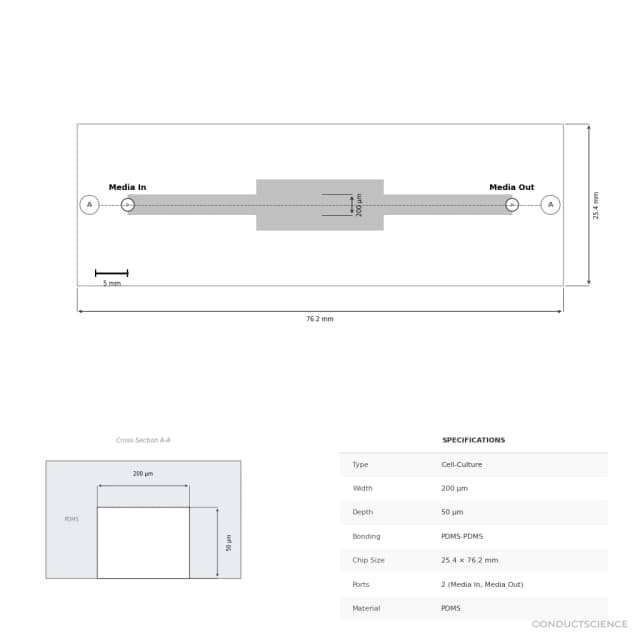
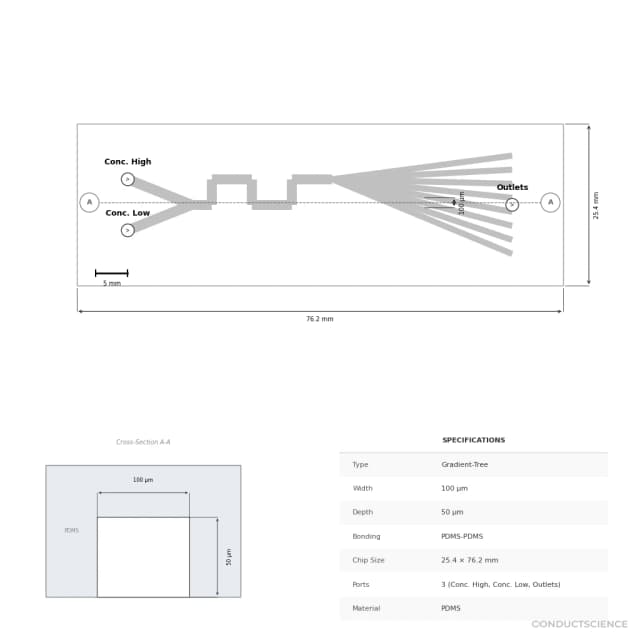
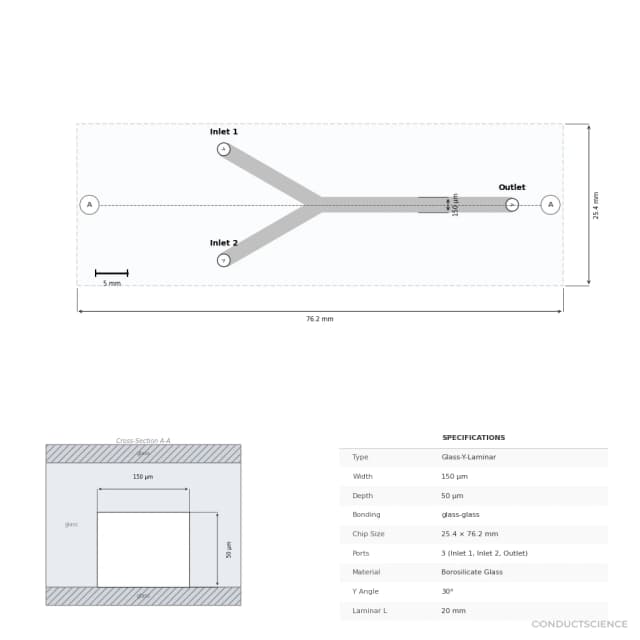
- 3 selectable configurations
- SKU family
- WHM-0122
- Shipping box
- 181.8 x 136.3 x 90.9 cm
- Ordering
- Online checkout and quote request available
- Category
- Electrode Chips
- Build notes
- Confirm accessories, station layout, and support needs before purchase
The Electrode Microfluidic Chip integrates multiple electrode materials (gold, platinum, ITO) within microfluidic channels for electrochemical sensing, dielectrophoresis (DEP), and impedance measurement applications. This lab-on-chip platform enables real-time electrical characterization of biological samples and chemical species within controlled microfluidic environments.
The chip design supports diverse electrokinetic phenomena including cell manipulation via DEP, impedance-based cytometry, and electrochemical detection of analytes. Multiple electrode materials provide flexibility for different sensing modalities and compatibility with various biological and chemical systems requiring specific electrode surface properties.
How It Works
The chip operates on electrokinetic principles where applied electric fields interact with particles and cells based on their dielectric properties. For dielectrophoresis applications, AC electric fields create non-uniform field gradients that exert forces on polarizable particles, enabling size- and property-based separation without physical barriers.
Electrochemical sensing utilizes the different electrode materials to provide optimal interfaces for specific analytes. Gold electrodes offer biocompatibility and stable surface chemistry for biosensing applications, platinum provides excellent catalytic properties for redox reactions, and ITO (indium tin oxide) combines optical transparency with electrical conductivity for combined optical-electrical measurements.
Impedance measurements are performed by applying small AC voltages across electrode pairs and measuring the resulting current. Changes in solution conductivity, cell membrane properties, or particle concentration alter the impedance spectrum, enabling label-free detection and characterization of biological and chemical samples within the microfluidic channels.
Features & Benefits
Shipping weight
- 3.3 lb
Shipping box
- L: 181.8 cm
- W: 136.3 cm
- H: 90.9 cm
| Feature | This Product | Typical Alternative | Advantage |
|---|---|---|---|
| Electrode Material Options | Gold, Platinum, and ITO electrodes integrated | Single electrode material designs are common | Multiple materials enable optimization for different analytes and measurement modes within the same device. |
| Application Versatility | Supports electrochemical sensing, DEP, and impedance measurement | Many chips are designed for single measurement modes | Multi-modal functionality reduces the need for separate specialized devices for different analytical techniques. |
| Electrode Integration | Fully integrated electrode array in microfluidic channels | External electrodes or limited integration varies by design | Integrated design ensures consistent electrode positioning and eliminates manual electrode placement variability. |
| Channel Design | Microfluidic channel integration with electrode arrays | Basic channel geometries without electrode optimization | Optimized channel-electrode integration improves measurement sensitivity and sample utilization efficiency. |
This chip provides multiple electrode materials and measurement modes in a single integrated platform. The combination of electrochemical sensing, dielectrophoresis, and impedance capabilities offers research flexibility for diverse analytical applications requiring minimal sample volumes.
| Model | SKU | Listed price | Status | Shipping box |
|---|---|---|---|---|
| 25-Pack | WHM-0122-25PK | Quote | Available | 181.8 x 136.3 x 90.9 cm |
| 10-Pack | WHM-0122-10PK | $1,490.00 | Available | 181.8 x 136.3 x 90.9 cm |
| 5-Pack | WHM-0122-5PK | Quote | Available | 181.8 x 136.3 x 90.9 cm |
Practical Tips
Test electrode functionality with standard redox couples before sample analysis to verify proper electrical contact and surface activity.
Why: Electrode fouling or poor connections can compromise measurement accuracy and data quality.
Store chips in dry conditions with electrode surfaces protected from contamination between uses.
Why: Moisture and contaminants can alter electrode surface properties and affect subsequent measurements.
Maintain consistent buffer ionic strength throughout experiments to ensure reproducible impedance baseline measurements.
Why: Ionic strength variations directly affect solution conductivity and can mask sample-related impedance changes.
If impedance readings are unstable, check for air bubbles in channels and verify all electrical connections are secure.
Why: Air bubbles create measurement artifacts while poor connections introduce noise and signal drift.
Record baseline measurements before sample introduction and monitor electrode stability throughout extended experiments.
Why: Baseline drift can be subtracted from measurements to improve signal-to-noise ratios and measurement accuracy.
Verify voltage limits for the specific electrode configuration before applying DEP or electrochemical potentials.
Why: Excessive voltages can damage electrodes, generate harmful byproducts, or compromise sample integrity.
Use appropriate flow rates to balance measurement time requirements with shear stress effects on biological samples.
Why: High flow rates can damage cells while very low rates may cause sedimentation or non-uniform sample distribution.
Setup Guide
What’s in the Box
- Electrode microfluidic chip
- Protective storage container (typical)
- Connection interface documentation (typical)
- Technical specifications sheet (typical)
Warranty
ConductScience provides a standard 1-year manufacturer warranty covering defects in materials and workmanship, with technical support for setup and troubleshooting procedures.
Compliance
References
Background reading relevant to this product:
What voltage ranges are suitable for dielectrophoresis applications?
Voltage requirements depend on channel geometry and target particles. Consult product datasheet for maximum voltage ratings and recommended operating ranges for DEP applications.
How do I select the appropriate electrode material for my application?
Gold electrodes work well for biosensing and biocompatibility applications, platinum for general electrochemistry and redox reactions, and ITO when optical access is required for fluorescence or imaging.
What sample preparation is required for impedance measurements?
Samples should be in appropriate buffer solutions with known conductivity. Remove particulates that might clog channels and ensure consistent ionic strength for reproducible impedance readings.
Can the chip be reused after biological sample analysis?
Yes, with appropriate cleaning protocols. Use mild detergents followed by deionized water rinses. Harsh chemicals may damage electrode surfaces or channel integrity.
What flow rates are compatible with the microfluidic channels?
Flow rate compatibility depends on channel dimensions and intended application. Consult product specifications for recommended flow rate ranges to avoid channel damage or measurement artifacts.
How do I prevent electrode fouling during long experiments?
Use appropriate buffer compositions, maintain clean sample preparation, and consider periodic electrode cleaning pulses or surface regeneration protocols between measurements.
What data acquisition equipment is needed?
Requires impedance analyzer or potentiostat capable of the desired frequency ranges and measurement modes. AC signal generators needed for DEP applications.
Have a question about this product?
Have a question? Just ask.
Send it over and we'll email you a personalized answer — no call, no scheduling.
Prefer to talk it through?