Electrophoresis Chip (100 um, Type B)
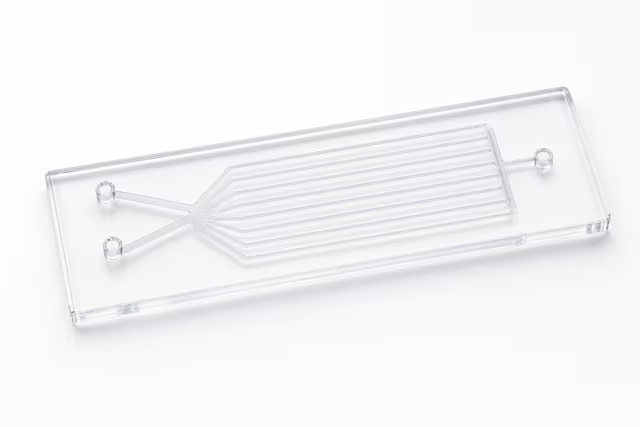
Precision microfluidic electrophoresis chip with 100 × 100 μm channels and extended separation design for high-resolution biomolecular analysis.
Reusable chip — designed for multiple experimental runs. Compatible with standard microfluidic tubing: steel pins (0.7 mm ID / 1.0 mm OD) and silicone tubing (0.8 mm ID / 1.9 mm OD). Available in bulk packs (5‑, 10‑, and 25‑unit) for lab-scale and consumable workflows.

Louise Corscadden, PhD
Director of Science · ConductScience
Ask Louise about Electrophoresis Chip (100 um, Type B) fit, setup, configuration, or quote prep.
Already working with us? Sign in to connect this with My Scientist.
Key Specifications
Full details →- Model fit
- 3 selectable configurations
- SKU family
- WHM-0106
- Shipping box
- 181.8 x 136.3 x 90.9 cm
- Ordering
- Online checkout and quote request available
- Category
- Electrophoresis Chips
- Build notes
- Confirm accessories, station layout, and support needs before purchase
The Electrophoresis Chip (100 μm, Type B) is a precision microfluidic device engineered for high-resolution electrophoretic separations. Featuring 100 × 100 μm channels with an extended separation design, this chip enables enhanced resolution of biomolecular analytes through increased separation length. The uniform channel geometry provides consistent electroosmotic flow profiles and predictable migration behavior for reproducible analytical results.
This microchip platform is designed for researchers requiring superior separation performance in analytical workflows. The extended channel architecture maximizes separation efficiency while maintaining sample integrity, making it suitable for complex mixture analysis where baseline resolution is critical. The chip integrates seamlessly with standard microchip electrophoresis systems and supports various detection modalities including fluorescence and UV-visible spectroscopy.
How It Works
Microchip electrophoresis separates charged analytes based on their differential migration velocities in an applied electric field. When voltage is applied across the chip channels, analytes migrate at rates determined by their charge-to-size ratio and the electroosmotic flow generated at the channel walls. The 100 × 100 μm square channel geometry provides optimal surface-to-volume ratio for efficient heat dissipation while maintaining uniform electric field distribution.
The extended separation design increases the effective separation length, allowing closely related compounds more time to resolve. This enhanced path length improves peak capacity and resolution compared to standard chip designs. Sample injection occurs at the intersection of sample and separation channels, with electrokinetic or pressure-driven injection methods controlling sample plug size and reproducibility.
Detection typically occurs near the channel terminus using laser-induced fluorescence, UV absorbance, or electrochemical methods. The chip substrate material and surface chemistry influence electroosmotic flow magnitude and direction, which can be modulated through buffer pH and ionic strength optimization.
Features & Benefits
Shipping weight
- 3.3 lb
Shipping box
- L: 181.8 cm
- W: 136.3 cm
- H: 90.9 cm
| Feature | This Product | Typical Alternative | Advantage |
|---|---|---|---|
| Channel Dimensions | 100 × 100 μm square channels | Standard chips often feature 50-200 μm channels with varying geometries | Optimized dimensions balance separation efficiency with sample volume requirements for reproducible results |
| Separation Design | Extended separation architecture | Basic designs offer shorter effective separation lengths | Enhanced resolution capability enables baseline separation of closely eluting compounds |
| Configuration Type | Type B high-resolution configuration | Entry-level chips may offer simpler channel layouts | Advanced design maximizes peak capacity for complex analytical applications |
| Application Focus | High-resolution electrophoresis applications | General-purpose chips may lack specialized optimization | Purpose-built design delivers superior performance for demanding separation challenges |
This chip combines precise 100 μm channel fabrication with extended separation design for enhanced analytical performance. The Type B configuration provides advanced capabilities for high-resolution applications requiring maximum separation efficiency.
| Model | SKU | Listed price | Status | Shipping box |
|---|---|---|---|---|
| 25-Pack | WHM-0106-25PK | Quote | Available | 181.8 x 136.3 x 90.9 cm |
| 10-Pack | WHM-0106-10PK | $1,490.00 | Available | 181.8 x 136.3 x 90.9 cm |
| 5-Pack | WHM-0106-5PK | Quote | Available | 181.8 x 136.3 x 90.9 cm |
Practical Tips
Condition channels with running buffer for several minutes before sample introduction to establish stable electroosmotic flow.
Why: Proper conditioning ensures reproducible baseline conditions and minimizes analysis variability.
Flush channels thoroughly between analyses to prevent sample carryover and maintain separation performance.
Why: Residual analytes can affect subsequent separations and compromise quantitative accuracy.
Monitor current stability during separations as fluctuations indicate buffer depletion or channel fouling.
Why: Stable current ensures consistent electric field strength and reproducible migration times.
If peak broadening occurs, reduce applied voltage to minimize Joule heating effects in the extended channels.
Why: Thermal gradients can cause band broadening and reduce separation efficiency in longer channel designs.
Use mobility standards appropriate for your analyte class to verify separation performance and channel integrity.
Why: Standards provide reference points for migration time reproducibility and system suitability assessment.
Ensure proper electrical grounding and use appropriate safety interlocks when working with high-voltage systems.
Why: Microchip electrophoresis involves potentially dangerous voltages that require proper safety precautions.
Setup Guide
What’s in the Box
- Electrophoresis chip (Type B, 100 μm channels)
- Product specification sheet (typical)
- Storage container (typical)
- Usage guidelines (typical)
Warranty
ConductScience provides standard manufacturer warranty coverage with technical support for optimal performance and application guidance.
Compliance
What voltage ranges are typically compatible with these channel dimensions?
Consult product datasheet for specific voltage recommendations. Channel geometry influences optimal field strength for efficient separations while avoiding Joule heating.
How does the extended separation design affect analysis time compared to standard chips?
Extended length increases migration time proportionally but provides enhanced resolution. Exact timing depends on applied voltage and analyte properties.
What buffer systems work best with the 100 μm channel geometry?
Most standard electrophoresis buffers are compatible. Buffer selection should consider pH, ionic strength, and electroosmotic flow requirements for your specific analytes.
Can this chip be reused for multiple analyses?
Reusability depends on sample type and cleaning protocols. Consult manufacturer guidelines for proper cleaning procedures and expected chip lifetime.
What detection systems are compatible with this chip design?
Standard microchip electrophoresis detection methods including laser-induced fluorescence, UV absorbance, and electrochemical detection are typically compatible.
How does channel surface treatment affect separation performance?
Surface chemistry influences electroosmotic flow magnitude and direction. Some applications may benefit from surface modifications to optimize separation conditions.
Have a question about this product?
Have a question? Just ask.
Send it over and we'll email you a personalized answer — no call, no scheduling.
Prefer to talk it through?