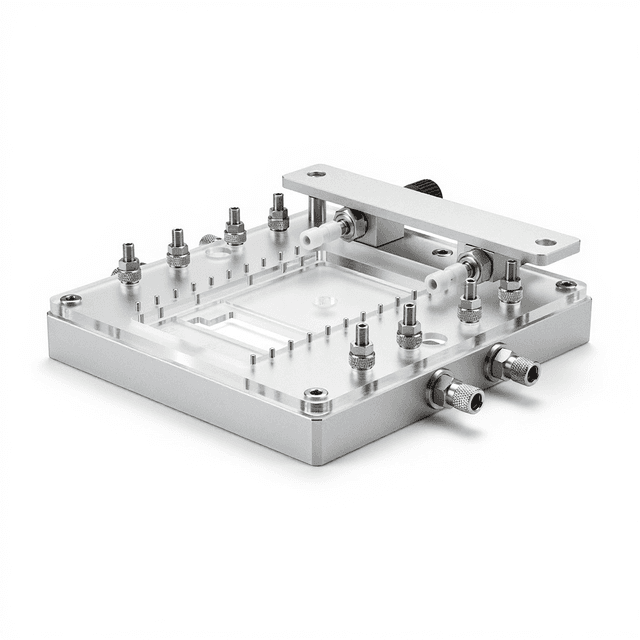
PMMA Cross-Junction Droplet Generator Chip
PMMA microfluidic chip with cross-junction geometry for controlled droplet generation, featuring 200 μm channel depth and 25 x 15 mm footprint.
Reusable chip — designed for multiple experimental runs. Compatible with standard microfluidic tubing: steel pins (0.7 mm ID / 1.0 mm OD) and silicone tubing (0.8 mm ID / 1.9 mm OD). Available in bulk packs (5‑, 10‑, and 25‑unit) for lab-scale and consumable workflows.

Louise Corscadden, PhD
Director of Science · ConductScience
Ask Louise about PMMA Cross-Junction Droplet Generator Chip fit, setup, configuration, or quote prep.
Already working with us? Sign in to connect this with My Scientist.
Key Specifications
Full details →- Model fit
- 3 selectable configurations
- SKU family
- WHM-0019
- Shipping box
- 25.0 x 15.0 x 3.0 cm
- Ordering
- Online checkout and quote request available
- Category
- Lab Equipment
- Build notes
- Confirm accessories, station layout, and support needs before purchase
The PMMA Cross-Junction Droplet Generator Chip is a microfluidic device designed for controlled droplet formation in research applications. Manufactured from optically clear polymethyl methacrylate (PMMA), this chip features a cross-junction geometry that enables precise control of droplet size and generation frequency through hydrodynamic focusing. The 200 μm channel depth provides optimal flow characteristics for aqueous and oil-phase systems commonly used in microfluidics research.
The compact 25 x 15 x 3 mm form factor makes this chip compatible with standard microscope stages and microfluidic pump systems. The cross-junction design allows for symmetric flow focusing, where continuous phases intersect the dispersed phase at perpendicular angles, resulting in consistent droplet formation. This geometry is particularly suited for applications requiring monodisperse droplet populations with controlled size distribution.
How It Works
The cross-junction droplet generator operates on the principle of hydrodynamic flow focusing, where two immiscible fluid phases meet at a perpendicular intersection within the microfluidic channel network. The dispersed phase flows through the central channel while the continuous phase flows through two perpendicular side channels, creating shear forces at the junction point. When the continuous phase flow rate exceeds the dispersed phase flow rate, the interfacial tension and viscous forces combine to pinch off regular droplets downstream of the junction.
The 200 μm channel depth provides sufficient cross-sectional area for stable flow while maintaining the capillary number regime necessary for droplet formation. The PMMA material offers excellent optical clarity for real-time visualization and has surface properties suitable for both aqueous and organic solvent systems. Droplet size can be controlled by adjusting the flow rate ratio between continuous and dispersed phases, with higher continuous phase flow rates producing smaller droplets.
Features & Benefits
Shipping weight
- 0.03 lb
Shipping box
- L: 25.0 cm
- W: 15.0 cm
- H: 3.0 cm
| Feature | This Product | Typical Alternative | Advantage |
|---|---|---|---|
| Junction Geometry | Cross-junction design | T-junction configurations are common in entry-level devices | Symmetric flow focusing provides better control over droplet formation and size consistency |
| Channel Depth | 200 μm depth | Basic devices often feature 50-100 μm depths | Deeper channels accommodate higher flow rates and reduce clogging risk |
| Material | PMMA construction | Glass chips offer higher precision but at greater cost | PMMA provides good optical clarity with lower cost and easier handling than glass alternatives |
| Form Factor | 25 x 15 x 3 mm compact design | Larger devices may exceed standard microscope stage dimensions | Compact footprint ensures compatibility with most microscopy and imaging systems |
This cross-junction droplet generator combines PMMA's cost-effectiveness with a 200 μm channel depth that supports diverse flow conditions. The symmetric junction geometry provides reliable droplet formation control for research applications.
| Model | SKU | Listed price | Status | Shipping box |
|---|---|---|---|---|
| 25-Pack | WHM-0019-25PK | Quote | Available | 25.0 x 15.0 x 3.0 cm |
| 10-Pack | WHM-0019-10PK | $1,490.00 | Available | 25.0 x 15.0 x 3.0 cm |
| 5-Pack | WHM-0019-5PK | Quote | Available | 25.0 x 15.0 x 3.0 cm |
Practical Tips
Always start continuous phase flow before introducing the dispersed phase to prevent channel wetting issues.
Why: Proper wetting sequence ensures stable droplet formation from the start of each experiment.
If droplets become irregular, check for air bubbles in the system and verify all connections are leak-free.
Why: Air bubbles and pressure variations disrupt the precise flow balance required for monodisperse droplet formation.
Store chips in a dust-free environment and avoid touching channel surfaces with bare hands.
Why: Contamination and surface deposits can alter wetting properties and affect droplet formation reproducibility.
Use known viscosity standards to establish flow rate-droplet size relationships for your specific setup.
Why: Systematic calibration enables predictable droplet size control across different experimental conditions.
Allow the system to stabilize for several minutes after changing flow rates before collecting data.
Why: Flow equilibration time is necessary to achieve steady-state droplet formation and consistent size distribution.
Ensure proper ventilation when using organic solvents and verify material compatibility before first use.
Why: Solvent vapors require appropriate handling, and incompatible solvents may compromise chip integrity.
Setup Guide
What’s in the Box
- PMMA Cross-Junction Droplet Generator Chip
- User manual with setup instructions (typical)
- Material compatibility guide (typical)
Warranty
ConductScience provides a one-year manufacturer warranty covering defects in materials and workmanship. Technical support is available for setup optimization and troubleshooting guidance.
Compliance
What flow rate ratios are recommended for different droplet sizes?
Typical continuous to dispersed phase flow rate ratios range from 2:1 to 20:1, with higher ratios producing smaller droplets. Consult product datasheet for specific recommendations based on fluid properties.
Is the PMMA material compatible with organic solvents?
PMMA shows good compatibility with most aqueous solutions and many organic solvents, but may swell or crack with certain aggressive solvents like acetone or chloroform. Test compatibility before extended use.
What tubing connections are compatible with this chip?
Standard microfluidic fittings for 1/16" or 1/32" tubing are typically used. Verify port specifications with manufacturer for proper fitting selection.
How do I clean the channels between different experiments?
Flush channels with appropriate solvents followed by isopropanol and DI water. For protein or cell applications, enzymatic cleaners may be required to remove biological residues.
What is the typical droplet size range achievable?
Droplet sizes typically range from 50-500 μm depending on flow conditions and fluid properties. Precise size control requires optimization of flow rate ratios and fluid viscosities.
Can this chip be reused for multiple experiments?
Yes, with proper cleaning protocols between uses. Avoid cross-contamination by thorough flushing and consider dedicating chips to specific applications when working with biological samples.
Have a question about this product?
Have a question? Just ask.
Send it over and we'll email you a personalized answer — no call, no scheduling.
Prefer to talk it through?