Electrophoresis Chip (200 um, Type B)
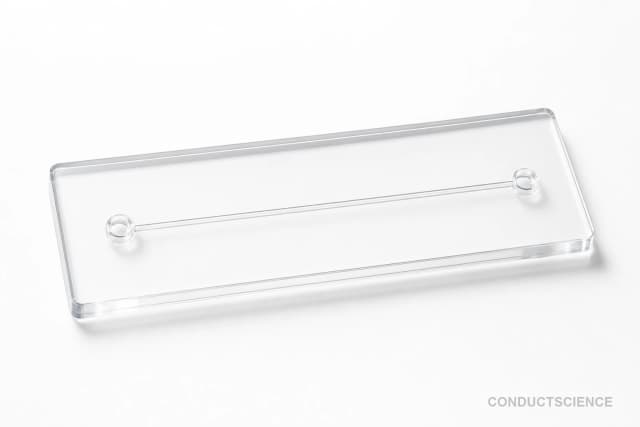
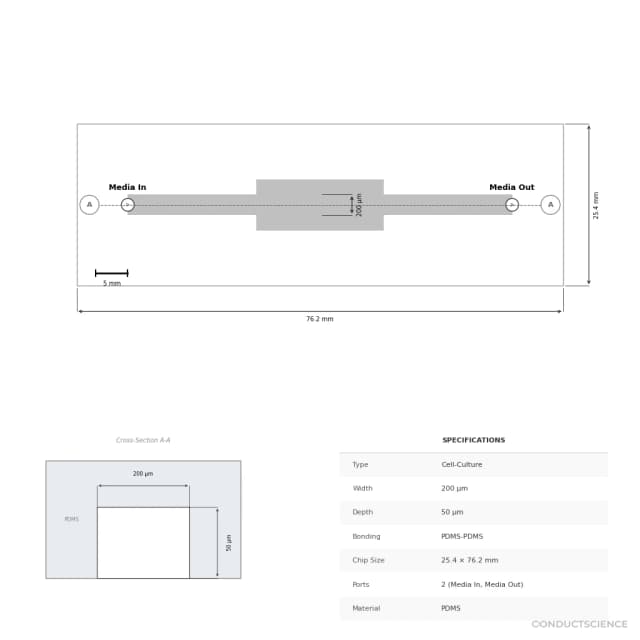
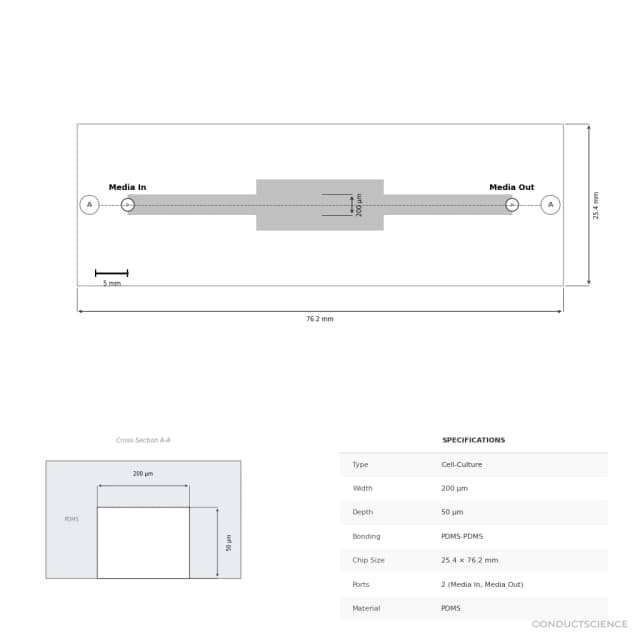
Precision microfluidic electrophoresis chip with 200 × 200 μm channels and field-amplified sample stacking capability for enhanced biomolecular separations.
Reusable chip — designed for multiple experimental runs. Compatible with standard microfluidic tubing: steel pins (0.7 mm ID / 1.0 mm OD) and silicone tubing (0.8 mm ID / 1.9 mm OD). Available in bulk packs (5‑, 10‑, and 25‑unit) for lab-scale and consumable workflows.

Louise Corscadden, PhD
Director of Science · ConductScience
Ask Louise about Electrophoresis Chip (200 um, Type B) fit, setup, configuration, or quote prep.
Already working with us? Sign in to connect this with My Scientist.
Key Specifications
Full details →- Model fit
- 3 selectable configurations
- SKU family
- WHM-0108
- Shipping box
- 181.8 x 136.3 x 90.9 cm
- Ordering
- Online checkout and quote request available
- Category
- Electrophoresis Chips
- Build notes
- Confirm accessories, station layout, and support needs before purchase
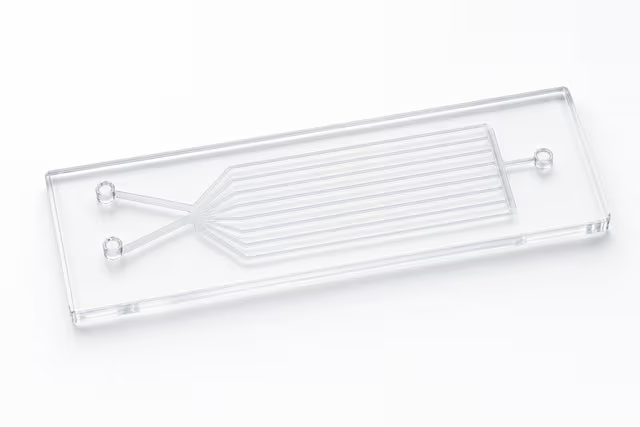
The Electrophoresis Chip (200 μm, Type B) is a precision-engineered microfluidic device designed for high-resolution electrophoretic separations in analytical applications. This chip features 200 × 200 μm square channels optimized for field-amplified sample stacking (FASS), enabling enhanced sample concentration and improved separation efficiency for biomolecular analysis.
The device integrates established electrophoretic principles with microfluidic architecture to provide researchers with a platform for protein and nucleic acid separations. The square channel geometry and integrated FASS capability support applications requiring both sample preconcentration and high-resolution separation, making it suitable for analytical workflows where sample volumes are limited and detection sensitivity is critical.
How It Works
The electrophoresis chip operates on the principle of electrokinetic transport, where charged molecules migrate through the microchannel under the influence of an applied electric field. The 200 × 200 μm square channel geometry provides controlled fluid dynamics and uniform electric field distribution, enabling reproducible separations based on charge-to-size ratios of analytes.
Field-amplified sample stacking (FASS) is achieved by creating conductivity discontinuities within the channel system. When the sample matrix has lower conductivity than the separation buffer, the electric field strength increases in the sample zone, causing analytes to stack at the interface. This preconcentration mechanism can enhance detection sensitivity by orders of magnitude while maintaining separation resolution.
The microfluidic architecture minimizes sample consumption and enables rapid analysis times compared to conventional capillary electrophoresis. The precise channel dimensions ensure consistent electroosmotic flow and migration behavior, supporting quantitative analytical applications.
Features & Benefits
Shipping weight
- 3.3 lb
Shipping box
- L: 181.8 cm
- W: 136.3 cm
- H: 90.9 cm
| Feature | This Product | Typical Alternative | Advantage |
|---|---|---|---|
| Channel Dimensions | 200 × 200 μm square channels | Basic chips often feature circular channels or lack dimensional precision | Square geometry provides uniform electric field distribution and predictable electroosmotic flow for quantitative analysis |
| Sample Stacking Capability | Integrated field-amplified sample stacking (FASS) | Standard electrophoresis chips lack concentration mechanisms | Enhances detection sensitivity by orders of magnitude for trace-level analyte detection |
| Channel Geometry Control | Precision-fabricated Type B design | Basic chips may have less controlled geometries | Ensures reproducible migration behavior and consistent analytical performance across devices |
| Application Versatility | Optimized for electrophoresis and sample concentration | Generic microfluidic devices often lack application-specific optimization | Purpose-built design maximizes separation efficiency and sensitivity for electrophoretic applications |
This electrophoresis chip combines precision channel fabrication with integrated FASS capability to provide enhanced sensitivity and reproducible performance. The 200 μm square channel geometry and Type B design configuration offer optimized conditions for analytical electrophoretic separations.
| Model | SKU | Listed price | Status | Shipping box |
|---|---|---|---|---|
| 25-Pack | WHM-0108-25PK | Quote | Available | 181.8 x 136.3 x 90.9 cm |
| 10-Pack | WHM-0108-10PK | $1,490.00 | Available | 181.8 x 136.3 x 90.9 cm |
| 5-Pack | WHM-0108-5PK | Quote | Available | 181.8 x 136.3 x 90.9 cm |
Practical Tips
Use standard protein or DNA markers to verify separation performance and migration time reproducibility before analyzing unknowns.
Why: Establishes baseline performance and confirms proper chip function and buffer conditions.
Flush channels with deionized water between different buffer systems and store with appropriate preservation solutions.
Why: Prevents buffer crystallization and maintains channel surface properties for consistent electroosmotic flow.
Optimize sample conductivity relative to separation buffer to maximize FASS efficiency and concentration enhancement.
Why: Greater conductivity differences produce stronger field amplification and improved detection sensitivity.
Monitor current stability during voltage application to detect channel blockages or electrical connection issues.
Why: Current fluctuations indicate problems that can affect separation reproducibility and data quality.
Allow adequate equilibration time after buffer changes before sample injection to establish stable electroosmotic flow.
Why: Stable flow conditions are essential for reproducible migration times and quantitative analysis.
Always disconnect power before handling the chip or changing buffer solutions to prevent electrical shock.
Why: High voltages used in electrophoresis can cause injury and damage to electronic components.
Pre-concentrate samples using FASS before detection window for optimal sensitivity in trace-level analyses.
Why: Takes full advantage of the chip's field amplification capability to enhance signal-to-noise ratios.
Setup Guide
What’s in the Box
- Electrophoresis chip with 200 μm channels
- Installation guide and protocols
- Quality control certificate
- Storage container (typical)
- Handling instructions (typical)
Warranty
ConductScience provides a standard 1-year manufacturer warranty covering defects in materials and workmanship, with technical support for setup and operational guidance.
Compliance
What buffer systems are compatible with FASS operation on this chip?
The chip works with most aqueous buffer systems where conductivity discontinuities can be established. Common choices include Tris-glycine, bis-tris, and phosphate buffers with sample matrices of lower ionic strength to achieve field amplification.
What voltage ranges are recommended for electrophoretic separations?
Optimal voltages depend on buffer composition and analyte properties, typically ranging from 100-1000 V across the channel length. Consult product datasheet for maximum voltage specifications and start with lower voltages to assess current stability.
How does channel geometry affect separation performance?
The 200 × 200 μm square cross-section provides uniform electric field distribution and predictable heat dissipation compared to circular channels, supporting higher field strengths and improved separation efficiency.
What detection methods are compatible with this chip format?
The chip supports laser-induced fluorescence, UV absorption, and other optical detection methods. Detection window positioning and optical path length should be optimized based on the specific detection system used.
How many samples can be processed per chip?
Usage depends on sample type and required cross-contamination levels. Some applications allow multiple injections per chip with appropriate cleaning protocols, while others require fresh chips for each sample.
What is the expected shelf life and storage requirements?
Store in clean, dry conditions at room temperature. Shelf life depends on storage conditions and intended application sensitivity requirements. Consult product documentation for specific stability data.
Can the chip be reused for different sample types?
Reusability depends on sample properties and cross-contamination tolerance. Proteins may require more aggressive cleaning than small molecules, and some applications may warrant single-use protocols.
Have a question about this product?
Have a question? Just ask.
Send it over and we'll email you a personalized answer — no call, no scheduling.
Prefer to talk it through?