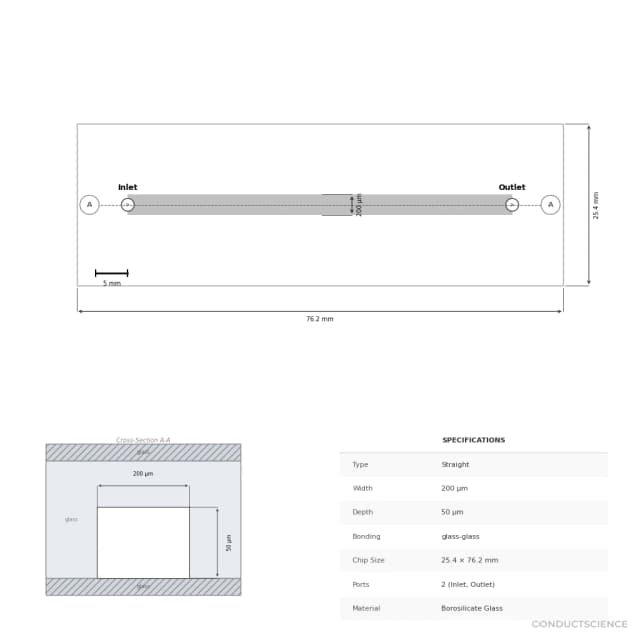
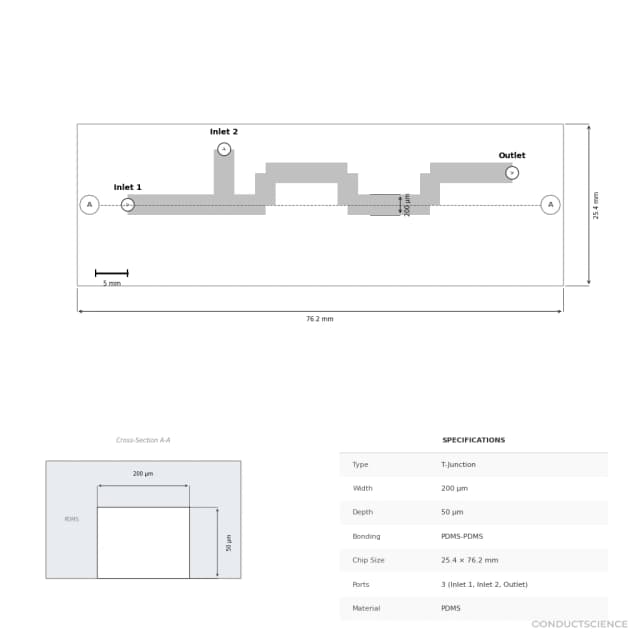
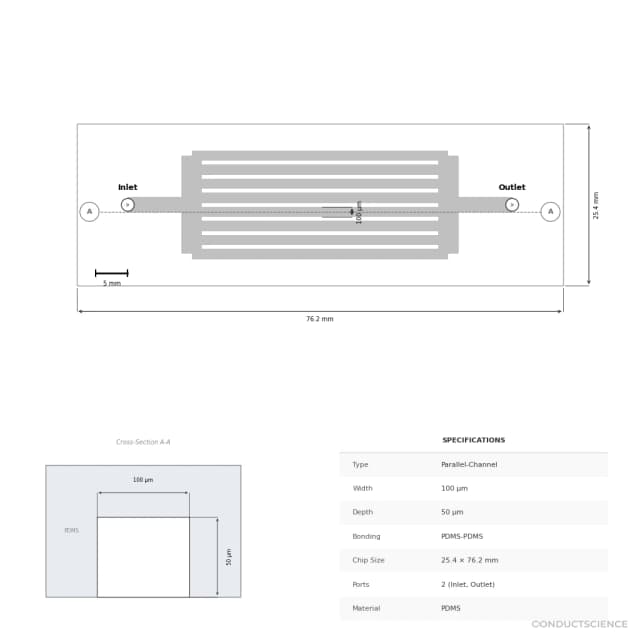
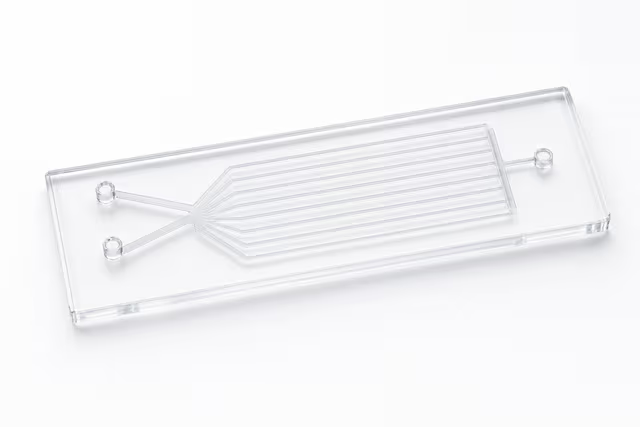
Food Safety Analysis Microfluidic Chip
PDMS microfluidic chip with PMMA fixture for rapid detection of contaminants, pathogens, and adulterants in food samples using minimal sample volumes.
Reusable chip — designed for multiple experimental runs. Compatible with standard microfluidic tubing: steel pins (0.7 mm ID / 1.0 mm OD) and silicone tubing (0.8 mm ID / 1.9 mm OD). Available in bulk packs (5‑, 10‑, and 25‑unit) for lab-scale and consumable workflows.

Louise Corscadden, PhD
Director of Science · ConductScience
Ask Louise about Food Safety Analysis Microfluidic Chip fit, setup, configuration, or quote prep.
Already working with us? Sign in to connect this with My Scientist.
Key Specifications
Full details →- Model fit
- 3 selectable configurations
- SKU family
- WHM-0143
- Shipping box
- 181.8 x 136.3 x 90.9 cm
- Ordering
- Online checkout and quote request available
- Category
- Environmental Detection Chips
- Build notes
- Confirm accessories, station layout, and support needs before purchase
The Food Safety Analysis Microfluidic Chip is a specialized analytical platform designed for rapid detection and screening of contaminants, pathogens, and adulterants in food samples. This microfluidic device integrates PDMS (polydimethylsiloxane) chip technology with a PMMA (polymethyl methacrylate) fixture to provide a controlled microenvironment for sample processing and analysis.
The chip enables researchers to perform high-throughput screening of food samples using minimal sample volumes while maintaining analytical precision. The microfluidic architecture allows for precise fluid control, rapid mixing, and real-time monitoring of biochemical reactions relevant to food safety assessment. This platform supports various detection methodologies including immunoassays, nucleic acid amplification, and enzymatic assays for comprehensive food quality analysis.
How It Works
The microfluidic chip operates on the principle of controlled fluid manipulation within microscale channels etched into the PDMS substrate. Sample and reagent solutions are introduced through designated inlet ports and guided through precisely engineered channel networks that enable mixing, reaction, and separation processes. The PMMA fixture provides structural support and optical accessibility for real-time monitoring of reactions.
Detection mechanisms vary depending on the target analyte but typically involve immunoaffinity capture, enzymatic reactions, or nucleic acid hybridization. The microfluidic environment enhances reaction kinetics through improved surface-to-volume ratios and controlled mass transport. Optical detection ports in the fixture allow for fluorescence, absorbance, or luminescence measurements using standard laboratory instrumentation.
The chip design minimizes sample requirements while maximizing analytical sensitivity through concentration effects and reduced dilution factors inherent to microscale fluid handling.
Features & Benefits
Shipping weight
- 3.3 lb
Shipping box
- L: 181.8 cm
- W: 136.3 cm
- H: 90.9 cm
| Feature | This Product | Typical Alternative | Advantage |
|---|---|---|---|
| Chip Material | PDMS chip with PMMA fixture | Glass or plastic substrates without integrated fixtures | PDMS provides superior sealing and biocompatibility while PMMA fixture ensures structural stability. |
| Application Focus | Specialized for food safety and contaminant detection | Generic microfluidic platforms requiring custom protocol development | Optimized channel geometry and protocols accelerate method development for food analysis. |
| Detection Integration | Optical detection compatibility through PMMA fixture | Separate detection setup required | Integrated design simplifies instrumentation setup and improves measurement reproducibility. |
| Sample Processing | Multi-inlet design for complex assays | Single inlet systems requiring external mixing | On-chip reagent mixing enables more sophisticated analytical protocols. |
This specialized food safety microfluidic chip combines PDMS biocompatibility with PMMA structural integration, offering a purpose-built platform for food contaminant detection with reduced sample requirements and streamlined analytical workflows.
| Model | SKU | Listed price | Status | Shipping box |
|---|---|---|---|---|
| 25-Pack | WHM-0143-25PK | Quote | Available | 181.8 x 136.3 x 90.9 cm |
| 10-Pack | WHM-0143-10PK | $1,490.00 | Available | 181.8 x 136.3 x 90.9 cm |
| 5-Pack | WHM-0143-5PK | Quote | Available | 181.8 x 136.3 x 90.9 cm |
Practical Tips
Prime channels with buffer solution before introducing samples to ensure uniform flow distribution and remove air bubbles.
Why: Air bubbles can disrupt fluid flow patterns and interfere with optical detection measurements.
Store unused chips in original packaging at room temperature away from direct light.
Why: PDMS can absorb small molecules and light exposure may affect material properties over time.
Include positive and negative controls in each analytical run to verify assay performance.
Why: Microfluidic systems can exhibit batch-to-batch variation that controls help identify.
If flow irregularities occur, check for proper sealing between PDMS chip and PMMA fixture.
Why: Incomplete sealing can cause pressure drops and uneven flow distribution affecting assay results.
Handle PDMS chips with powder-free gloves to prevent contamination and maintain optical clarity.
Why: Powder residues and skin oils can interfere with optical detection and create background signals.
Verify flow rates using known standards before each experimental session.
Why: Flow rate variations can affect reaction kinetics and detection sensitivity in microfluidic assays.
Filter complex food samples through 0.45 μm filters before introduction to prevent channel clogging.
Why: Particulates in food matrices can block microfluidic channels and compromise assay performance.
Setup Guide
What’s in the Box
- PDMS microfluidic chip
- PMMA fixture assembly
- User manual with protocols
- Quality control certificate (typical)
- Inlet/outlet port adapters (typical)
Warranty
ConductScience provides a standard one-year manufacturer warranty covering defects in materials and workmanship, along with technical support for protocol development and troubleshooting.
Compliance
References
Background reading relevant to this product:
What detection methods are compatible with this microfluidic platform?
The chip supports fluorescence, absorbance, and luminescence detection methods. The PMMA fixture provides optical access for standard laboratory instrumentation including plate readers and fluorescence microscopes.
How much sample volume is required for analysis?
The microfluidic design minimizes sample requirements to microliters, though specific volumes depend on the assay protocol and target analyte concentration.
Can the chip be reused for multiple samples?
No, the chip is designed for single-use to prevent cross-contamination between samples and ensure analytical reliability in food safety applications.
What types of food contaminants can be detected?
The platform supports detection of pathogens, chemical adulterants, and environmental contaminants depending on the specific assay reagents and protocols employed.
How do you prevent channel clogging with complex food matrices?
Sample pre-filtration and appropriate dilution factors are recommended. The channel geometry is optimized to minimize clogging, but sample preparation may be required for particulate-rich matrices.
What reagent storage considerations apply?
Reagents should be stored according to manufacturer specifications. The microfluidic format allows for reduced reagent consumption while maintaining assay sensitivity.
How does performance compare to traditional culture methods?
The microfluidic approach provides faster results with reduced sample volumes compared to conventional culture methods, though specific sensitivity and specificity depend on the detection chemistry employed.
Have a question about this product?
Have a question? Just ask.
Send it over and we'll email you a personalized answer — no call, no scheduling.
Prefer to talk it through?