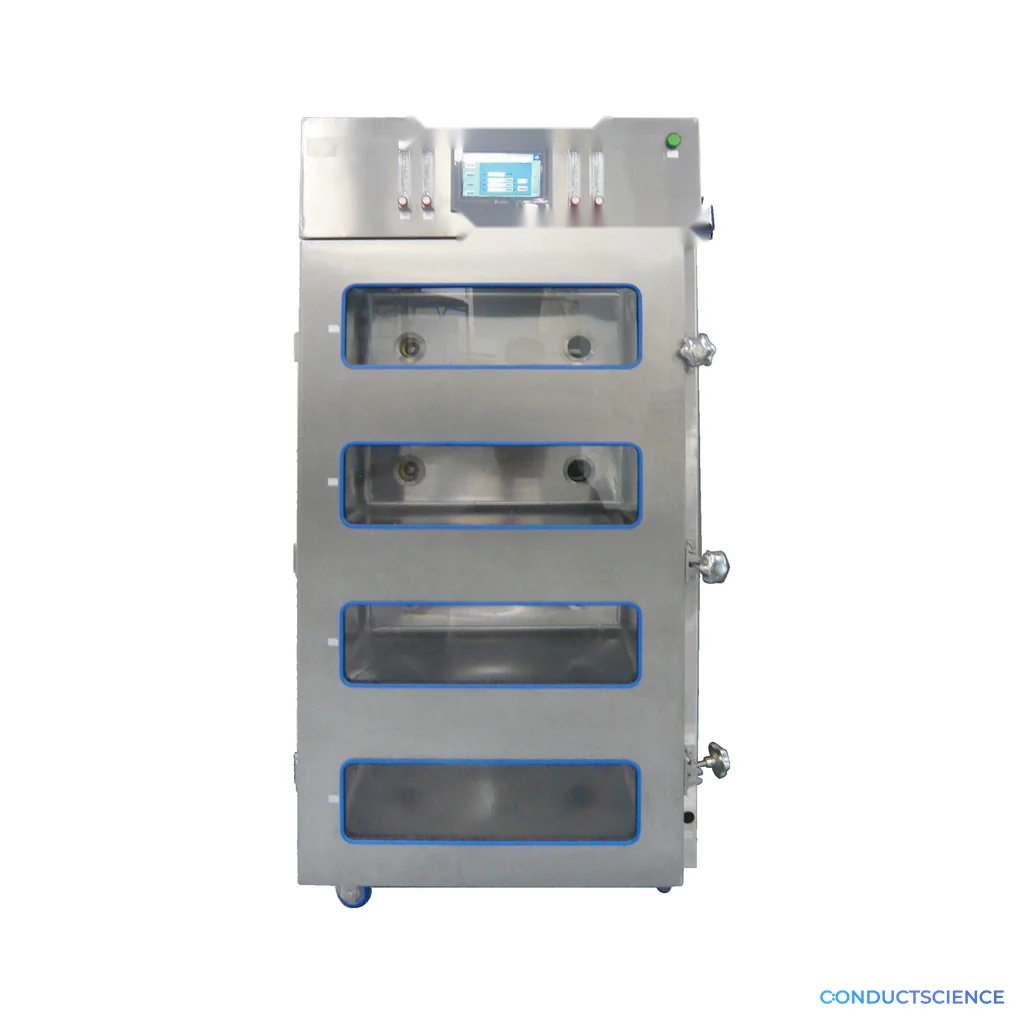
Four-Cage CO₂ Euthanasia Chamber
Standing four-cage CO₂ chamber for institutions that need programmable fill, hold, and exhaust phases with room-level gas safety planning.
The 780 × 670 × 1630 mm cabinet accepts four 610 × 435 × 210 mm cages and combines touchscreen PLC control, sealed doors, metal gas supply, low-temperature-resistant piping, a 75 mm exhaust, CO₂ monitoring, leak alarm, and automatic gas shutoff.

Louise Corscadden, PhD
Director of Science · ConductScience
Ask Louise about Four-Cage CO₂ Euthanasia Chamber fit, setup, configuration, or quote prep.
Already working with us? Sign in to connect this with My Scientist.
Key Specifications
Full details →- External dimensions
- 780 × 670 × 1630 mm
- Cage format
- Four cages · each 610 × 435 × 210 mm
- Control
- Touchscreen PLC · configurable fill, hold, and exhaust phases
- Gas path
- Metal supply pipeline · low-temperature-resistant piping and solenoid valves
- Exhaust
- 75 mm interface
- Door interface
- Sealed chamber doors
Treat the chamber as one controlled part of the approved euthanasia program
This standing CO₂ chamber is intended for institutions that need to process compatible rodent cages within a veterinarian-approved euthanasia workflow. The equipment provides enclosure, gas routing, programmable phases, exhaust, and leak response. It does not establish the humane method, gas-displacement rate, exposure endpoint, death confirmation, or secondary method. Those decisions belong to the current institutional protocol, veterinary guidance, staff training, and applicable requirements.
The cabinet measures 780 × 670 × 1630 mm and accommodates four cages measuring 610 × 435 × 210 mm. A touchscreen PLC lets authorized staff configure fill, hold, and exhaust times for the approved process. Because animal number, cage loading, species, age, health, and enclosure geometry can affect the procedure, the facility should qualify each permitted configuration rather than assuming that one stored program covers every use.
The chamber accepts CO₂ through a metal pipeline, and internal piping and solenoid valves are specified for low-temperature service. A 75 mm exhaust interface supports planned gas removal. Door seals, chamber condition, regulator performance, gas concentration, exhaust function, and room ventilation should be checked through a documented pre-use and maintenance program. Gas supply sizing and final connections require facility engineering review.
An internal CO₂ monitor supports leak detection, with an alarm and automatic gas shutoff if leakage is detected. That feature complements rather than replaces room-level monitoring, ventilation, occupational exposure controls, emergency response, and staff authorization. Teams should define who can change programs, how alarms are handled, how animals are observed, how death is confirmed, how the chamber is cleared, and what happens after a power, gas, exhaust, or sensor fault.
Share the approved protocol, species and cage details, batch plan, veterinarian-defined method, gas supply, regulator, pipeline, exhaust, room ventilation, monitoring, alarm integration, cleaning, and delivery route with ConductScience. The quote will define the chamber, controls, gas and exhaust interfaces, safety devices, accessories, installation, testing, training, and commissioning. This gives the institution a clear equipment basis for its own humane and compliant operating procedure.
Features & Benefits
External dimensions
- 780 × 670 × 1630 mm
Cage format
- Four cages · each 610 × 435 × 210 mm
Control
- Touchscreen PLC · configurable fill, hold, and exhaust phases
Gas path
- Metal supply pipeline · low-temperature-resistant piping and solenoid valves
Exhaust
- 75 mm interface
Door interface
- Sealed chamber doors
Leak response
- CO₂ concentration monitor · alarm · automatic gas shutoff
Setup Guide
What’s in the Box
- Four-cage CO₂ chamber; controller, gas and exhaust interfaces, safety devices, accessories, and commissioning scope confirmed in the quote
Does the chamber set the correct gas-displacement rate?
No. The veterinarian-approved protocol and commissioning process must define and verify the method for each permitted load.
Is the internal leak monitor enough for room safety?
No. Room ventilation, occupational monitoring, supply controls, alarms, and emergency response remain part of the facility safety plan.
What must be tested before use?
Test cage fit, door seals, programs, gas supply, concentration monitoring, exhaust, alarms, shutoff, fault response, and staff procedures.
Have a question about this product?
Have a question? Just ask.
Send it over and we'll email you a personalized answer — no call, no scheduling.
Prefer to talk it through?
Related Products