Glass Heavy Metal Detection Chip (1000 um)
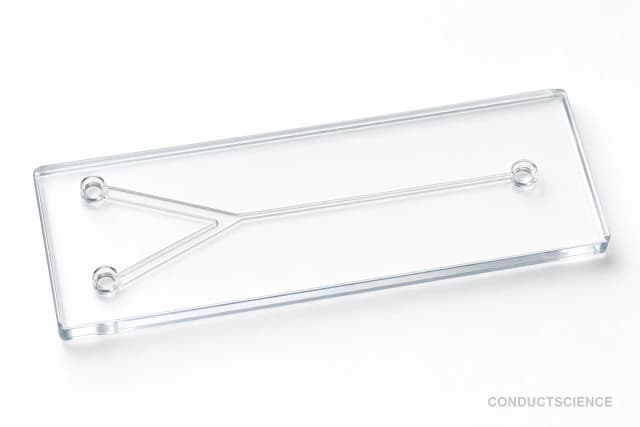
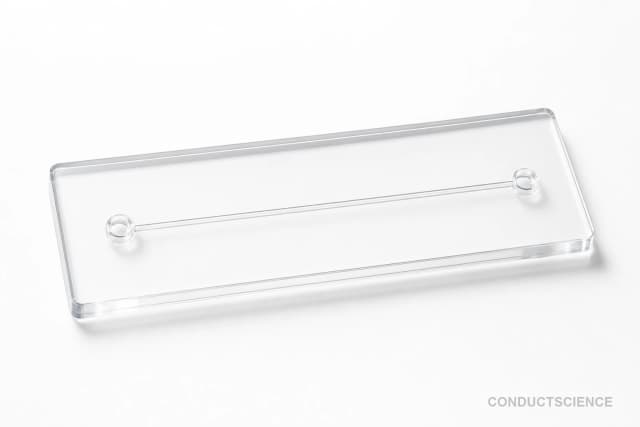
Glass microfluidic chip with 1000 × 1000 μm channels designed for quantitative heavy metal detection and water quality analysis applications.
Reusable chip — designed for multiple experimental runs. Compatible with standard microfluidic tubing: steel pins (0.7 mm ID / 1.0 mm OD) and silicone tubing (0.8 mm ID / 1.9 mm OD). Available in bulk packs (5‑, 10‑, and 25‑unit) for lab-scale and consumable workflows.

Louise Corscadden, PhD
Director of Science · ConductScience
Ask Louise about Glass Heavy Metal Detection Chip (1000 um) fit, setup, configuration, or quote prep.
Already working with us? Sign in to connect this with My Scientist.
Key Specifications
Full details →- Model fit
- 3 selectable configurations
- SKU family
- WHM-0132
- Shipping box
- 181.8 x 136.3 x 90.9 cm
- Ordering
- Online checkout and quote request available
- Category
- Environmental Detection Chips
- Build notes
- Confirm accessories, station layout, and support needs before purchase
The Glass Heavy Metal Detection Chip (1000 μm) is a specialized microfluidic device engineered for quantitative analysis of heavy metal contaminants in aqueous samples. Featuring 1000 × 1000 μm glass channels, this chip provides the spatial resolution and surface chemistry properties necessary for reliable detection and quantification of toxic metal ions including lead, mercury, cadmium, and arsenic.
The glass substrate offers superior chemical inertness and optical clarity compared to polymer alternatives, enabling precise optical detection methods and minimizing sample adsorption artifacts. The large channel dimensions accommodate higher sample volumes while maintaining laminar flow characteristics essential for reproducible sensing performance. This microfluidic platform integrates sample handling, reaction chemistry, and detection in a single disposable device, reducing contamination risk and improving analytical throughput in environmental monitoring workflows.
How It Works
The glass microfluidic chip operates on the principle of controlled sample introduction and reaction within precisely fabricated microchannels. Sample and reagent streams are introduced through separate inlets and mix under laminar flow conditions within the 1000 μm square channels. The large channel dimensions provide sufficient residence time for complete reaction between target metal ions and detection reagents while maintaining predictable fluid dynamics.
Detection typically relies on colorimetric, fluorometric, or electrochemical methods compatible with the glass substrate. The optical transparency of the glass material enables real-time monitoring of reaction progress and quantitative measurement of signal intensity. Channel geometry ensures consistent optical path length and eliminates variations in detection sensitivity across different regions of the chip.
The disposable nature of the chip eliminates carryover contamination between samples, a critical consideration in trace metal analysis. Each chip provides a fresh, uncontaminated surface for analysis, ensuring measurement accuracy and reproducibility across sample batches.
Features & Benefits
Shipping weight
- 3.3 lb
Shipping box
- L: 181.8 cm
- W: 136.3 cm
- H: 90.9 cm
| Feature | This Product | Typical Alternative | Advantage |
|---|---|---|---|
| Channel Dimensions | 1000 × 1000 μm square channels | Many devices offer smaller channels in the 50-500 μm range | Larger channels reduce pressure drop and accommodate higher sample volumes for improved detection sensitivity. |
| Substrate Material | Glass construction | Polymer-based devices often use PDMS or other plastics | Glass provides superior chemical inertness and optical clarity critical for accurate heavy metal analysis. |
| Target Application | Specifically designed for heavy metal detection | General-purpose microfluidic chips require custom optimization | Purpose-built design eliminates need for extensive method development and validation. |
| Sample Compatibility | Optimized for water analysis applications | Generic chips may not be validated for environmental matrices | Application-specific design ensures reliable performance with complex environmental samples. |
| Detection Integration | Compatible with multiple detection methods | Some devices are limited to single detection modalities | Flexibility allows method selection based on sensitivity requirements and available instrumentation. |
This glass microfluidic chip offers specialized design for heavy metal detection with large 1000 μm channels and glass substrate construction. The application-specific optimization for water analysis applications provides advantages over general-purpose microfluidic devices that require custom development for environmental monitoring workflows.
| Model | SKU | Listed price | Status | Shipping box |
|---|---|---|---|---|
| 25-Pack | WHM-0132-25PK | Quote | Available | 181.8 x 136.3 x 90.9 cm |
| 10-Pack | WHM-0132-10PK | $1,490.00 | Available | 181.8 x 136.3 x 90.9 cm |
| 5-Pack | WHM-0132-5PK | Quote | Available | 181.8 x 136.3 x 90.9 cm |
Practical Tips
Prepare fresh calibration standards daily using certified reference materials in the same matrix as your samples.
Why: Matrix effects and standard degradation can significantly impact accuracy in trace metal analysis.
Store unused chips in original protective packaging in a clean, dry environment away from potential metal contamination sources.
Why: Proper storage prevents contamination and maintains chip integrity before use.
Use metal-free reagents and containers throughout sample preparation and analysis workflow.
Why: Contamination from sample handling can exceed detection limits and compromise measurement accuracy.
If flow irregularities occur, check for air bubbles in channels and ensure proper sealing of all fluidic connections.
Why: Air bubbles and leaks disrupt laminar flow conditions essential for reproducible mixing and detection.
Run blank and quality control samples with each batch to monitor for contamination and system drift.
Why: Quality control measures ensure detection system performance and identify potential contamination sources.
Handle chips with appropriate PPE and dispose according to local regulations for materials exposed to heavy metals.
Why: Proper handling prevents exposure to potentially toxic metal solutions and ensures safe waste disposal.
Optimize sample and reagent flow rates to ensure complete mixing within the reaction zone before detection.
Why: Incomplete mixing leads to poor reproducibility and reduced detection sensitivity.
Verify calibration linearity across the expected concentration range for each target metal.
Why: Non-linear response at high or low concentrations can lead to quantification errors.
Setup Guide
What’s in the Box
- Glass Heavy Metal Detection Chip (1000 μm)
- Protective storage case (typical)
- Usage instructions (typical)
- Certificate of specifications (typical)
Warranty
ConductScience provides standard warranty coverage for manufacturing defects and material quality. Technical support is available for application guidance and troubleshooting assistance.
Compliance
What detection methods are compatible with this glass microfluidic chip?
The glass substrate supports colorimetric, fluorometric, and electrochemical detection methods. Optical transparency enables absorbance and fluorescence measurements, while glass surface can be modified for electrochemical sensing applications.
What is the minimum sample volume required for analysis?
Sample volume requirements depend on the specific assay protocol and detection method used. The 1000 μm channels accommodate larger volumes than standard microfluidic devices. Consult product datasheet for specific volume specifications.
How does channel size affect detection sensitivity?
The 1000 μm channels provide longer optical path length for absorbance-based detection and larger reaction volume for improved signal-to-noise ratio compared to smaller microchannels, potentially enhancing detection sensitivity.
Can the chip be reused for multiple samples?
The chip is designed as a disposable device to eliminate cross-contamination between samples, which is critical for trace metal analysis. Single-use design ensures measurement accuracy and reproducibility.
What flow rate ranges are recommended for optimal performance?
Flow rates should be optimized based on mixing requirements and reaction kinetics of the specific metal detection assay being performed. Consult product datasheet for recommended flow rate ranges.
How do I prevent metal contamination during chip handling?
Use metal-free tools and containers during chip handling and sample preparation. Store chips in provided protective packaging until use and handle only with clean, powder-free gloves.
What is the detection limit for different heavy metals?
Detection limits depend on the specific assay chemistry and detection method employed. The chip provides the microfluidic platform; actual detection limits are determined by the analytical method used. Consult product datasheet for performance data.
Can this chip handle samples with high ionic strength or pH extremes?
Glass substrate offers excellent chemical resistance to most aqueous solutions. However, sample compatibility should be verified for specific pH ranges and ionic compositions relevant to your application.
Have a question about this product?
Have a question? Just ask.
Send it over and we'll email you a personalized answer — no call, no scheduling.
Prefer to talk it through?