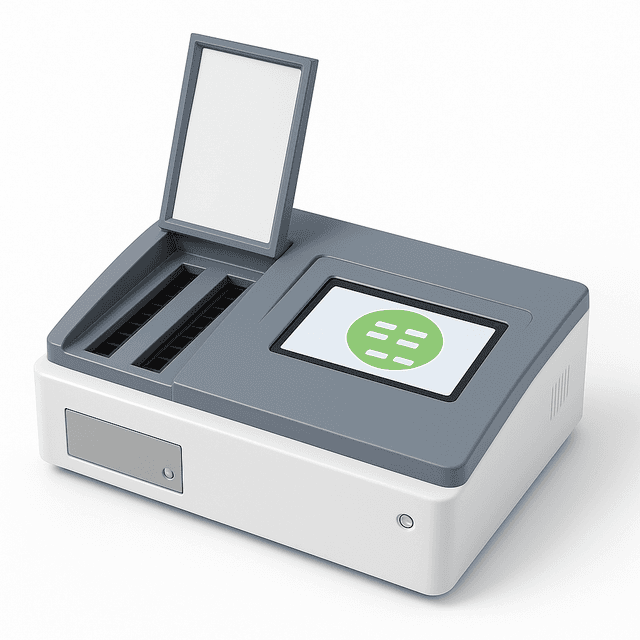
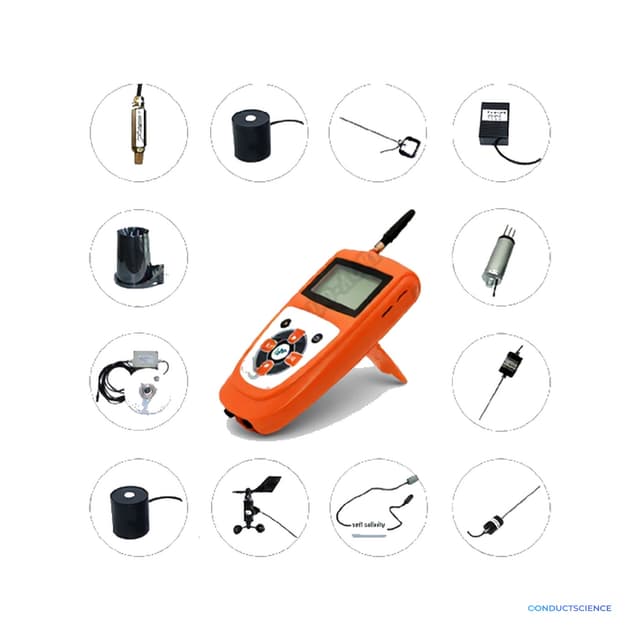
Handheld Pesticide Residue Meter
Detect organophosphate & carbamate residues in produce, seafood & food.
±3% accuracy, 500-record storage, USB data transfer. Compact field-ready meter.

Louise Corscadden, PhD
Director of Science · ConductScience
Ask Louise about Handheld Pesticide Residue Meter fit, setup, configuration, or quote prep.
Already working with us? Sign in to connect this with My Scientist.
Key Specifications
Full details →- Inspected Analytes
- Organophosphate and carbamate pesticide residues
- Test Principle
- Enzyme inhibition (cholinesterase hydrolyzing acetylcholine)
- Reagent Storage
- Supplementary reagent kept in a refrigerator at 4 to 6 °C
- Sample Categories
- Agricultural and sideline products, vegetables, fruits, daily food, seafood and seafood products
- Transmittance Accuracy
- ±3%
- Transmittance Repeatability
- ±2%
The Handheld Portable Pesticide Residue Tester is a compact, portable meter designed for rapid quantitative detection of pesticide residues directly in the field or at the point of inspection. It targets organophosphate and carbamate residues—the two classes most commonly regulated in fresh produce—delivering results without the delays of laboratory send-out.
The meter operates across a broad range of food categories, including fresh vegetables, fruits, agricultural and sideline products, daily food items, and seafood. This versatility makes it suitable for use by food safety inspectors, farm operators, market supervisors, and research teams conducting field surveys on residue contamination.
Results are shown on a 128 × 64 LCD screen, and up to 500 records can be stored onboard for later review. Data can be transferred to a computer via the built-in USB interface. The instrument is powered by an internal 3.7 V lithium battery with an option for 5 V external power, and includes automatic power-off to conserve charge during fieldwork.
The meter specifies ±3% transmittance accuracy, ±2% transmittance repeatability and ±5% linear error.
The test uses an enzyme inhibition method based on cholinesterase hydrolyzing acetylcholine: pesticide residue inhibits the enzyme, and the change in absorbance reflects the amount of residue. The meter shows the result as a value, with no calculation needed. A reading of 50% or more is positive, meaning the residue is over the limit, and the higher the value, the more residue. The supplementary reagent is stored in a refrigerator at 4 to 6 °C.
Inspected Analytes
- Organophosphate and carbamate pesticide residues
Test Principle
- Enzyme inhibition (cholinesterase hydrolyzing acetylcholine)
Reagent Storage
- Supplementary reagent kept in a refrigerator at 4 to 6 °C
Sample Categories
- Agricultural and sideline products, vegetables, fruits, daily food, seafood and seafood products
Transmittance Accuracy
- ±3%
Transmittance Repeatability
- ±2%
Linear Error
- ±5%
Display
- LCD, 128 × 64 resolution
Light Source
- Semi-permanent, long life
Data Storage
- 500 records; upload to a computer before the limit is reached, or records are lost
PC Interface
- USB
Power Supply
- 3.7 V internal lithium battery; 5 V external power
Operating Temperature
- 0–40 °C
Operating Humidity
- 35–85% RH
Additional Features
- Time and battery-level display; automatic power-off
What types of pesticide residues does this meter detect?
The meter is designed for rapid quantitative testing of organophosphate and carbamate pesticide residues, which are among the most widely regulated classes in fresh produce and food safety programs.
What food and sample types can be tested?
The instrument is suited for agricultural and sideline products, fresh vegetables, fruits, daily food items, and seafood and its products. It is intended for field and point-of-inspection use rather than a restricted single-commodity application.
How accurate are the measurements?
The meter specifies a transmittance accuracy of ±3%, a transmittance repeatability of ±2%, and a linear error of ±5%.
How is data stored and transferred?
Up to 500 test records can be stored on the device. When storage approaches the limit, records should be exported before deletion to avoid data loss. Saved data can be transferred to a computer via the built-in USB interface.
What are the power and operating environment requirements?
The meter runs on an internal 3.7 V lithium battery and can also be powered from a 5 V external supply. It is rated for use in temperatures of 0–40 °C and relative humidity of 35–85%. An automatic power-off function helps extend battery life during field sessions.
Have a question about this product?
Have a question? Just ask.
Send it over and we'll email you a personalized answer, with no call or scheduling.
Prefer to talk it through?
Frequently Bought Together