Large-Channel PDMS Cell Sorting Chip (500 um)
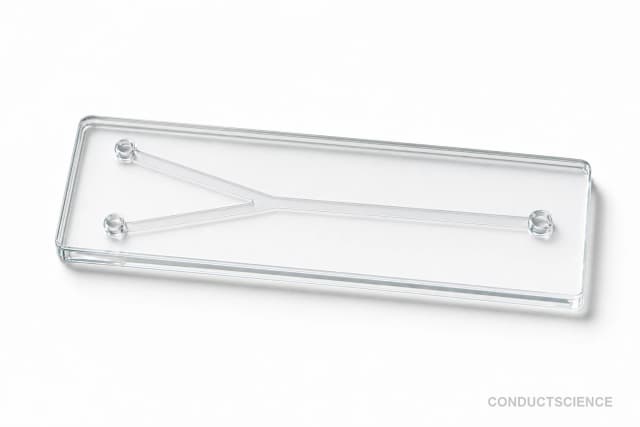
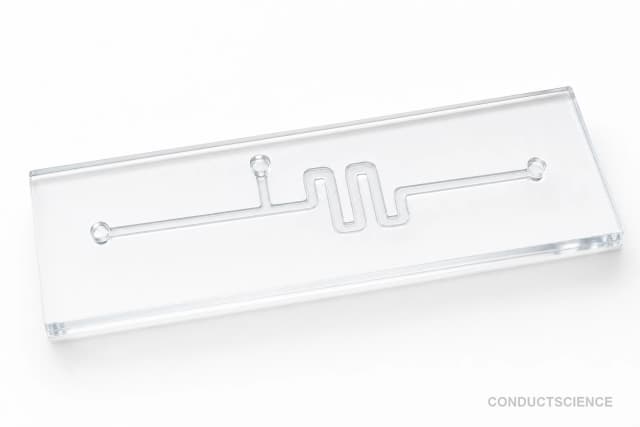
Microfluidic cell sorting chip with 500 × 500 μm channels designed for handling large cells, organoids, and cell clusters in PDMS format.
Reusable chip — designed for multiple experimental runs. Compatible with standard microfluidic tubing: steel pins (0.7 mm ID / 1.0 mm OD) and silicone tubing (0.8 mm ID / 1.9 mm OD). Available in bulk packs (5‑, 10‑, and 25‑unit) for lab-scale and consumable workflows.

Louise Corscadden, PhD
Director of Science · ConductScience
Ask Louise about Large-Channel PDMS Cell Sorting Chip (500 um) fit, setup, configuration, or quote prep.
Already working with us? Sign in to connect this with My Scientist.
Key Specifications
Full details →- Model fit
- 3 selectable configurations
- SKU family
- WHM-0078
- Shipping box
- 181.8 x 136.3 x 90.9 cm
- Ordering
- Online checkout and quote request available
- Category
- Cell Culture Chips
- Build notes
- Confirm accessories, station layout, and support needs before purchase
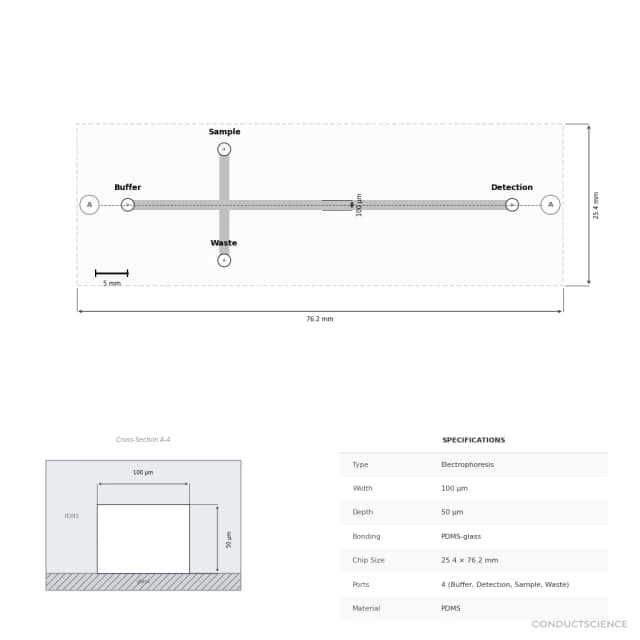
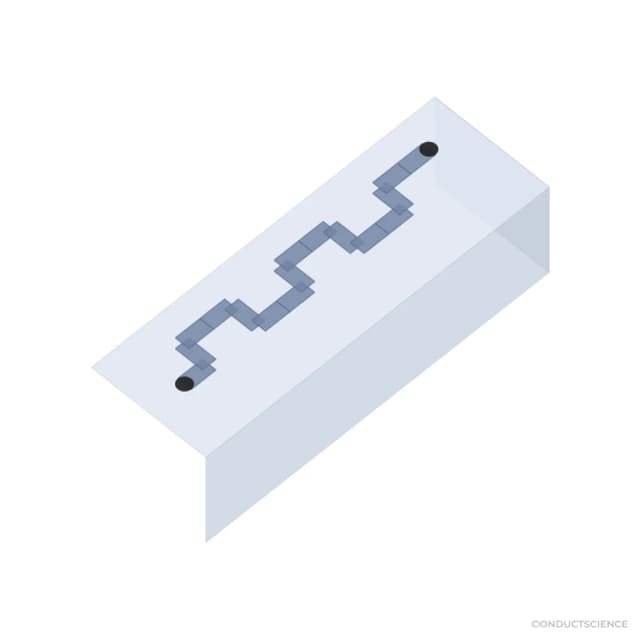
The Large-Channel PDMS Cell Sorting Chip (500 μm) is a microfluidic device designed for handling large cells, cell clusters, and organoids that cannot be processed effectively with standard microfluidic channels. The 500 × 500 μm channel dimensions accommodate spheroids, tumor organoids, stem cell aggregates, and primary cell clusters without inducing mechanical stress or causing channel blockage. This chip enables researchers to perform cell sorting, isolation, and encapsulation protocols on samples that require larger channel architectures.
Fabricated from polydimethylsiloxane (PDMS), this microfluidic chip provides biocompatible cell handling with optical transparency for real-time monitoring during sorting operations. The large channel design supports applications in organoid research, primary tissue processing, and cell culture workflows where maintaining cell viability and morphology during microfluidic manipulation is critical. Integration with standard microfluidic pumps and microscopy systems enables precise control over flow conditions and cell positioning.
How It Works
The large-channel PDMS cell sorting chip operates on microfluidic flow control principles adapted for oversized biological specimens. The 500 × 500 μm channels create laminar flow conditions that allow precise manipulation of large cells and organoids without the shear stress limitations encountered in standard microfluidic devices. Flow cytometry-based sorting is achieved through hydrodynamic focusing, where sample and sheath flows converge to position cells in the detection region.
Cell sorting is accomplished through either passive or active mechanisms depending on the specific chip design. Passive sorting relies on size-based separation using channel geometry and flow rate differentials, while active sorting may incorporate pneumatic or electrical actuation for real-time cell deflection. The PDMS material provides excellent optical clarity for fluorescence detection and bright-field imaging during sorting operations.
The large channel architecture prevents clogging issues common with smaller microchannels when processing heterogeneous samples containing debris or cell aggregates. Flow rates are typically optimized to maintain cell viability while achieving adequate sorting resolution, with residence times in the chip minimized to reduce cellular stress.
Features & Benefits
Shipping weight
- 3.3 lb
Shipping box
- L: 181.8 cm
- W: 136.3 cm
- H: 90.9 cm
| Feature | This Product | Typical Alternative | Advantage |
|---|---|---|---|
| Channel Size | 500 × 500 μm channels | Standard chips typically feature 10-100 μm channels | Enables processing of large cells, organoids, and tissue fragments that would clog smaller channels. |
| Material Construction | PDMS fabrication | Various materials including glass, silicon, or plastic | Provides excellent biocompatibility and optical clarity while maintaining cost-effectiveness for research applications. |
| Target Applications | Large cell sorting and organoid manipulation | Most devices focus on single-cell analysis | Specialized design addresses the growing need for organoid and tissue engineering research workflows. |
| Flow Characteristics | Laminar flow optimized for large specimens | Higher shear rates in smaller channels | Reduces mechanical stress on fragile three-dimensional cell cultures and primary tissue samples. |
This chip addresses the specific need for microfluidic processing of large biological specimens that cannot be handled by standard microfluidic devices. The 500 μm channel architecture and PDMS construction provide a specialized solution for organoid research and large cell manipulation applications.
| Model | SKU | Listed price | Status | Shipping box |
|---|---|---|---|---|
| 25-Pack | WHM-0078-25PK | Quote | Available | 181.8 x 136.3 x 90.9 cm |
| 10-Pack | WHM-0078-10PK | $1,490.00 | Available | 181.8 x 136.3 x 90.9 cm |
| 5-Pack | WHM-0078-5PK | Quote | Available | 181.8 x 136.3 x 90.9 cm |
Practical Tips
Pre-filter cell suspensions to remove debris larger than 400 μm that could still cause blockage even in large channels.
Why: Prevents clogging and ensures consistent flow patterns throughout the sorting process.
Clean channels immediately after use with appropriate buffers followed by air drying to prevent protein buildup.
Why: Protein adsorption can alter surface properties and affect cell adhesion in subsequent experiments.
Establish optimal flow rate ratios between sample and sheath streams for each cell type through systematic testing.
Why: Large channel dimensions require different hydrodynamic conditions compared to standard microfluidic protocols.
Monitor cell viability before and after sorting to assess the impact of microfluidic processing on your specific cell type.
Why: Different cell types and organoids have varying sensitivity to shear stress and residence time in microchannels.
If cells aggregate during processing, reduce flow rates and consider adding anti-aggregation agents to the buffer.
Why: Cell aggregation can lead to unpredictable sorting behavior and reduced efficiency in large-channel devices.
Use appropriate biosafety containment when processing primary tissue samples or potentially infectious material.
Why: Primary tissue samples may contain unknown pathogens requiring proper safety protocols during microfluidic processing.
Setup Guide
What’s in the Box
- Large-Channel PDMS Cell Sorting Chip (500 μm)
- User manual with protocols (typical)
- Quality control certificate (typical)
Warranty
ConductScience provides a standard one-year manufacturer warranty covering defects in materials and workmanship. Technical support includes application guidance and troubleshooting assistance for microfluidic protocols.
Compliance
What cell sizes can be processed through the 500 μm channels?
The 500 × 500 μm channels can accommodate single large cells up to approximately 400 μm diameter, cell clusters, spheroids, and organoids. The exact size limit depends on cell deformability and flow conditions, but the design targets specimens that cannot pass through standard microfluidic channels (typically <100 μm).
How does the large channel design affect sorting resolution?
Larger channels reduce hydrodynamic focusing efficiency compared to standard microchannels, potentially decreasing spatial resolution. However, this trade-off is necessary for processing large specimens. Sorting resolution can be optimized through flow rate adjustment and detection system configuration.
What flow rates are recommended for organoid sorting?
Flow rates should be empirically optimized for each application, typically ranging from 1-50 μL/min depending on organoid size and fragility. Begin with conservative rates (1-5 μL/min) and increase gradually while monitoring cell viability and sorting efficiency.
Can the chip be sterilized for cell culture applications?
PDMS chips can be sterilized using gamma irradiation, ethylene oxide, or UV exposure. Autoclave sterilization is not recommended as it may deform the PDMS structure. Always verify sterilization method compatibility with your specific cell culture requirements.
How many times can the chip be reused?
Reuse depends on the specific application and cleaning protocol. For cell culture work, single-use is often preferred to avoid contamination. If reusing, thorough cleaning with appropriate detergents and sterilization is essential. Consult product datasheet for specific reuse guidelines.
What detection methods are compatible with this chip design?
The chip supports fluorescence detection, bright-field imaging, and impedance-based measurements. The PDMS material's optical properties enable most standard microscopy techniques. Detection sensitivity may differ from smaller channel devices due to the increased channel volume.
How does this compare to FACS for large cell sorting?
The microfluidic approach offers gentler handling with reduced mechanical stress compared to FACS, making it suitable for fragile organoids and cell clusters. However, throughput is typically lower than FACS systems. The choice depends on sample fragility, throughput requirements, and downstream applications.
Have a question about this product?
Have a question? Just ask.
Send it over and we'll email you a personalized answer — no call, no scheduling.
Prefer to talk it through?