Metallogical Microscope
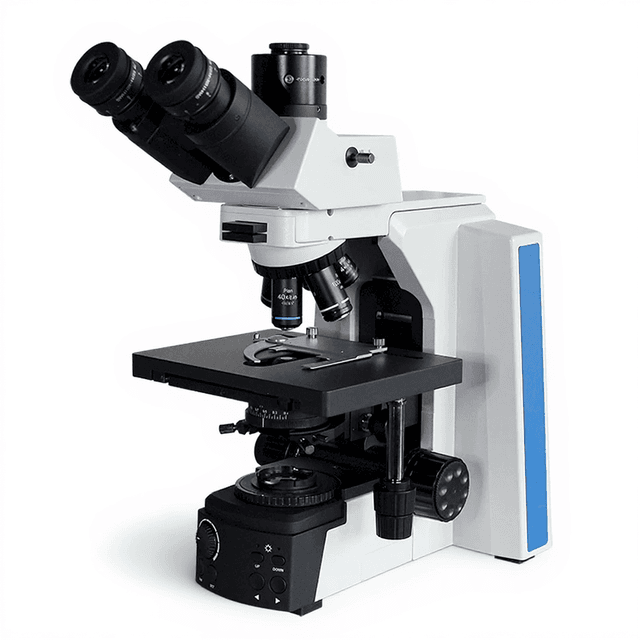
Research-grade metallographic microscope with infinite optical system, brightfield/darkfield objectives 5X-100X, and polarization capabilities for materials analysis and quality control.

Louise Corscadden, PhD
Director of Science · ConductScience
Ask Louise about Metallogical Microscope fit, setup, configuration, or quote prep.
Already working with us? Sign in to connect this with My Scientist.
Key Specifications
Full details →- Model fit
- Configured during quote
- SKU family
- BIO-0500
- Shipping box
- 42.0 x 43.6 x 38.0 cm
- Ordering
- Online checkout and quote request available
- Category
- Microscopy
- Build notes
- Confirm accessories, station layout, and support needs before purchase
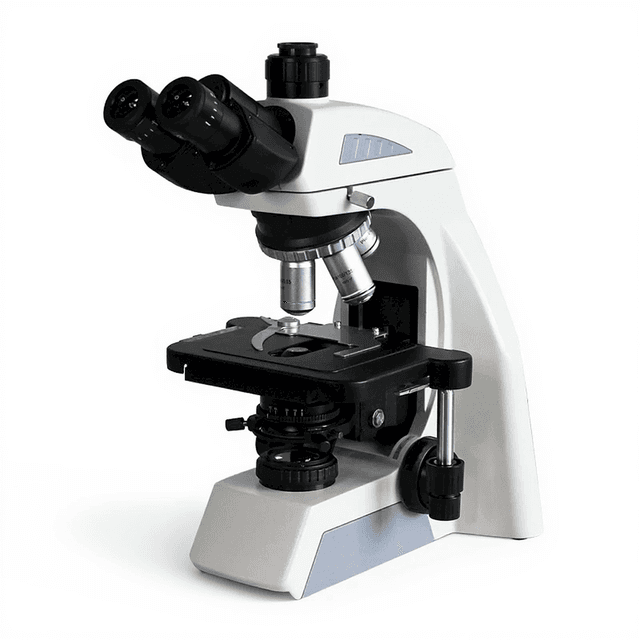
The Metallogical Microscope is a research-grade optical system designed for metallographic analysis, materials characterization, and quality control applications. Built with an infinite optical system and Siedentopf binocular viewing head inclined at 30°, this microscope provides precise observation capabilities for examining metal structures, surface morphology, and material defects. The system includes a complete range of brightfield/darkfield objectives from 5X to 100X magnification, supporting comprehensive microscopic analysis workflows.
The microscope features both polarizing capabilities and differential interference contrast (DIC) options for enhanced contrast imaging of crystalline structures and surface features. With its 12V/50W halogen illumination system and center brightness adjustment, the instrument delivers consistent, controllable lighting conditions essential for reliable microscopic documentation and measurement. The extra-wide field eyepieces, including options up to EW20X/12, provide comfortable viewing with reduced eye strain during extended observation periods.
How It Works
The Metallogical Microscope operates on the principle of transmitted and reflected light microscopy with polarization capabilities. The infinite optical system eliminates spherical aberration by creating parallel light rays between the objective and tube lens, ensuring consistent image quality across all magnifications. Light from the 12V/50W halogen source passes through the polarizer, sample, and analyzer to reveal birefringent properties and crystalline structures invisible under conventional brightfield illumination.
The brightfield/darkfield objectives utilize different illumination geometries to enhance contrast and reveal specific sample features. Brightfield mode transmits light directly through the specimen, while darkfield mode uses oblique illumination to scatter light from edges and interfaces, making transparent or low-contrast features visible. The differential interference contrast (DIC) option further enhances surface topography visualization by converting optical path differences into visible contrast variations.
The Siedentopf binocular head design allows independent adjustment of interpupillary distance (48-75mm) without affecting focus or magnification, accommodating different users while maintaining precise optical alignment. The 30° viewing angle reduces neck strain during prolonged observations, while the extra-wide field eyepieces maximize the observable area and improve spatial resolution for detailed structural analysis.
Features & Benefits
Automation Level
- manual
Optical System
- Infinite optical system
Extra Wide Field Eyepiece
- EW10X/22
EW10X/20 eyepiece with scale of cross hair
- √
EW15X/16
- ●
EW20X/12
- ●
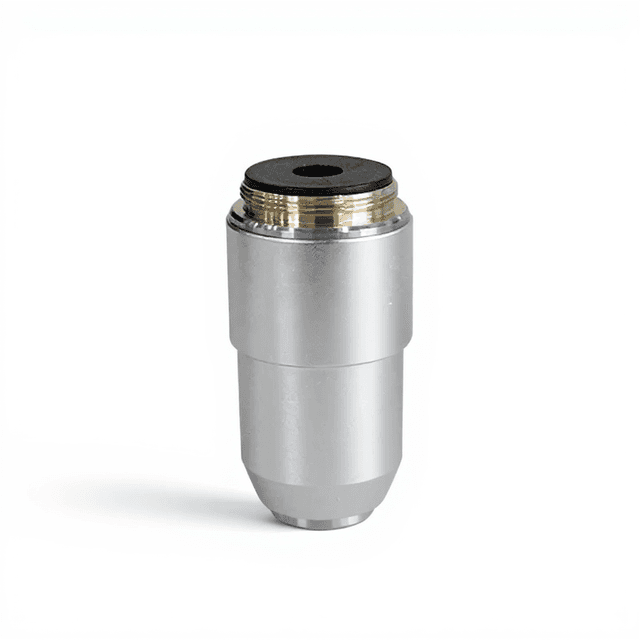
5X/0.12/∞/-(BF/DF) LWD 10mm
- √
10X/0.25/∞/-(BF/DF) LWD 10mm
- √
20X/0.4/∞/0(BF/DF) LWD 5mm
- √
50X/0.75/∞/0(BF/DF) LWD 1.3mm
- √
100X/0.9/∞/0(BF/DF) LWD 0.7mm
- √
View Head
- Siedentopf binocular viewing head, incline at 30°, Interpupillary 48mm~75mm
12V/50W halogen light, center and brightness adjus
- √
Polarizer and analyzer
- √
DIC
- ●
Brand
- ConductScience
Research Domain
- Analytical Chemistry
- Environmental Monitoring
- Food Science
- Industrial Hygiene
- Materials Science
- Pharmaceutical QC
Shipping weight
- 18.0 lb
Shipping box
- L: 42.0 cm
- W: 43.6 cm
- H: 38.0 cm
| Feature | This Product | Typical Alternative | Advantage |
|---|---|---|---|
| Optical System Design | Infinite optical system with aberration correction | Entry-level models often use finite tube length designs | Provides consistent image quality across all magnifications and enables modular optical component integration. |
| Objective Magnification Range | Complete 5X-100X set with brightfield/darkfield capability | Basic systems may offer limited magnifications or lack darkfield | Covers full analytical range needed for comprehensive materials characterization in a single system. |
| Viewing Head Configuration | Siedentopf binocular head with 30° inclination and 48-75mm IPD range | Fixed binocular heads with limited adjustment options | Accommodates multiple users with ergonomic positioning that reduces fatigue during extended analysis sessions. |
| Contrast Enhancement Options | Polarization, brightfield/darkfield, and DIC compatibility | Many systems offer only brightfield illumination | Multiple contrast methods reveal different sample features essential for complete microstructural analysis. |
| Eyepiece Field Options | Extra-wide field eyepieces including EW20X/12 and measurement reticle | Standard field eyepieces with narrower viewing area | Maximizes observable area for efficient sample survey and provides integrated measurement capability. |
| Working Distances | Long working distances up to 10mm (5X and 10X objectives) | Shorter working distances limit sample accessibility | Accommodates thick specimens and allows manipulation tools access for in-situ examination. |
This microscope combines infinite optical design with comprehensive contrast enhancement capabilities and ergonomic features. The complete objective set with polarization and DIC options provides versatile analytical capability, while the Siedentopf head design and extra-wide field eyepieces enhance user comfort and observation efficiency for extended research applications.
Practical Tips
Calibrate the cross-hair scale eyepiece using a stage micrometer at each magnification to ensure measurement accuracy.
Why: Optical magnification can vary slightly between systems and accurate dimensional analysis requires precise calibration.
Clean objective lenses with lens paper and appropriate solvent, working from center outward in circular motions.
Why: Contaminated optics degrade image quality and can cause permanent damage to expensive lens coatings.
Allow halogen illumination to stabilize for 10-15 minutes before critical photomicrography or measurements.
Why: Color temperature and intensity drift during warm-up can affect reproducibility and color balance in documented images.
Use the lowest magnification that provides adequate resolution to maximize field of view and depth of focus.
Why: Higher magnifications reduce the observable area and working distance, potentially missing important contextual features.
If polarized light images appear too dark, check polarizer and analyzer alignment and verify they are not over-rotated.
Why: Misaligned polarizers prevent proper extinction and reduce the contrast needed for crystalline structure visualization.
Record illumination settings and optical configuration for each documented image to ensure reproducible results.
Why: Consistent documentation parameters are essential for comparative analysis and peer review validation.
Allow halogen lamp to cool completely before handling or replacing to prevent burns and glass breakage.
Why: Halogen bulbs operate at high temperatures and retain heat for extended periods after switching off.
Store polarizer and analyzer components in dust-free environment and handle only by edges to prevent optical damage.
Why: Polarizing films are sensitive to scratches and contamination that permanently degrade optical performance.
Setup Guide
What’s in the Box
- Metallogical microscope with binocular head
- Complete objective set (5X, 10X, 20X, 50X, 100X)
- EW10X/22 extra-wide field eyepieces (pair)
- EW10X/20 eyepiece with cross-hair scale
- Polarizer and analyzer components
- 12V/50W halogen lamp assembly
- Power cord and illumination controls
- Dust cover (typical)
- User manual and optical specifications (typical)
Warranty
ConductScience provides a standard one-year manufacturer warranty covering optical and mechanical components, with technical support available for setup, calibration, and troubleshooting assistance.
Compliance
What is the maximum numerical aperture available and what resolution does this provide?
The 100X objective provides NA 0.9, which theoretically resolves features down to approximately 0.3 micrometers under optimal conditions with proper illumination wavelength selection.
Can this microscope accommodate thickness measurements of transparent samples?
Yes, the EW10X/20 eyepiece includes a calibrated cross-hair scale for direct measurements, and the DIC capability enables precise thickness determination through optical sectioning techniques.
What sample preparation is required for polarized light examination?
Samples should be polished to optical quality (typically 0.05 micron finish) and must be of appropriate thickness to avoid excessive birefringence. Metal samples require etching to reveal grain boundaries and phase structures.
How do I achieve proper Köhler illumination with this system?
Adjust the field and aperture diaphragms while focusing the condenser to create uniform, glare-free illumination. The center and brightness adjustment controls enable fine-tuning for optimal contrast.
What is the field of view at different magnifications with the EW10X/22 eyepieces?
Field number is 22mm, providing approximately 4.4mm field of view at 50X total magnification (5X objective × 10X eyepiece) down to 0.22mm at 1000X (100X objective × 10X eyepiece).
Can I add a camera system to this microscope?
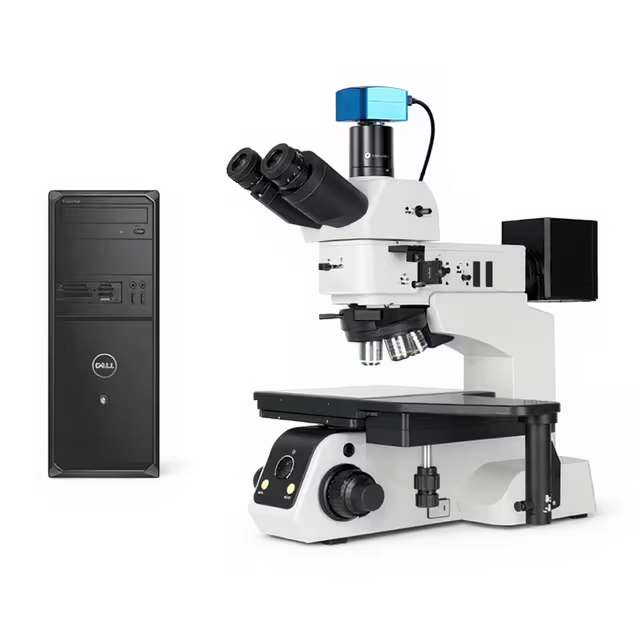
The infinite optical system design accommodates camera attachments through the appropriate tube lens and C-mount adapter, though specific compatibility should be verified with camera specifications.
What maintenance is required for the halogen illumination system?
Replace halogen bulbs when output decreases noticeably or color temperature shifts. Clean lamp housing and reflector surfaces monthly to maintain uniform illumination intensity.
How does this compare to LED illumination systems?
Halogen provides continuous spectrum illumination ideal for color-sensitive applications and polarized light work, though LED systems offer longer life and lower heat generation for routine brightfield examination.
Have a question about this product?
Have a question? Just ask.
Send it over and we'll email you a personalized answer — no call, no scheduling.
Prefer to talk it through?
Accessories
Enhance your setup with compatible accessories
Frequently Bought Together
Related Products