Micro Cross-Junction Droplet Generator (100 um)
PDMS microfluidic chip with 100 μm cross-junction geometry for generating monodisperse droplets in digital PCR and single-cell analysis applications.

Louise Corscadden, PhD
Director of Science · ConductScience
Ask Louise about Micro Cross-Junction Droplet Generator (100 um) fit, setup, configuration, or quote prep.
Already working with us? Sign in to connect this with My Scientist.
Key Specifications
Full details →- Model fit
- 3 selectable configurations
- SKU family
- WHM-0098
- Shipping box
- 181.8 x 136.3 x 90.9 cm
- Ordering
- Online checkout and quote request available
- Category
- Droplet Generator Chips
- Build notes
- Confirm accessories, station layout, and support needs before purchase
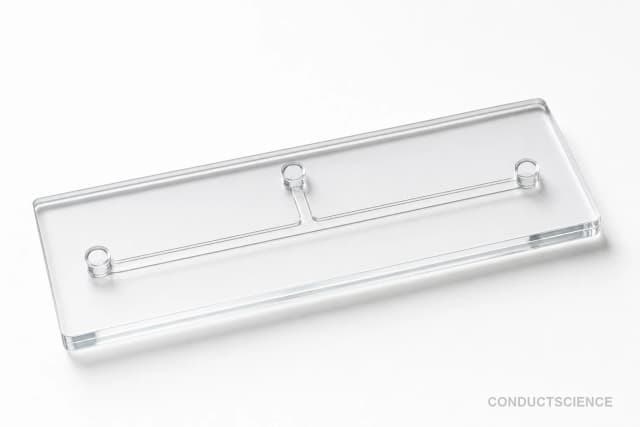
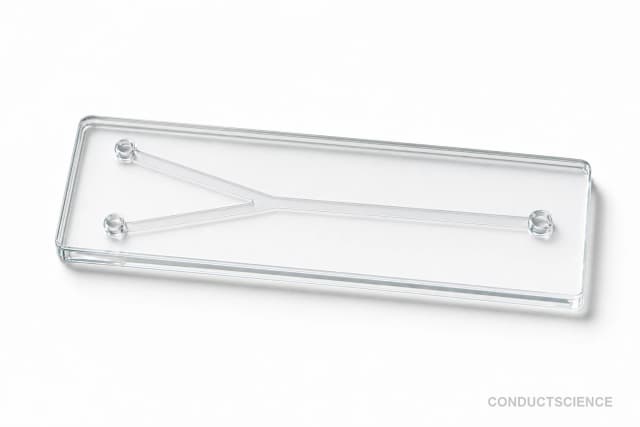
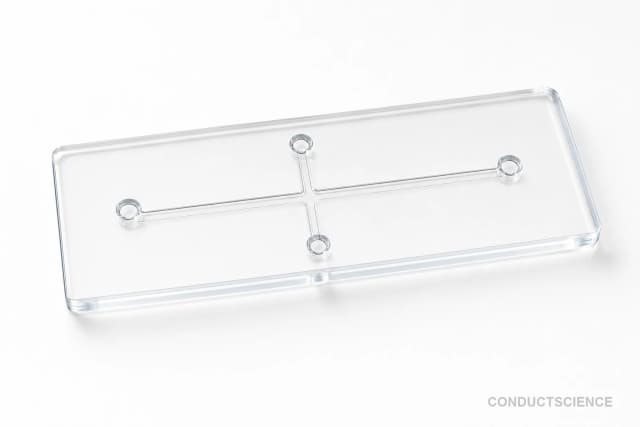
The Micro Cross-Junction Droplet Generator (100 μm) is a PDMS-based microfluidic device engineered for precise formation of monodisperse droplets in the 100-micrometer size range. The chip employs a cross-junction geometry where two fluid streams intersect perpendicularly, enabling controlled breakup of the dispersed phase into uniform droplets within a continuous carrier phase.
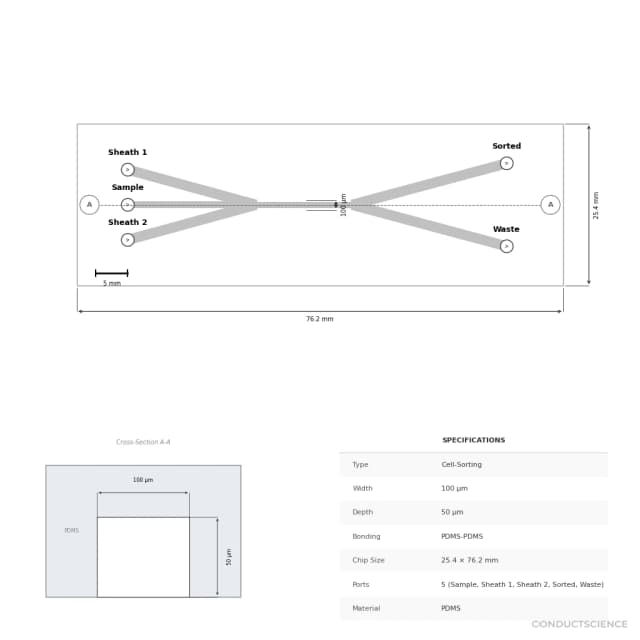
This microfluidic platform supports applications requiring fine droplet control, including digital PCR workflows where discrete reaction volumes are essential for single-molecule analysis. The 100 × 100 μm channel dimensions provide optimal flow characteristics for generating consistent droplet sizes while maintaining stable flow patterns across varying flow rate conditions.
How It Works
The cross-junction droplet generator operates on the principle of hydrodynamic flow focusing, where two immiscible fluid phases meet at a perpendicular intersection. The dispersed phase (typically aqueous) flows through the central channel, while the continuous phase (typically oil) flows through the perpendicular channels. At the junction, the continuous phase applies shear stress to the dispersed phase, causing periodic breakup and droplet formation.
Droplet size is controlled by the ratio of flow rates between the continuous and dispersed phases, with higher continuous phase flow rates producing smaller droplets. The 100 μm channel geometry provides sufficient space for droplet formation while maintaining laminar flow conditions necessary for reproducible droplet generation. Surface tension forces and channel wetting properties determine the final droplet morphology and stability.
The PDMS material enables rapid prototyping and provides optical transparency for real-time monitoring of droplet formation dynamics. The elastic properties of PDMS also facilitate reversible sealing to glass substrates and integration with external pumping systems for continuous operation.
Features & Benefits
Shipping weight
- 3.3 lb
Shipping box
- L: 181.8 cm
- W: 136.3 cm
- H: 90.9 cm
| Feature | This Product | Typical Alternative | Advantage |
|---|---|---|---|
| Channel Dimensions | 100 × 100 μm channels | Entry-level chips often feature larger 200-500 μm channels | Smaller channels enable generation of finer droplets for applications requiring higher surface-to-volume ratios. |
| Junction Design | Cross-junction geometry | Basic models commonly use T-junction configurations | Cross-junction provides more symmetric flow focusing and improved droplet size uniformity. |
| Material Construction | PDMS fabrication | Glass or thermoplastic alternatives available | PDMS offers superior optical clarity and enables reversible bonding for easy chip replacement. |
| Application Specificity | Optimized for digital PCR and fine droplets | General-purpose designs may lack application-specific optimization | Purpose-built geometry ensures optimal performance for demanding quantitative applications. |
This chip provides fine droplet generation capability through optimized 100 μm channel geometry and cross-junction design. The PDMS construction enables optical monitoring while maintaining compatibility with digital PCR workflows and single-cell analysis protocols.
| Model | SKU | Listed price | Status | Shipping box |
|---|---|---|---|---|
| 25-Pack | WHM-0098-25PK | Quote | Available | 181.8 x 136.3 x 90.9 cm |
| 10-Pack | WHM-0098-10PK | $1,490.00 | Available | 181.8 x 136.3 x 90.9 cm |
| 5-Pack | WHM-0098-5PK | Quote | Available | 181.8 x 136.3 x 90.9 cm |
Practical Tips
Calibrate flow rate controllers using the actual fluids you will use in experiments, as viscosity differences affect droplet size significantly.
Why: Fluid properties directly influence the hydrodynamic forces governing droplet formation.
Flush channels immediately after use with appropriate solvents to prevent protein precipitation or cell adhesion.
Why: Biological materials can rapidly form blockages that are difficult to remove once dried.
Monitor droplet formation continuously during the first 15 minutes to ensure stable operation before starting critical experiments.
Why: Flow stabilization time varies with fluid properties and initial channel conditions.
If droplet formation becomes irregular, check for air bubbles in the tubing system and prime all lines thoroughly.
Why: Air bubbles create flow instabilities that disrupt the precise pressure balance needed for consistent droplet generation.
Collect droplets into temperature-controlled reservoirs to minimize thermal effects on droplet stability during collection.
Why: Temperature fluctuations can cause droplet expansion or contraction affecting downstream quantitative measurements.
Use chemical-resistant gloves when handling organic solvents and ensure adequate ventilation in the work area.
Why: PDMS can swell in certain organic solvents, and solvent vapors require proper ventilation for safety.
Document flow rate settings and droplet size measurements for each experimental condition to enable reproducible protocols.
Why: Small variations in flow conditions can significantly impact droplet characteristics and experimental outcomes.
Store chips in dust-free containers and avoid touching channel surfaces to maintain optimal wetting properties.
Why: Surface contamination can alter wetting behavior and lead to inconsistent droplet formation.
Setup Guide
What’s in the Box
- PDMS droplet generator chip with cross-junction geometry
- Protective packaging case (typical)
- User instructions and handling guidelines (typical)
- Certificate of specifications (typical)
Warranty
ConductScience provides a standard manufacturer warranty covering material defects and fabrication quality. Technical support is available for setup optimization and troubleshooting droplet formation issues.
Compliance
What flow rate ratios are recommended for stable droplet formation?
Typical continuous-to-dispersed phase flow rate ratios range from 2:1 to 10:1, with higher ratios producing smaller droplets. Start with 5:1 and adjust based on desired droplet size and fluid properties.
Can the chip handle viscous fluids or cell suspensions?
The 100 μm channels accommodate moderately viscous solutions and cell suspensions up to 10^6 cells/mL. Higher viscosities may require reduced flow rates to maintain stable droplet formation.
How do I prevent channel clogging during extended operation?
Filter all fluids through 0.22 μm filters before use, maintain consistent flow rates, and flush channels with surfactant solutions between experiments to prevent protein or cell adhesion.
What surfactants are compatible for stabilizing droplets?
Common surfactants include Span 80, Tween 20, and commercial stabilizers like QX200 droplet generation oil for digital PCR applications. Consult product datasheet for specific compatibility information.
Can the chip be reused after cleaning?
PDMS chips can be reused multiple times with proper cleaning protocols including solvent flushing, sonication, and plasma treatment to restore surface properties between experiments.
What microscopy magnification is needed for droplet monitoring?
10× to 20× objective magnification provides sufficient resolution for monitoring droplet formation and measuring droplet diameters in the 50-200 μm range typically produced.
How stable are the generated droplets during thermal cycling?
Droplet stability depends on surfactant choice and concentration. Properly stabilized droplets maintain integrity through standard PCR thermal cycling (95°C to 60°C) with minimal coalescence.
Have a question about this product?
Have a question? Just ask.
Send it over and we'll email you a personalized answer — no call, no scheduling.
Prefer to talk it through?