Microfluidic Cell Sorting Chip (100 um)
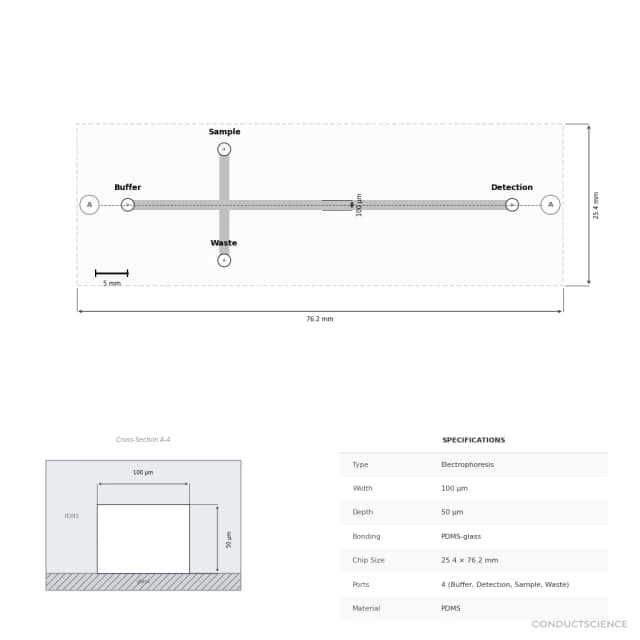
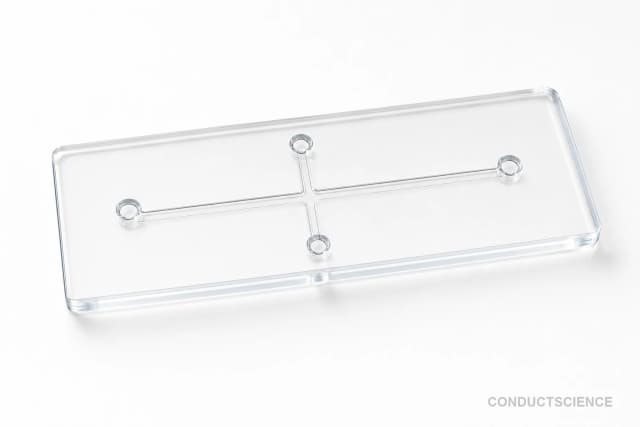
Passive hydrodynamic microfluidic chip with 100 x 100 μm channels for label-free cell sorting and size-based separation applications.
Reusable chip — designed for multiple experimental runs. Compatible with standard microfluidic tubing: steel pins (0.7 mm ID / 1.0 mm OD) and silicone tubing (0.8 mm ID / 1.9 mm OD). Available in bulk packs (5‑, 10‑, and 25‑unit) for lab-scale and consumable workflows.

Louise Corscadden, PhD
Director of Science · ConductScience
Ask Louise about Microfluidic Cell Sorting Chip (100 um) fit, setup, configuration, or quote prep.
Already working with us? Sign in to connect this with My Scientist.
Key Specifications
Full details →- Model fit
- 3 selectable configurations
- SKU family
- WHM-0077
- Shipping box
- 181.8 x 136.3 x 90.9 cm
- Ordering
- Online checkout and quote request available
- Category
- Cell Culture Chips
- Build notes
- Confirm accessories, station layout, and support needs before purchase
The Microfluidic Cell Sorting Chip (100 μm) is a passive hydrodynamic sorting device designed for label-free separation of cells based on size differences. The chip features 100 x 100 μm microchannels that enable precise cell isolation and enrichment without the need for fluorescent markers or active sorting mechanisms. Fabricated using standard soft lithography techniques, this PDMS-based device provides a cost-effective alternative to flow cytometry for size-based cell separation applications.
The chip operates on passive hydrodynamic principles, utilizing carefully engineered channel geometries to create predictable flow patterns that separate cells based on their physical dimensions. This approach preserves cell viability and functionality while providing consistent, reproducible sorting performance. The device is particularly well-suited for applications requiring gentle cell handling and high viability retention, such as downstream cell culture or analysis workflows.
How It Works
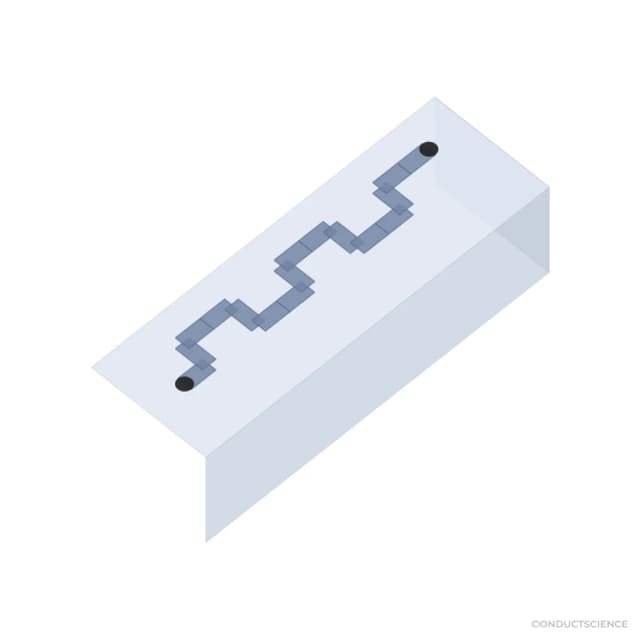
The chip operates through passive hydrodynamic focusing and sorting mechanisms that exploit differences in particle trajectories within structured microfluidic channels. When cells are introduced into the 100 x 100 μm channels, they experience size-dependent migration patterns due to differential flow velocities and wall effects. Larger particles tend to migrate toward the channel center while smaller particles remain closer to channel walls, creating predictable separation profiles.
The sorting process relies on laminar flow conditions maintained within the microchannels, where Reynolds numbers remain low and particle trajectories become highly predictable. Channel geometry and flow rate ratios determine the separation efficiency and resolution. Unlike active sorting methods, this passive approach requires no external forces, electrical fields, or optical manipulation, making it suitable for sensitive cell types that may be damaged by active sorting techniques.
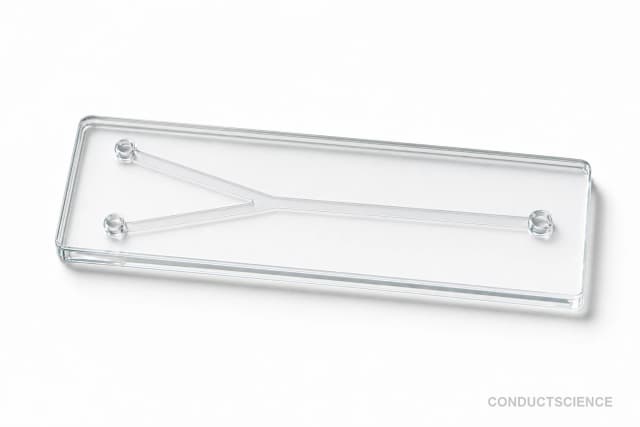
Multiple outlet channels collect different size fractions, allowing for simultaneous separation of multiple cell populations in a single pass. The sorting resolution and purity depend on the size difference between target populations and can be optimized through flow rate adjustment and channel design parameters.
Features & Benefits
Shipping weight
- 3.3 lb
Shipping box
- L: 181.8 cm
- W: 136.3 cm
- H: 90.9 cm
| Feature | This Product | Typical Alternative | Advantage |
|---|---|---|---|
| Channel Dimensions | 100 x 100 μm channels | Entry-level chips often feature smaller channels (50-75 μm) or larger channels (150+ μm) | Optimized dimensions accommodate most mammalian cell types while maintaining sorting resolution and preventing clogging. |
| Sorting Mechanism | Passive hydrodynamic sorting | Some devices require active sorting with electric fields or optical forces | Passive operation preserves cell viability and eliminates need for complex control systems or high-power equipment. |
| Application Focus | Cell sorting and size separation | Generic microfluidic chips may lack specialized sorting geometries | Purpose-built design optimizes sorting performance for cellular applications rather than general particle manipulation. |
| Material Construction | PDMS-based fabrication | Some alternatives use glass or thermoplastic materials | PDMS provides excellent biocompatibility, optical clarity, and cost-effectiveness for cell culture applications. |
This chip provides optimized channel dimensions and passive sorting specifically designed for cell separation applications. The 100 x 100 μm channels and hydrodynamic sorting mechanism offer a balance between throughput and gentleness for mammalian cell processing.
| Model | SKU | Listed price | Status | Shipping box |
|---|---|---|---|---|
| 25-Pack | WHM-0077-25PK | Quote | Available | 181.8 x 136.3 x 90.9 cm |
| 10-Pack | WHM-0077-10PK | $1,490.00 | Available | 181.8 x 136.3 x 90.9 cm |
| 5-Pack | WHM-0077-5PK | Quote | Available | 181.8 x 136.3 x 90.9 cm |
Practical Tips
Test sorting performance with reference particles or control cell populations before processing experimental samples.
Why: Validates chip performance and establishes baseline separation characteristics for your specific application.
Flush channels immediately after use with buffer followed by deionized water to prevent protein buildup.
Why: Prevents channel blockage and maintains consistent flow patterns for subsequent experiments.
Filter cell suspensions through 40 μm strainers before introduction to remove debris and large aggregates.
Why: Prevents channel clogging and ensures predictable sorting behavior by removing particles larger than channel dimensions.
If sorting efficiency decreases, check for air bubbles in channels and verify consistent flow rates at all inlets.
Why: Air bubbles and flow instabilities disrupt laminar flow patterns essential for predictable cell separation.
Collect outlet fractions in appropriate volumes and analyze immediately to prevent cell settling or aggregation.
Why: Maintains sample integrity and provides accurate assessment of sorting performance and purity.
Handle chips with appropriate biosafety protocols when processing primary cell samples or potentially infectious materials.
Why: PDMS is porous and may retain biological materials even after cleaning, requiring proper decontamination procedures.
Optimize cell concentration between 10⁵-10⁶ cells/mL to balance sorting efficiency with processing time.
Why: Too high concentrations cause cell-cell interactions that disrupt sorting, while too low concentrations reduce throughput.
Store chips in buffer solution or humid environment to prevent PDMS dehydration and channel deformation.
Why: Dried PDMS can crack or change dimensions, affecting flow patterns and sorting performance.
Setup Guide
What’s in the Box
- Microfluidic cell sorting chip
- User manual with protocols
- Quality control certificate (typical)
- Storage container (typical)
Warranty
ConductScience provides a standard 1-year manufacturer warranty covering defects in materials and workmanship, along with technical support for setup and optimization protocols.
Compliance
What cell size range can this chip effectively sort?
The 100 x 100 μm channels are optimized for mammalian cells typically ranging from 5-50 μm diameter. Sorting efficiency depends on the size difference between target populations, with best results achieved when size differences exceed 20-30%.
How does sorting efficiency compare to flow cytometry?
While flow cytometry offers higher throughput and multi-parameter sorting, this passive chip provides gentler cell handling with higher viability retention and no requirement for fluorescent labeling. Purity typically ranges from 70-95% depending on size differences.
What flow rates should be used for optimal sorting?
Optimal flow rates typically range from 5-50 μL/min for most cell types. Lower flow rates improve sorting purity while higher rates increase throughput. The specific rate should be optimized based on cell size, concentration, and desired purity.
Can the chip be reused for multiple experiments?
Yes, the chip can be cleaned and reused multiple times with appropriate washing protocols. Use detergent solutions followed by extensive buffer washes between experiments to prevent cross-contamination.
What sample preparation is required before sorting?
Cells should be suspended in appropriate buffer at 10⁵-10⁶ cells/mL concentration. Remove debris and cell clumps through filtration or settling, and ensure buffer viscosity is similar to water for optimal flow characteristics.
How do you monitor sorting performance in real-time?
The transparent PDMS construction allows direct microscopic observation of cell trajectories and sorting behavior. Use brightfield or phase contrast microscopy to monitor flow patterns and verify separation efficiency.
What are the main limitations compared to active sorting methods?
Passive sorting is limited to size-based separation and cannot sort based on other cellular properties like surface markers. Resolution is lower than active methods, and sorting efficiency decreases as size differences become smaller.
Have a question about this product?
Have a question? Just ask.
Send it over and we'll email you a personalized answer — no call, no scheduling.
Prefer to talk it through?