Multi-Geometry Chemical Synthesis Chip
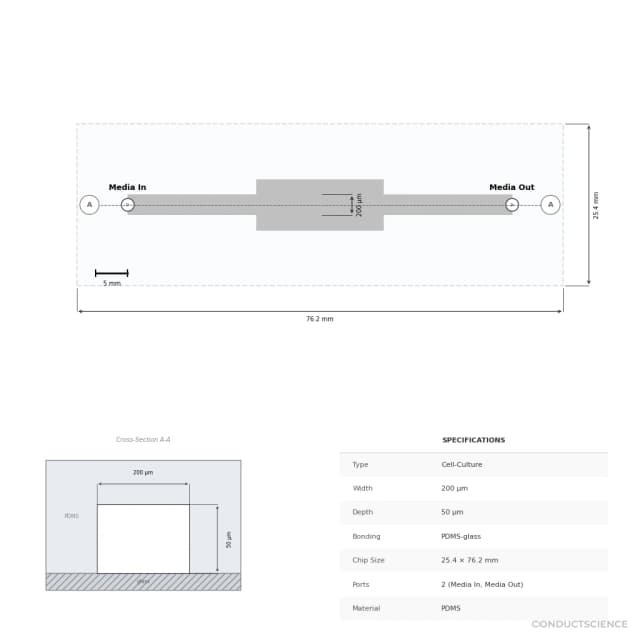
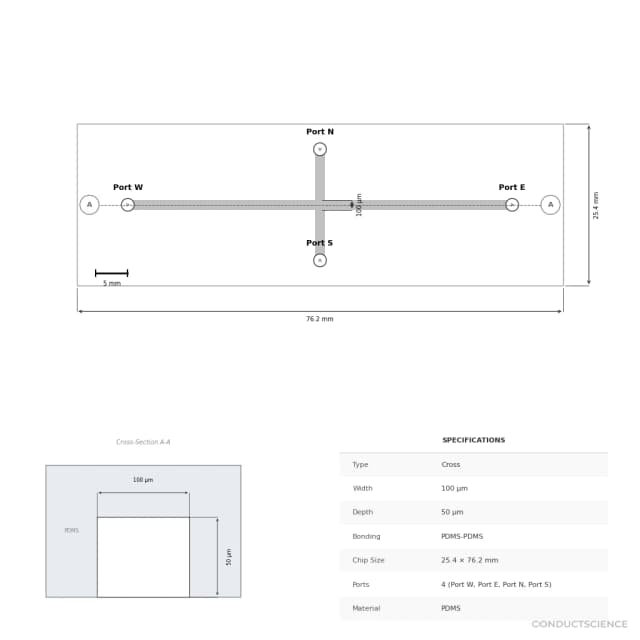
Microfluidic chip featuring curved, branched, detection, and mixing geometries with 100-300 μm channels for chemical reaction optimization and screening applications.
Reusable chip — designed for multiple experimental runs. Compatible with standard microfluidic tubing: steel pins (0.7 mm ID / 1.0 mm OD) and silicone tubing (0.8 mm ID / 1.9 mm OD). Available in bulk packs (5‑, 10‑, and 25‑unit) for lab-scale and consumable workflows.

Louise Corscadden, PhD
Director of Science · ConductScience
Ask Louise about Multi-Geometry Chemical Synthesis Chip fit, setup, configuration, or quote prep.
Already working with us? Sign in to connect this with My Scientist.
Key Specifications
Full details →- Model fit
- 3 selectable configurations
- SKU family
- WHM-0104
- Shipping box
- 181.8 x 136.3 x 90.9 cm
- Ordering
- Online checkout and quote request available
- Category
- Chemical Synthesis Chips
- Build notes
- Confirm accessories, station layout, and support needs before purchase
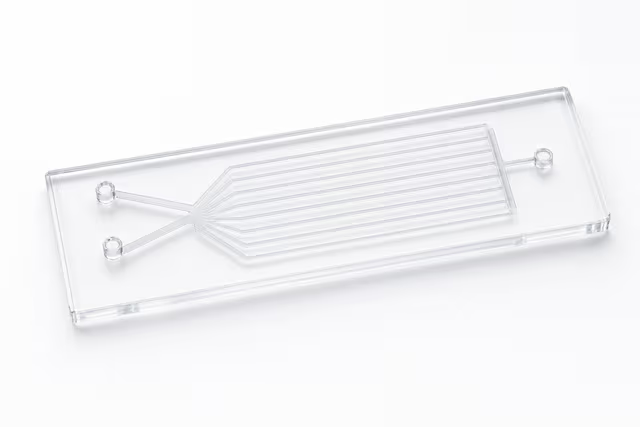
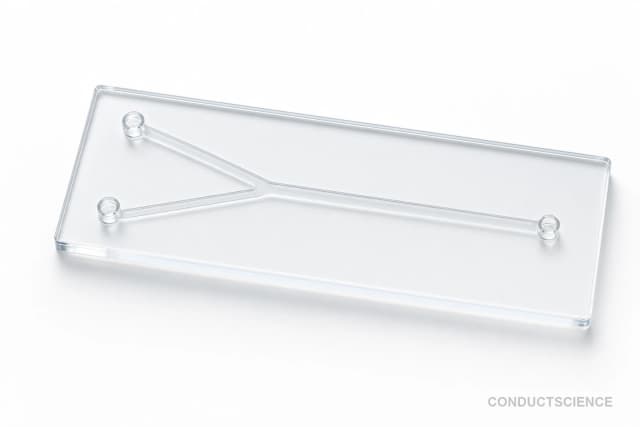
The Multi-Geometry Chemical Synthesis Chip is a microfluidic device engineered for versatile chemical reaction optimization and screening applications. This chip incorporates multiple channel geometries including curved, branched, detection, and mixing configurations within a single platform, enabling researchers to evaluate different flow chemistry conditions and reaction pathways in parallel or sequential arrangements.
With channel widths ranging from 100-300 micrometers, the chip provides precise control over residence times, mixing efficiency, and mass transfer characteristics. The integrated detection geometries allow for inline monitoring of reaction progress, while the branched and curved channels facilitate systematic screening of reaction parameters. This multi-geometry approach enables comprehensive optimization studies within a single microfluidic platform.
How It Works
The Multi-Geometry Chemical Synthesis Chip operates on laminar flow principles within microscale channels to control chemical reactions with high precision. Reactants are introduced at separate inlets and merge within the chip's channel network, where molecular-level mixing occurs through diffusion across laminar flow interfaces. The 100-300 micrometer channel dimensions ensure Reynolds numbers below 100, maintaining predictable flow patterns essential for reproducible reaction conditions.
Different channel geometries serve specific functions: curved channels introduce secondary flows that enhance mixing through Dean flow effects, branched channels enable parallel screening of multiple reaction conditions, mixing channels provide extended contact time for slower reactions, and detection channels incorporate optical windows or electrode interfaces for real-time monitoring. The residence time within each geometry can be precisely controlled through flow rate adjustment, allowing systematic optimization of reaction parameters.
Features & Benefits
Shipping weight
- 3.3 lb
Shipping box
- L: 181.8 cm
- W: 136.3 cm
- H: 90.9 cm
| Feature | This Product | Typical Alternative | Advantage |
|---|---|---|---|
| Channel Geometries | Four integrated geometries: curved, branched, detection, and mixing | Single geometry designs typically offer only straight channels or basic T-junctions | Enables comprehensive reaction screening within one platform rather than requiring multiple chips for different mixing and detection requirements |
| Channel Width Range | 100-300 μm width range | Entry-level chips often have fixed channel widths around 50-100 μm | Broader range accommodates different viscosity fluids and provides flexibility for various reaction timescales and throughput requirements |
| Application Focus | Designed for reaction optimization and screening | General-purpose microfluidic chips may lack specialized features for chemical synthesis | Purpose-built geometries and integrated detection capabilities specifically support systematic reaction development workflows |
| Detection Integration | Integrated detection geometry within chip design | External detection often required with separate optical or analytical instrumentation | Enables real-time reaction monitoring without additional complex instrumentation setup or sample extraction steps |
This multi-geometry chip provides integrated reaction screening capabilities with four distinct channel types and 100-300 μm width flexibility. The platform combines synthesis, mixing, and detection functions in a single device optimized for chemical reaction optimization workflows.
| Model | SKU | Listed price | Status | Shipping box |
|---|---|---|---|---|
| 25-Pack | WHM-0104-25PK | Quote | Available | 181.8 x 136.3 x 90.9 cm |
| 10-Pack | WHM-0104-10PK | $1,490.00 | Available | 181.8 x 136.3 x 90.9 cm |
| 5-Pack | WHM-0104-5PK | Quote | Available | 181.8 x 136.3 x 90.9 cm |
Practical Tips
Perform tracer studies using colored dyes or fluorescent molecules to map residence time distributions in each geometry before introducing reactive species.
Why: Establishes accurate timing parameters essential for kinetic studies and reaction optimization.
Flush channels with compatible solvents immediately after each experiment to prevent reagent crystallization or polymerization within the narrow channels.
Why: Prevents permanent channel blockage that would render the chip unusable for future experiments.
Start reaction screening with the mixing geometry to establish baseline conditions before utilizing more complex branched or curved sections.
Why: Provides reference performance data for comparing enhancement effects of different channel geometries.
Allow sufficient equilibration time when changing flow rates or reagent concentrations to ensure steady-state conditions in detection channels.
Why: Transient mixing effects can lead to misleading results if measurements are taken before reaching steady state.
If flow distribution appears uneven between branched channels, check for partial blockages or air bubbles using microscopic inspection.
Why: Uneven flow distribution compromises parallel screening accuracy and can invalidate comparative results between reaction conditions.
Verify chemical compatibility of chip materials with all reagents and solvents before introducing them into the system.
Why: Incompatible chemicals can cause chip degradation, contamination, or failure that may compromise experimental results or safety.
Document flow rate and pressure conditions for each successful reaction optimization to enable reproducible scale-up.
Why: Systematic documentation facilitates technology transfer to larger production systems or additional research groups.
Setup Guide
What’s in the Box
- Multi-Geometry Chemical Synthesis Chip
- Protective storage case (typical)
- User manual and specifications sheet (typical)
- Quality control test certificate (typical)
Warranty
ConductScience provides a standard one-year manufacturer warranty covering defects in materials and workmanship. Technical support is available for setup guidance, troubleshooting, and application optimization.
Compliance
What pressure range can this chip safely operate under?
Consult product datasheet for specific pressure ratings. Most microfluidic chips of this type operate safely up to 5-10 bar depending on substrate material and channel design.
How do I prevent channel clogging during synthesis reactions?
Use appropriate filtration upstream, maintain consistent flow rates, and implement periodic flushing protocols with compatible solvents. The 100-300 μm channel width provides good resistance to particle-induced blockages.
Can I use organic solvents with this chip?
Solvent compatibility depends on chip substrate material. Consult product specifications for chemical compatibility information before use with organic solvents or aggressive reagents.
How do I optimize mixing in the curved channel sections?
Mixing efficiency in curved channels depends on flow rate and channel curvature. Start with moderate flow rates to establish Dean flow patterns, then adjust based on residence time requirements for your specific reaction.
What detection methods can be integrated with the detection geometry?
The detection channels typically accommodate optical monitoring (UV-vis, fluorescence) and electrochemical detection. Specific compatibility depends on channel material and geometry dimensions.
How do I scale up reactions optimized on this chip?
Use the optimized flow rates, residence times, and mixing conditions as starting parameters for larger microreactor systems or consider numbering-up approaches with multiple chips in parallel.
What is the typical residence time range for the different geometries?
Residence time depends on channel volume and flow rate. Calculate using channel dimensions and desired flow rate, then verify experimentally using tracer studies through each geometry section.
Have a question about this product?
Have a question? Just ask.
Send it over and we'll email you a personalized answer — no call, no scheduling.
Prefer to talk it through?