Nanoparticle Formation Microfluidic Chip
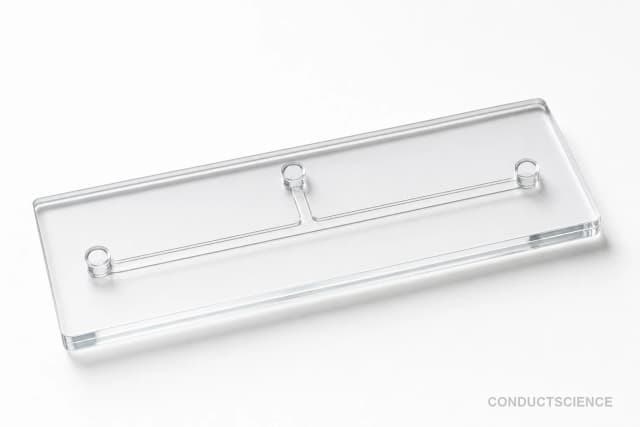
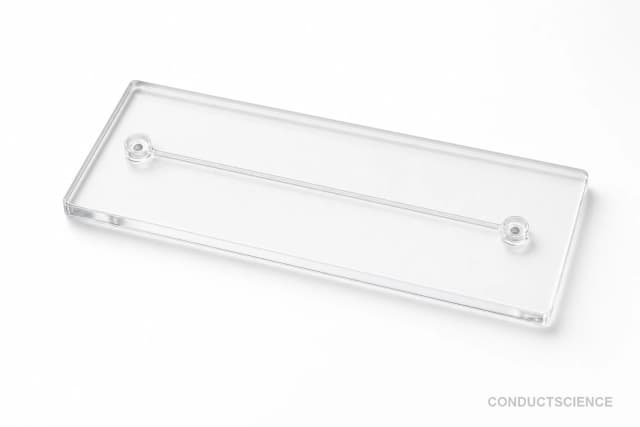
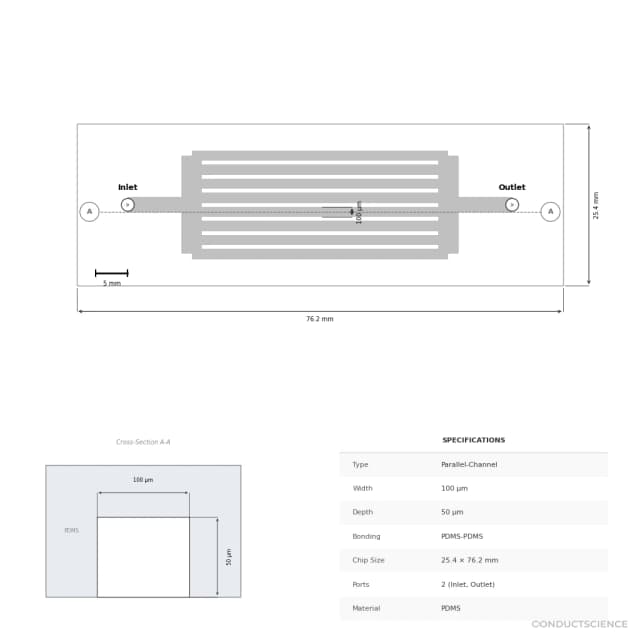
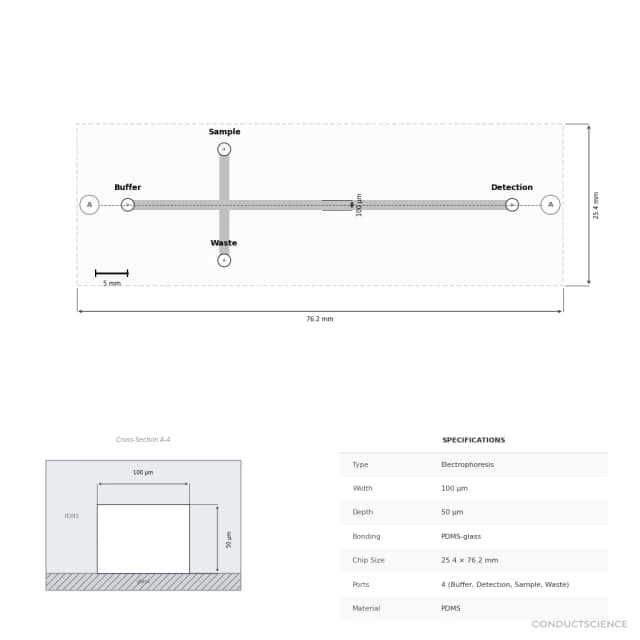
Microfluidic chip for controlled nanoparticle synthesis featuring 100 x 100 μm channels for nucleation control and continuous flow production.
Reusable chip — designed for multiple experimental runs. Compatible with standard microfluidic tubing: steel pins (0.7 mm ID / 1.0 mm OD) and silicone tubing (0.8 mm ID / 1.9 mm OD). Available in bulk packs (5‑, 10‑, and 25‑unit) for lab-scale and consumable workflows.

Louise Corscadden, PhD
Director of Science · ConductScience
Ask Louise about Nanoparticle Formation Microfluidic Chip fit, setup, configuration, or quote prep.
Already working with us? Sign in to connect this with My Scientist.
Key Specifications
Full details →- Model fit
- 3 selectable configurations
- SKU family
- WHM-0101
- Shipping box
- 181.8 x 136.3 x 90.9 cm
- Ordering
- Online checkout and quote request available
- Category
- Chemical Synthesis Chips
- Build notes
- Confirm accessories, station layout, and support needs before purchase
The Nanoparticle Formation Microfluidic Chip (WHM-0101) enables controlled synthesis of nanoparticles through precise microfluidic mixing and nucleation control. This device features 100 x 100 μm channels optimized for continuous flow synthesis, allowing researchers to manipulate reaction conditions with spatial and temporal precision not achievable in bulk synthesis methods.
The chip facilitates bottom-up nanoparticle formation by controlling mixing rates, residence times, and concentration gradients within the microfluidic environment. This approach enables uniform particle size distribution and reproducible synthesis conditions, making it suitable for applications requiring consistent nanoparticle properties across production batches.
How It Works
The microfluidic chip operates on the principle of controlled mixing and precipitation in confined geometries. Reactant solutions are introduced through separate inlets and converge within the 100 x 100 μm channels, creating well-defined concentration gradients and mixing zones. The small channel dimensions ensure rapid mass transport and uniform mixing conditions.
Nanoparticle nucleation occurs when reactant concentrations exceed critical supersaturation levels within the mixing zone. The controlled flow environment allows precise manipulation of nucleation rates through residence time control and concentration profiles. This approach minimizes batch-to-batch variability and enables systematic optimization of particle properties.
The continuous flow design allows steady-state operation with consistent product quality. Process parameters such as flow rates, reactant concentrations, and temperature can be independently controlled to achieve desired particle size distributions and morphologies.
Features & Benefits
Shipping weight
- 3.3 lb
Shipping box
- L: 181.8 cm
- W: 136.3 cm
- H: 90.9 cm
| Feature | This Product | Typical Alternative | Advantage |
|---|---|---|---|
| Channel Dimensions | 100 x 100 μm channels | Varies by model, often larger channels with less precise mixing control | Optimized dimensions provide effective mixing while maintaining reasonable pressure drops for most synthesis applications. |
| Synthesis Application | Designed specifically for nanoparticle synthesis and nucleation control | General-purpose mixing chips without synthesis-specific optimization | Purpose-built design ensures optimal conditions for controlled nanoparticle formation processes. |
| Flow Configuration | Continuous flow design | Some devices limited to batch or droplet-based operation | Enables steady-state operation and larger production volumes compared to batch synthesis methods. |
| Quality Control | ConductScience fabrication standards | Fabrication quality varies significantly among suppliers | Consistent channel geometry and surface properties ensure reproducible synthesis results. |
This microfluidic chip offers precise 100 x 100 μm channels specifically optimized for nanoparticle synthesis applications. The continuous flow design and nucleation control capabilities provide researchers with a reliable platform for systematic particle synthesis optimization.
| Model | SKU | Listed price | Status | Shipping box |
|---|---|---|---|---|
| 25-Pack | WHM-0101-25PK | Quote | Available | 181.8 x 136.3 x 90.9 cm |
| 10-Pack | WHM-0101-10PK | $1,490.00 | Available | 181.8 x 136.3 x 90.9 cm |
| 5-Pack | WHM-0101-5PK | Quote | Available | 181.8 x 136.3 x 90.9 cm |
Practical Tips
Start with well-characterized synthesis chemistries before attempting novel formulations to establish baseline performance.
Why: This approach allows verification of chip performance and optimization of operating parameters with predictable systems.
Measure actual flow rates through the device using collection and timing methods rather than relying solely on pump settings.
Why: Channel geometry and fluid properties can cause actual flow rates to differ from pump settings, affecting synthesis results.
Flush channels immediately after synthesis runs to prevent particle accumulation and clogging.
Why: Prompt cleaning prevents formation of difficult-to-remove deposits that can alter channel geometry and flow patterns.
Collect samples at regular intervals during extended runs to monitor synthesis consistency and detect any drift in product properties.
Why: Continuous monitoring ensures stable operation and helps identify optimal run durations for your specific synthesis.
If particles are aggregating, reduce reactant concentrations or increase flow rates to minimize residence time in high concentration zones.
Why: Aggregation often occurs when local supersaturation is too high or residence times allow secondary nucleation processes.
Ensure all connections are secure and leak-free before introducing reactive chemicals, and maintain appropriate ventilation for volatile solvents.
Why: Microfluidic systems operate under pressure and chemical leaks can pose safety hazards in laboratory environments.
Setup Guide
What’s in the Box
- Nanoparticle Formation Microfluidic Chip (typical)
- User manual and setup guide (typical)
- Quality inspection certificate (typical)
Warranty
ConductScience provides a one-year manufacturer warranty covering defects in materials and workmanship, along with technical support for setup and operation guidance.
Compliance
References
Background reading relevant to this product:
What flow rates are optimal for nanoparticle synthesis in these channels?
Flow rates typically range from 1-100 μL/min depending on desired residence time and mixing requirements. Start with low rates (1-10 μL/min) for initial optimization and adjust based on particle characterization results.
How do I prevent channel clogging during nanoparticle synthesis?
Maintain reactant concentrations below critical aggregation limits and ensure adequate flow rates to prevent settling. Use filtration for input solutions and periodic flushing with solvent between runs.
What materials are compatible with the chip channels?
Consult product datasheet for specific material compatibility. Most microfluidic chips handle aqueous solutions and common organic solvents, but verify compatibility for aggressive chemicals or extreme pH conditions.
How do I characterize particles produced by this system?
Collect samples from the outlet and analyze using dynamic light scattering for size distribution, electron microscopy for morphology, and UV-Vis spectroscopy for optical properties depending on particle type.
Can I control particle size through operational parameters?
Yes, particle size can be controlled through flow rate ratios, total flow rate (residence time), reactant concentrations, and temperature. Systematic variation of these parameters enables size optimization.
What is the typical particle size range achievable?
Particle size depends on specific synthesis chemistry and operating conditions. The 100 μm channel dimensions are suitable for particles ranging from nanometers to several micrometers, with optimal control in the 10-500 nm range.
How do I clean the chip between different syntheses?
Flush channels with appropriate solvent (water, ethanol, or acetone) at moderate flow rates. For stubborn residues, use ultrasonic cleaning or extended solvent flushing. Avoid aggressive mechanical cleaning that could damage channels.
Have a question about this product?
Have a question? Just ask.
Send it over and we'll email you a personalized answer — no call, no scheduling.
Prefer to talk it through?