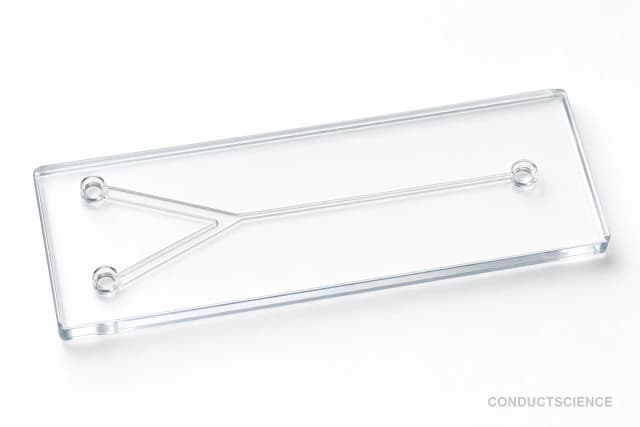
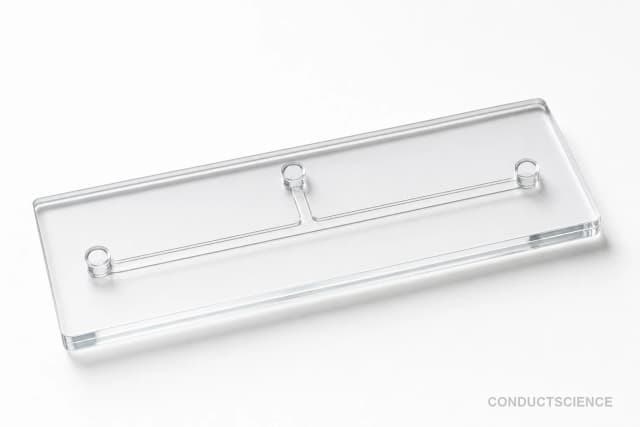
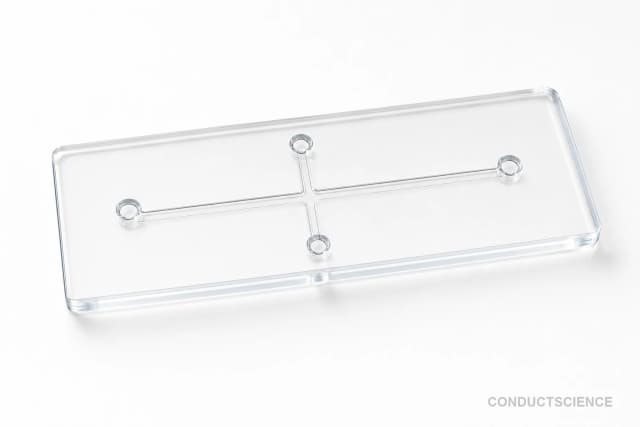
Nucleic Acid Analysis Microfluidic Chip
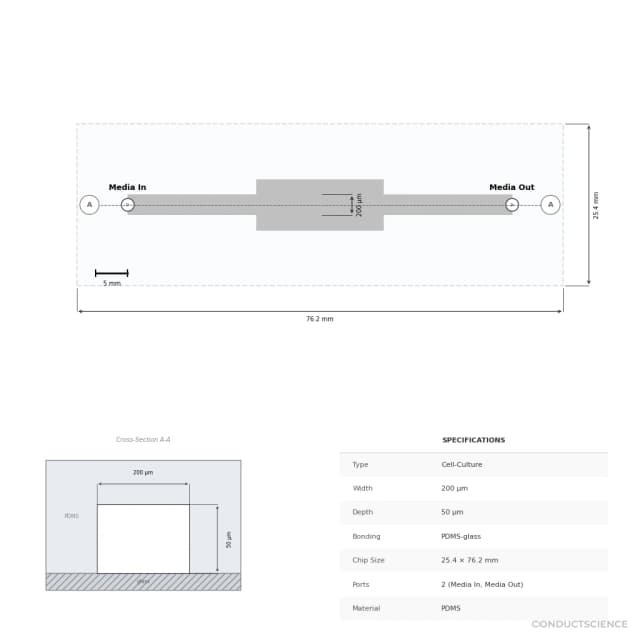
Integrated microfluidic chip for nucleic acid extraction, amplification, and detection with 100 x 100 µm precision channels designed for molecular diagnostics and genetic testing applications.
Reusable chip — designed for multiple experimental runs. Compatible with standard microfluidic tubing: steel pins (0.7 mm ID / 1.0 mm OD) and silicone tubing (0.8 mm ID / 1.9 mm OD). Available in bulk packs (5‑, 10‑, and 25‑unit) for lab-scale and consumable workflows.

Louise Corscadden, PhD
Director of Science · ConductScience
Ask Louise about Nucleic Acid Analysis Microfluidic Chip fit, setup, configuration, or quote prep.
Already working with us? Sign in to connect this with My Scientist.
Key Specifications
Full details →- Model fit
- 3 selectable configurations
- SKU family
- WHM-0142
- Shipping box
- 181.8 x 136.3 x 90.9 cm
- Ordering
- Online checkout and quote request available
- Category
- Environmental Detection Chips
- Build notes
- Confirm accessories, station layout, and support needs before purchase
The Nucleic Acid Analysis Microfluidic Chip (WHM-0142) is a specialized microfluidic device designed for integrated nucleic acid processing workflows. This lab-on-a-chip platform combines extraction, amplification, and detection capabilities within precision-engineered 100 x 100 µm microchannels, enabling streamlined molecular analysis from sample to result.
The chip architecture supports molecular diagnostics and genetic testing applications by providing controlled fluidic environments for nucleic acid manipulation. The integrated workflow eliminates manual transfer steps between separate instruments, reducing contamination risk and processing time while maintaining analytical precision required for quantitative nucleic acid analysis.
How It Works
The microfluidic chip operates through precisely controlled fluid flow within 100 x 100 µm microchannels that guide samples through sequential processing zones. Sample introduction occurs at designated inlet ports, where nucleic acids undergo extraction through lysis and purification steps facilitated by controlled mixing and separation within the microchannel architecture.
Amplification occurs in thermally controlled regions of the chip where temperature cycling enables PCR or isothermal amplification reactions. The confined geometry provides rapid thermal cycling and uniform temperature distribution essential for consistent amplification efficiency. Detection is achieved through integrated optical or electrochemical sensors that monitor amplification products in real-time.
The chip design eliminates cross-contamination through spatial separation of processing steps and controlled flow paths. Waste products are directed to designated collection areas, while purified and amplified nucleic acids proceed to detection zones for quantitative analysis.
Features & Benefits
Shipping weight
- 3.3 lb
Shipping box
- L: 181.8 cm
- W: 136.3 cm
- H: 90.9 cm
| Feature | This Product | Typical Alternative | Advantage |
|---|---|---|---|
| Channel Dimensions | 100 x 100 µm precision channels | Entry-level chips often feature larger channels with less precise dimensions | Optimized dimensions provide better fluidic control and surface-to-volume ratios for efficient nucleic acid processing. |
| Integration Level | Complete extraction, amplification, and detection workflow | Many microfluidic devices focus on single-step processing | Eliminates manual transfer steps and reduces contamination risk throughout the analysis workflow. |
| Application Focus | Molecular diagnostics and genetic testing | General-purpose microfluidic chips may lack application-specific optimization | Specialized design ensures optimal performance for nucleic acid analysis workflows. |
| Channel Architecture | Precision-engineered microchannel geometry | Basic microfluidic devices may have simpler channel designs | Advanced architecture enables controlled reaction conditions and reproducible results. |
This microfluidic chip offers integrated nucleic acid processing with precision-engineered 100 x 100 µm channels specifically designed for molecular diagnostics and genetic testing applications. The complete workflow integration from extraction through detection provides streamlined analysis compared to multi-instrument approaches.
| Model | SKU | Listed price | Status | Shipping box |
|---|---|---|---|---|
| 25-Pack | WHM-0142-25PK | Quote | Available | 181.8 x 136.3 x 90.9 cm |
| 10-Pack | WHM-0142-10PK | $1,490.00 | Available | 181.8 x 136.3 x 90.9 cm |
| 5-Pack | WHM-0142-5PK | Quote | Available | 181.8 x 136.3 x 90.9 cm |
Practical Tips
Store chips in controlled temperature and humidity conditions to maintain channel integrity and prevent material degradation.
Why: Environmental conditions can affect microfluidic performance and detection sensitivity over time.
Run positive and negative controls with each batch of samples to verify extraction efficiency and amplification performance.
Why: Control samples ensure consistent chip performance and validate the complete workflow.
Inspect chip channels for debris or damage before use using appropriate magnification equipment.
Why: Physical obstructions can disrupt fluidic flow and compromise analysis results.
Monitor amplification curves in real-time to detect anomalies and ensure proper reaction kinetics.
Why: Real-time monitoring enables immediate identification of processing issues before completion.
Verify reagent loading and flow rates if extraction or amplification efficiency appears suboptimal.
Why: Improper fluidic conditions are common sources of performance variability in microfluidic systems.
Handle chips with appropriate personal protective equipment and dispose according to laboratory biosafety protocols.
Why: Biological samples and reagents may pose health risks requiring proper handling procedures.
Validate new sample types or reagent formulations with pilot studies before routine use.
Why: Different sample matrices or reagents may require optimization of processing parameters.
Setup Guide
What’s in the Box
- Nucleic acid analysis microfluidic chip
- User manual and protocol guide
- Quality control certificate (typical)
- Protective storage container (typical)
Warranty
ConductScience provides a one-year manufacturer warranty covering material defects and manufacturing issues, with technical support for application optimization and troubleshooting assistance.
Compliance
References
Background reading relevant to this product:
What sample volumes are required for the integrated workflow?
Consult product datasheet for specific volume requirements, which depend on the target nucleic acid concentration and detection sensitivity needed for your application.
Can the chip process both DNA and RNA samples?
The chip design supports nucleic acid analysis workflows; specific compatibility with DNA/RNA depends on the reagent systems and protocols used with the device.
How many samples can be processed per chip?
Each chip is designed as a single-use device; consult technical specifications for throughput capabilities and parallel processing options.
What detection methods are compatible with this chip?
The chip supports various detection approaches including fluorescence-based and electrochemical methods; compatibility depends on your analysis system configuration.
What is the temperature range for amplification reactions?
Consult product datasheet for thermal cycling capabilities and temperature uniformity specifications across the chip surface.
How does this compare to conventional tube-based PCR methods?
The microfluidic approach reduces sample volumes, accelerates thermal cycling, and integrates multiple processing steps, though setup complexity may be higher than standard tube protocols.
What maintenance is required between uses?
As a single-use device, no maintenance is required; proper storage conditions should be maintained to preserve chip integrity before use.
Can custom reagent formulations be used with this chip?
Reagent compatibility depends on viscosity, ionic strength, and chemical compatibility with chip materials; validation testing is recommended for custom formulations.
Have a question about this product?
Have a question? Just ask.
Send it over and we'll email you a personalized answer — no call, no scheduling.
Prefer to talk it through?