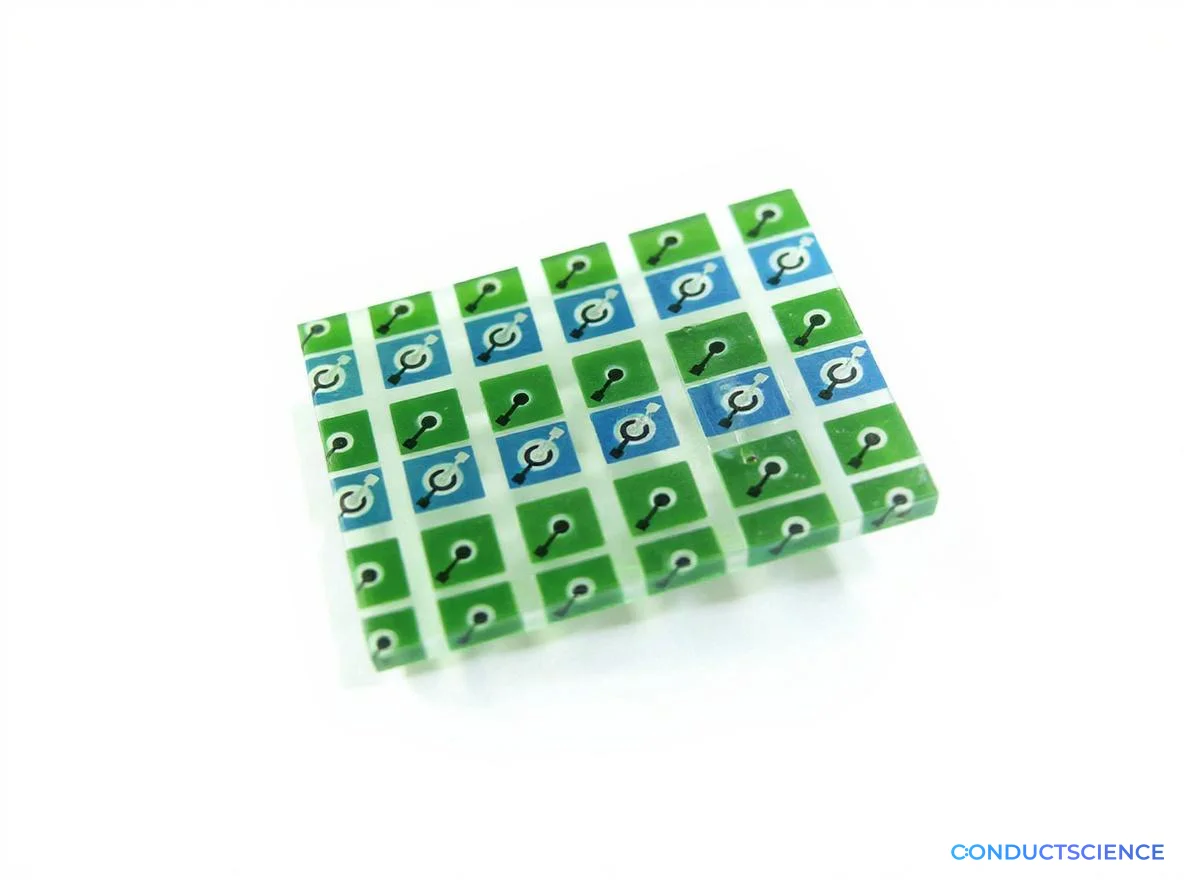
Paper-Based Electrode Chip
Disposable electrochemical sensing platform with 2- or 3-electrode configuration on paper substrate for point-of-care diagnostic applications.
Reusable chip — designed for multiple experimental runs. Compatible with standard microfluidic tubing: steel pins (0.7 mm ID / 1.0 mm OD) and silicone tubing (0.8 mm ID / 1.9 mm OD). Available in bulk packs (5‑, 10‑, and 25‑unit) for lab-scale and consumable workflows.

Louise Corscadden, PhD
Director of Science · ConductScience
Ask Louise about Paper-Based Electrode Chip fit, setup, configuration, or quote prep.
Already working with us? Sign in to connect this with My Scientist.
Key Specifications
Full details →- Model fit
- 1 selectable configurations
- SKU family
- WHM-0123
- Shipping box
- 181.8 x 136.3 x 90.9 cm
- Ordering
- Quote-reviewed before fulfillment
- Category
- Electrode Chips
- Build notes
- Confirm accessories, station layout, and support needs before purchase
The Paper-Based Electrode Chip is a disposable electrochemical sensing platform constructed on filter paper or nitrocellulose membrane substrates. This cost-effective diagnostic tool features configurable 2-electrode or 3-electrode systems designed specifically for point-of-care electrochemical applications. The paper-based architecture enables rapid sample processing through capillary-driven fluid transport while maintaining stable electrochemical performance.
The chip's porous substrate allows for integrated sample preparation, analyte detection, and waste containment within a single disposable unit. This design eliminates cross-contamination risks and reduces operational complexity compared to traditional electrode systems. The flexible electrode configuration supports both amperometric and voltammetric detection methods, making it suitable for diverse analytical workflows requiring portable, low-cost electrochemical sensing.
How It Works
The paper-based electrode chip operates through electrochemical signal transduction facilitated by screen-printed or deposited conductive materials on porous substrates. In 2-electrode configurations, a working electrode generates analytical signals through oxidation or reduction of target analytes, while a combined counter/reference electrode completes the electrochemical circuit. The 3-electrode system separates these functions with dedicated working, counter, and reference electrodes for improved analytical precision.
Sample introduction occurs through capillary action within the paper matrix, eliminating the need for external pumping systems. The porous substrate controls sample volume and flow rate while concentrating analytes at the electrode surface. Electrochemical reactions generate measurable current or voltage signals proportional to analyte concentration, enabling quantitative analysis. The paper matrix can be pre-functionalized with enzymes, antibodies, or other recognition elements to enhance selectivity for specific targets.
Features & Benefits
Shipping weight
- 3.3 lb
Shipping box
- L: 181.8 cm
- W: 136.3 cm
- H: 90.9 cm
| Feature | This Product | Typical Alternative | Advantage |
|---|---|---|---|
| Substrate Material | Filter paper or nitrocellulose membrane | Traditional systems use glass, ceramic, or plastic substrates | Paper substrates enable integrated sample handling and reduce manufacturing costs for disposable applications. |
| Electrode Configuration | 2-electrode or 3-electrode options | Many entry-level devices offer only single configuration | Flexible electrode selection allows optimization for specific analytical requirements and measurement precision needs. |
| Sample Handling | Capillary-driven sample transport | Requires external pumps or manual pipetting | Eliminates need for additional fluid handling equipment, reducing complexity and cost in field applications. |
| Cost Structure | Disposable format with low per-unit cost | Higher initial cost with reusable components | Reduces contamination risks and eliminates electrode cleaning protocols between measurements. |
| Portability | Compact chip format compatible with portable analyzers | Often requires benchtop instrumentation | Enables point-of-care testing and field-based measurements with minimal equipment requirements. |
The Paper-Based Electrode Chip provides cost-effective electrochemical sensing with integrated sample handling capabilities. The flexible electrode configuration and disposable format make it well-suited for point-of-care diagnostics and field applications where simplicity and contamination control are priorities.
Practical Tips
Perform calibration using standards prepared in matrix-matched solutions to account for ionic strength effects.
Why: Paper substrate interactions can alter electrochemical response compared to simple buffer systems.
Store unused chips in sealed containers with desiccant to prevent moisture absorption by paper substrate.
Why: Humidity can alter paper structure and electrode performance over time.
Apply sample to center of designated zone and allow complete wicking before starting measurements.
Why: Uniform sample distribution ensures reproducible electrode coverage and consistent analytical signals.
Check for air bubbles or incomplete sample wetting if signals are erratic or low.
Why: Poor sample contact with electrodes reduces signal quality and measurement precision.
Run blank measurements with buffer-only samples to assess baseline stability.
Why: Paper substrates may contribute background signals that vary between chip lots.
Handle used chips as potentially contaminated waste according to sample type and local regulations.
Why: Biological samples or hazardous analytes may require special disposal protocols.
Minimize exposure time between chip preparation and use to prevent degradation of surface treatments.
Why: Paper substrates and electrode modifications may be sensitive to ambient conditions.
Setup Guide
What’s in the Box
- Paper-based electrode chips (quantity varies by package)
- Connection leads or pins (typical)
- User manual with protocols (typical)
- Storage container (typical)
Warranty
ConductScience provides standard warranty coverage for manufacturing defects. Technical support is available for protocol optimization and troubleshooting assistance.
Compliance
References
Background reading relevant to this product:
What types of analytes can be detected with these electrode chips?
The chips support detection of electrochemically active species including glucose, lactate, hydrogen peroxide, heavy metals, and other redox-active compounds. Specific analyte compatibility depends on electrode functionalization and measurement protocol.
How does sample volume affect measurement reproducibility?
Paper substrate controls sample distribution through capillary action, but optimal sample volumes typically range from 5-50 microliters. Consistent sample application technique is critical for reproducible electrode coverage and signal response.
Can these chips be stored long-term before use?
Storage conditions depend on electrode materials and substrate treatment. Store in dry conditions at room temperature. Consult product datasheet for specific storage requirements and shelf life limitations.
What potentiostat specifications are required?
Standard benchtop potentiostats or portable electrochemical analyzers are compatible. Ensure sufficient current range and potential window for target analytes. Typical requirements include picoampere current sensitivity and 1-3V potential range.
How do 2-electrode and 3-electrode configurations differ?
2-electrode systems combine reference and counter functions in a single electrode, suitable for simple amperometric measurements. 3-electrode systems provide separate reference control for improved precision in voltammetric techniques.
Are these chips compatible with enzyme-based assays?
Yes, the paper substrate can be functionalized with enzymes, antibodies, or other biorecognition elements. Enzyme immobilization protocols should be optimized for the specific substrate material used.
What is the typical detection limit for common analytes?
Detection limits vary significantly by analyte and measurement protocol. Glucose detection typically achieves millimolar sensitivity while heavy metal detection may reach micromolar levels. Consult product datasheet for specific performance data.
Have a question about this product?
Have a question? Just ask.
Send it over and we'll email you a personalized answer — no call, no scheduling.
Prefer to talk it through?